Wednesday, June 11, 2014

7 Billion and Counting: That’s a Lot of People

Good article and questions to contemplate.  Let us know your thoughts: 
Can the planet sustain mankind’s growing numbers? Depends on whom you ask.
By FRANK CARINI/ecoRI News staff

(University of Pennsylvania)
Since the start of the Industrial Revolution some 250 years ago, the widespread use of chemical fertilizers and pesticides that began about a century and a half later and the atomic half-life of the past seven decades, humans have developed and doused land and dammed and diverted water. These practices have left a wound that continues to fester as the human population swells.
Artificial fertilizer and the commercialization of industrial nitrogen changed the world significantly, according to author Alan Weisman, who was a panelist at The Nature Conservancy's first forum in its 2014 Future of Nature Boston Speaker Series. “Forty percent of us wouldn’t be here without it," he said.
The global population is closing in on 7.2 billion — a mere 15 years ago it was at 6 billion. Earth’s human population is expected to exceed 9 billion by 2050. While global population growth must be part of the conversation about sustaining the planet, it is seldom discussed. The issue is largely ignored at our own peril.
Some 40 years ago, human population was at the forefront of many discussions, because it was seen then as a barrier to economic growth, said Andrew Foster, director of thePopulation Studies and Training Center at Brown University. Today, environmental concerns associated with population growth don’t have the same place on the global agenda, he said.
Roger-Mark De Souza, director of population, environmental security and resilience at the Washington, D.C.-based Wilson Center, said there is another reason the population conversation has been muted.
“Politically it’s a third-rail issue in D.C,” he said. “Touch it and you’re dead. It’s the easy way out to avoid a needed conversation.”
To help push this conservation from the fringes, The Nature Conservancy hosted a panel discussion in late April at the Boston Center for the Arts entitled “7 Billion and Counting: Population and the Planet.” De Souza and Weisman, author of “Countdown” and “The World Without Us,” were two of the four panelists.
The panel, which also included Caroline Crosbie, senior vice president of Pathfinder International, and Peter Kareiva, chief scientist for The Nature Conservancy, spent 90 minutes discussing the impacts of human population growth.
The media packet distributed at the event included a few questions the panelists would discuss: Does human population growth affect other species and the planet as a whole? What about families already struggling to find food, water and health care? Can empowering women make life more sustainable for people and nature? Can conservation and technology support the planet’s ability to provide food, water and other benefits to a growing human population?
Each panelist addressed the topic differently. Weisman was the most pessimistic; Kareiva the most optimistic. But there’s little disagreement globally that humankind’s rapidly growing numbers are stressing the planet’s finite natural resources.
REST OF ARTICLE LATER TODAY

Tuesday, June 10, 2014

Obama "Nails It!" Cutting Carbon Will Create Opportunities/Part 2

We believe the President's push to reduce carbon emissions by 30% by switching off of fossil fuel at many power plants in the US is a very good step forward.  See below to add your own positive and endorsement.

Of course, if you disagree, we are happy to consider your position, and data, as well.

Our hope is that this change creates accelerated economic growth (pushing new technologies, jobs needed for retrofitting, training for experts who will manage new centralized fuel sources, new delivery systems, etc).


"I just proposed a plan that cuts carbon pollution from existing power plants 30 percent by 2030.

That's a responsible, common-sense step to address climate change.


But we're already getting intense opposition from polluters and special interests who like things the way they are.


OFA is fighting back to show there's broad support for these new EPA standards. Thanks for being part of it. 
If you know someone who wants to take action to combat climate change, pass this along and tell them to add their name today.

Climate change is happening, and it's happening now. As a president and as a father, I feel a moral responsibility to do something about it. The world our children grow up in depends on what we do about it.


Carbon pollution is threatening our health right now. Over half of all Americans already live in areas where air pollution too often makes it unhealthy to breathe -- it's time to cut carbon pollution the same way we already regulate toxic chemicals in our air. 


Modernizing our power plants so they pollute less will also spark homegrown clean energy innovation, creating jobs and growing our economy.


I'm not going to wait to take action on this.


Right now, big polluters are going to do everything they can to derail this momentum. They've been fighting these EPA standards since before they were even announced.


Your voice on this issue is the most powerful thing you've got in this fight. Thank you for using it.


OFA is stepping up and gathering names in support of these EPA standards -- pass this along and ask your friends to add their name:


http://my.barackobama.com/Support-Carbon-Pollution-Standards"

Thanks,


Barack Obama

Monday, June 9, 2014

April Ties For Warmest On Record

Whether you believe this relates to global warming or you feel it is part of a cyclical weather pattern, the earth's warming has tremendous impact on society and, of course, the economy.  This is a game change for so many industries, but brings forth new jobs, technology and forces us to shift investments in transportation, energy, waste and resilience.  

Yesterday there was a story in the US about the country's northeast and southeast regions seeing the greatest jump in average temperatures.  Therefore, we can make any blanket statements as to the overall impact we'll see from climate change here.  However, those areas are of particular concern as their environment is changing very quickly.

More to follow.


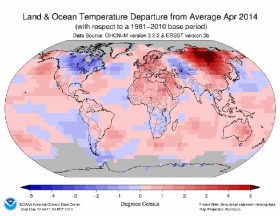
Globally, this April was a scorcher, tying with 2010 for the warmest April on record, according to new data released by the National Oceanic and Atmospheric Administration (NOAA) last week. This makes 2014, to date, the sixth warmest year on record going back to 1880 when comparing the first four months. However, if an El Nino event strikes this summer or fall—as seems increasingly likely—global temperatures could rise even more.


April's temperatures were 0.77 degrees Celsius (1.39 degrees Fahrenheit) above the 20th Century average around the world. Europe, Australia, the Middle East, and northern Africa all experienced temperatures well-above average. But the hottest region proved to be Eastern Siberia, where temperatures hit more than 5 degrees Celsius (9 degrees Fahrenheit) above the 20th Century average. Meanwhile, much of Canada, the U.S. Midwest, and portions of Central Asia were below average.
April 2014 is also a landmark for being the 350th month in a row where global temperatures have been above the 20th Century average: the last time the world had a below-average month was February 1985. Moreover the last time the world had a below average year was 1976. According to NOAA the warmest year on record was 2010.
Continue Reading at Mongabay.com

Saturday, June 7, 2014

Guests Richard Bookbinder/Terra Verde Capitol Management


We will be recording a show with Richard on Weds.  In the meantime get familiar with his company and some of the great work they are doing, including finding solutions for a global water shortage and future drought conditions:


Download BookbinderPhoto_68.jpg (1718.4 KB)

BIO:  

Richard S. BookbinderManaging MemberMr. Bookbinder formed Bookbinder Capital Management LLC (“BCM”) in 1999 and is actively involved in all aspects of fund management including portfolio allocation, manager research, and due diligence. Mr. Bookbinder currently manages two funds of funds, The Roebling Fund LP launched October 1999, and TerraVerde Capital Partners LP, launched July 2009.

Prior to forming BCM, Mr. Bookbinder was a Founding Principal of Sandler O’Neill & Partners, L.P, a leading investment bank specializing in middle-market financial institutions. Previously, Mr. Bookbinder was a Limited Partner and Associate Director in fixed-income sales at Bear, Stearns & Co. Inc. and before that he directed the sale of municipal bonds to high net worth individuals at L.F. Rothschild & Co. He began his career in the fixed income area of J.B. Hanauer & Co.
Company:
http://terraverdecap.com/

WHY TERRAVERDE: WHY INFRASTRUCTURE & GREEN INVESTMENTS?

With the growing energy imbalance and growing investment in infrastructure including renewable energy, clean tech, and water,  TerraVerde Capital is leveraging its industry relationships with managers who have fundamental insight and information networks in green investments including alternative energy and technology related markets, power, transmission, and transportation to identify sectors with growing problems.


INVESTMENT PHILOSOPHY:

TerraVerde strives to meet its targeted risk/reward portfolio objectives by offering investment solutions that access multiple investment managers and asset classes globally, and by achieving a targeted portfolio return while protecting partner capital in periods of market stress. By combining various managers with strategies that capitalize on market inefficiencies that are not necessarily dependent on a market’s direction, our diversified portfolio seeks to generate attractive returns versus peer traditional long only investing.

WHY A HEDGE FUND APPROACH FOR INFRASTRUCTURE & GREEN INVESTMENTS :

In this era of increasing visibility and focus on power and renewable energy with intense technology competition and high barriers to entry, there will be companies that will be winners along with some that may be losers. By allocating to a wide range of strategies across the clean energy supply chain of renewable energy, and by capitalizing on high-growth developing opportunities, each of these strategies has a major impact on our carbon reduction theme. With the pressure on global infrastructure and natural resources due to growing populations, energy efficiency and energy security are long term investments that offer unique investment opportunities.


Friday, June 6, 2014

Robots clean Israel's solar panels without water

Our thanks to a new contributor, Dea Handara, based in CA, who introduced us to a great newsletter, Israel 21c, and a great story.  How cool to combine clean energy with waterless maintenance.   Talk about ingenious and a win-win.  Our hats off to the creators of the robots and their further ingenuity on the sustainability side:


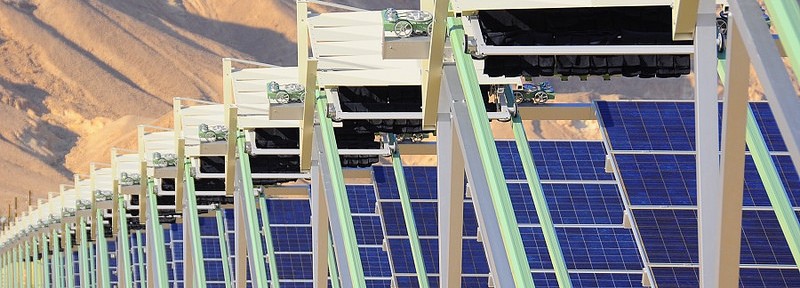
Ecoppia’s solution clears dust from energy-generating panels every night, without human intervention and without a drop of precious water.

The robots clean dust off 18,200 panels at Ketura Sun every evening.

One of the greatest things about hot, desert locations like Israel is that you get sunshine 300 days of the year. This is the perfect condition for solar energy power plants, but with one drawback –– all the dust.
Dust storms spit particles onto the photovoltaic panels, causing efficiency to plunge over time. Up to 40 percent of the energy can be lost from dirt. Less efficient panels means less energy back to the grid and less money in the pocket of stakeholders and investors.
But Israel has a solution that can replace backbreaking grunge work.
Last year, a group of inventors who made their money in biotech enterprises took their expertise into a new venture: solar-panel cleaning robots. Their company, called Ecoppia has been operating since last March on an Israeli kibbutz, cleaning the 18,200 panels at the Ketura Sun solar power plant– a 4.95-megawatt solar power plant near the southernmost tip of Israel.
This is the lower limit of the size of solar plants that Ecoppia robots can clean daily, says CEO Eran Meller.
Moving the dust without water
“We’ve removed 99 percent of the dust on a daily basis,” says Meller. “Within a two-week period we increased efficiency rates [of Ketura Sun] by a significant figure.”
Instead of sending in human cleaners with buckets and squeegees every six or eight weeks, plant managers can deploy the panel-cleaning robots fitted with solar power packs that sustain a charge for three days.
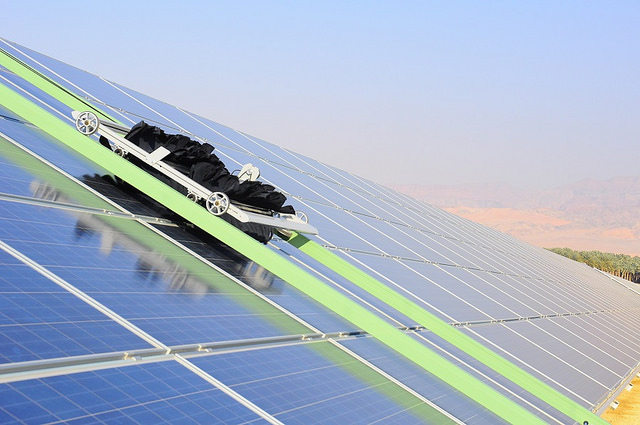
Working for an hour every evening, they brush the air above the panels with a gentle swishing movement –– not touching the panels, but causing enough action so the dust is suspended and rolls off without danger of breakage as there is with human cleaners. The machines are self-cleaning and – especially important in an arid climate – no water is required.
“Our [method] is still much more effective than manual cleaning,” says Meller. “There are a few other competitive advantages. We are the only solution which is water-free. We use a unique gravitation method, which generates air flow to take out dust.
“Our unique microfiber elements catch microns of dust and are gentle on the panel. We make green energy even greener.”
When the sun comes up, the robots “rest” under a shaded canopy so the sun and the panels can do their job making energy.
An Ecoppia robot at work
Normally the robots start the cycle of cleaning automatically, but an operator can intervene if there is a need.
Business projections
Interested in buying a team of robots? Return on investment takes about 2.5 years, Meller estimates. Not bad considering the life of a solar power plant is at least 20 years and up.  
The business model is an upfront purchase of the robots with an annual maintenance fee.
There are other solutions on the market. The Swiss company Serbot has a water-based system run by a human operator. The Israeli-built Ivanpah Solar Electric Generating System in California relies on BrightSource robots to clean its panels. And the solar power company SunPower bought Greenbotics to clean its panels.
Meller says that Ecoppia is the only system that is waterless, and it has several patents pending. “We have a very extensive IP portfolio and files for five patents worldwide,” he says.
Barriers for other companies to enter the market include method, design and hybrid technology, he says.
Also the arduous process of getting certifications from the panel producers and the projects is no easy task, he notes.
By July, Ecoppia “will close five additional major solar parks,” he tells ISRAEl21c. “By the year end we will be the only one who will be able to clean five million panels per month. This will be the only technology that enables solar park owners to conduct daily cleaning.”
There is a growing trend for robots doing our dirty work in the renewable energy business, where solar fields can practically run all by themselves. This isn’t true in the polluting industries of coal, natural gas, oil and nuclear energy –– all of which require large staffs to run operations.
Hats off to the robots.
For more information about Ecoppia, visit www.ecoppia.com.

Thursday, June 5, 2014

Great radio show on our site this week

If you have not listened to any of our shows, we invite you to do so now.  Here's a description of this week's episode.  The link below will get you into our broadcast section and from there you can find all of our past shows.  Enjoy and send us your comments.  We invite potential guests, as experts, to contact us as well:

http://www.renewablenow.biz/main.html

"There are so many ways to "envision the future." We talked about two of those prisms with our co-host, Jack Greg, and guests, Dr. Karen Weber and Rick Heede--Weber is through Green Fest in Boston, a world-class showcase for everything sustainability, and Heede is working with organizations like Climate Mitigation to carry out the hard work of removing carbon from the air.

How do you "envision the future?"  Do you, in fact, spend time imagining a cleaner world?   We do, of course, each day, and with the help of Jack and guests on this episode, we think about the next 100 years, a century of innovation, change, global balance and the beauty of creating a new, sustainable economy that runs on clean energy, not fossil fuel. 

Can mankind survive on this planet?  Not without some major changes and concessions from large-scale polluters.  What are those changes and concessions?"


Wednesday, June 4, 2014

Potential Seen to Reduce Air Pollutants by 750K Tons

Great follow up to our story on Obama's recent push to clean up power plants and shift the types of energy that grids buy and deliver to customers:

By ecoRI News staff
Setting strong standards for climate-changing carbon emissions from power plants would provide an added bonus: reductions in other air pollutants that can make people sick, damage forests, crops and lakes, and harm fish and wildlife, according to a recently released study by Harvard and Syracuse University scientists
The authors mapped the potential environmental and human-health benefits of power plant carbon standards using three policy options for the forthcoming Environmental Protection Agency (EPA) rule as a guide to model changes in power plant emissions of four other air pollutants: fine particulate matter; nitrogen oxides; sulfur dioxide and mercury. The scientists compared the model results with a business-as-usual reference case for the year 2020.
Of the three scenarios simulated in the study, the top-performing option decreased sulfur dioxide and mercury emissions by 27 percent and nitrogen oxide emissions by 22 percent by 2020 compared to the reference case. This option reduced carbon dioxide emissions from the power sector by 35 percent from 2005 levels by 2020.

The resulting air-quality improvements are likely to lead to significant gains in public and environmental health, according to the study.
“When power plants limit carbon dioxide emissions, they can also release less sulfur dioxide, nitrogen oxide and other pollutants,” said Charles Driscoll, Ph.D., of Syracuse University. “One of the policy options we analyzed cut emissions of these non-carbon pollutants by approximately 775,000 tons per year by 2020. We know that these other pollutants contribute to increased risk of premature death and heart attacks, as well as increased incidence and severity of asthma. They also contribute to acid rain, ozone damage to trees and crops, and the accumulation of toxic mercury in fish.”
In addition to summarizing changes in emissions, the study quantifies the resulting improvements in air quality. With a strong carbon standard, improvements are widespread and every state receives some benefit, according to the study. The maps show that the greatest benefits occur in the eastern United States, particularly in states in and around the Ohio River Valley, and in the Rocky Mountain region.
States that are projected to benefit from the largest average decreases in fine particle pollution and summer ozone pollution detrimental to human health include: Ohio, Pennsylvania, Maryland, West Virginia, Illinois, Kentucky, Missouri, Indiana, Arkansas, Colorado and Alabama.
States that are projected to benefit from the largest average decreases in sulfur and nitrogen pollution detrimental to ecosystems include: Pennsylvania, West Virginia, Ohio, Maryland, Kentucky, Delaware, Indiana, Illinois and Missouri.
Most other states see improvements in both air quality and atmospheric deposition of pollutants that vary state to state. The findings also show that different policy options yield different outcomes. The detailed air quality modeling makes it clear that a modest rule limited to making power plant improvements  “inside the fence,” similar to what some industry groups have proposed, would bring little if any air-quality benefits, according to the study.
“Our analysis demonstrates that strong carbon standards could also have widespread benefits to air quality and public health,” said Dr. Jonathan Buonocore of the Harvard School of Public Health. “With a mix of stringency and flexibility, the new EPA rules have the potential to substantially reduce emissions of sulfur dioxide and nitrogen oxides from power plants, which contribute to local and regional air pollution. This is an opportunity to both mitigate climate change and protect public health.”