Tuesday, April 24, 2018

Landfill stabilization budget is $1,995,000/Block Island Times

One of the reasons we worry so much about waste, and promote waste-to-gold initiatives, is seen right here in this story:  The massive costs of over burdening a landfill.  Running out of room, space, overwhelming our ability to burn waste, cap it ends up costing us millions to remediate.

Instead, let's get ahead of the looming crises and stop sending 99% of what we make to a landfill.  Logic tells us we can do much better in sourcing, producing and reusing materials.


Stabilization of the town’s old landfill at West Beach will be priced at close to $2 million.
The lowest bid for the proposed project came in at $1,929,800, but with the addition of administrative costs, and contingency funds, the town will be asking voters to approve $1,995,000 as a warrant question at the May 7 Financial Town Meeting.
According to Finance Director Amy Land, and assuming a 4 percent interest rate over 20 years, the $1.9 million bond will have an annual debt service of $145,874, and an annual cost of $70 to a taxpayer owning property assessed at $1 million. 
The Town Council voted unanimously at its April 18 meeting, as part of the overall 2019 fiscal year budget package, to approve Town Manager Ed Roberge’s recommendation that the town hire Pawtucket-based RC&D, Inc., for stabilzing the town’s old landfill. RC&D, Inc. was one of eight contractors who took a pre-bid walking tour of the trash-filled site with Town Engineer Jim Geremia on March 28. According to Geremia, life expectancy of the project is about 15 to 20 years, weather permitting.
“Usually an improvement like this has a substantial lifespan,” Roberge told The Block Island Times, noting that while it’s a “sensitive tidal zone,” and an unusual event like “back-to-back hurricanes” could destroy the revetment, he said he’s “very confident it will have a lifespan in excess of 20 years.”  
The town received four bid proposals for the project on April 9, which includes the winning bid from RC&D ($1,929,880), of Pawtucket, R.I., and three other contractors: Cherenzia Excavating ($2,127,500); J.H. Lynch & Sons ($2,209,700); and Northern Construction Services ($2,444,050).
“We are pleased with the results” from the bidding process, said Roberge. “RC&D is well-qualified to handle this type of project. They have done this kind of work before — having built ocean revetments.”
Geremia echoed Roberge’s sentiments, and said that RC&D came with “good references,” and are familiar with “big stone projects.” He said they “built the Narragansett breakwater,” and “are capable of performing the job.” 
Per an April 16 report from Roberge to the Council, Geremia recommended that RC&D not include installation of a new drainage system at the Transfer Station at a cost of $192,500 as an alternate item, which reduced the contractor’s bid to $1,737,380. The project is budgeted with a 7 percent contingency fund of $127,290, resident inspection services at $90,550, and contract administration cost of $39,860 for a total cost of $1,995,080. (Roberge said the drainage system may be added back into the project, which would bring the project’s cost to over $2 million.)
In his report, Roberge noted that due to the lack of federal grant funding, the Town Council reconsidered the project, and directed Geremia at a meeting in early 2017 “to revise the project scope of work to be more in line with the local funding limits provided for the project.” The West Beach project was originally budgeted at $4.2 million in May of 2015, but was scaled back to $2.2 million in July of 2016.
In an April 13 letter from Geremia to Roberge, the Town Engineer wrote: “Based upon our evaluation, RC&D, Inc. has submitted the most responsive and responsible bid for this project.” The ten items included in the contractor’s proposal are: 2,500 tons of stone, 1,500 cubic yards of landfill capping material, 1,000 tons of seed, 200 cubic yards of gravel, the hauling of 100 tons of recycled metals, silt fencing, testing on screened soil, calcium chloride for dust control, a chainlink fence, and mobilization and demobilization.
On its website, RC&D, Inc. states that it was established in 2004, and has “completed over 150 civil, environmental remediation and development projects the past thirteen years.” The company “is a self-performing heavy civil and environmental contractor specializing in remediation, civil sites, and marine construction,” and “serves the private, public and federal marketplace throughout the northeast region.”
The project will involve cleaning and stabilizing the shoreline in the area where the landfill has been breached due to erosion. The contractor, in this case RC&D, will remove trash and bury it in town-owned land adjacent to the Transfer Station. The contractor will also stabilize the slope through the use of heavy stones, vegetation and soil, creating a 3-to-1 grade.
Roberge said if voters approve the funding authorization at the FTM, the funding will become available immediately. 
The project has a completion date of May 22, 2019, with work activities being restricted between May 25, 2018 and Sept. 7, 2018.

Monday, April 23, 2018

Earth Day is Every Day End Plastic Pollution/Earth Day.org

Plastic pollution is poisoning our oceans and land, injuring marine life, and affecting our health! 
Help End Plastic Pollution by finding out how many plastic items you consume
every year and make a PLEDGE to reduce that amount.
Earth Day Network in 2018 and beyond is dedicated to providing the information and inspiration needed to fundamentally
change human attitude and behavior about plastics.


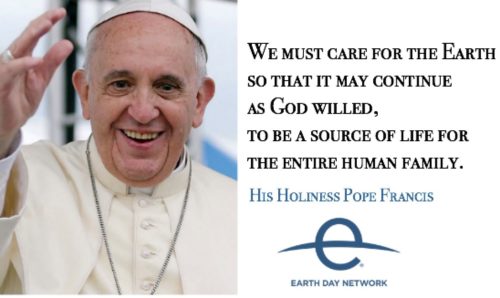
An Earth Day Message From Pope Francis/Earth Day Network

God bless you all who care for our planet and for each other.


The Earth is our environment to protect and our garden to tend to. 
The relationship of mankind with nature must not be conducted with greed, manipulation and exploitation, but it must conserve the divine harmony that exists between creatures and Creation within the logic of respect and care, so it can be put to the service of our brothers, also of future generations.
I exhort everyone to see the world through the eyes of God the Creator.
Pope Francis's important messages continue to inspire and encourage people worldwide to take responsibility for the environment, and do so in the service of God. For this, and a multitude of other great efforts, we look to him as one of today’s greatest moral authorities on the issue of climate change and its impact on the world’s most vulnerable communities. Today, more than ever, we need to safeguard our planet and care for the Earth.
This Earth Day, Protect our Home.


Friday, April 20, 2018

Americans waste about a quarter of the food they buy, and the environmental consequences are staggering

Americans waste about a quarter of the food they buy, and the environmental consequences are staggering

by Christopher Mooney


a variety of fresh fruit and vegetables on display in a store


The mass quantities of food Americans waste every year has staggering environmental consequences, according to a study published Wednesday.

“Our data suggest that the average person in the United States wastes about a pound of food per day,” said the University of Vermont’s Meredith Niles, one of the study’s authors, along with researchers at the Department of Agriculture and the University of New Hampshire.

That totals about 25 percent of all food, by weight, available for consumption in the United States — or about 30 percent of all available calories, the researchers estimate — a figure that’s larger than previous attempts to measure food waste.

The environmental costs of that wasted food are tremendous: 30 million acres of cropland (about the land area of Pennsylvania), 4.2 trillion gallons of water and nearly 2 billion pounds of fertilizer. Fertilizer contains compounds that can run off farm fields and compromise water quality.

Subscribe to the Post Most newsletter: Today’s most popular stories on The Washington Post
The study, published in the journal PLOS ONE, did not calculate the resulting greenhouse gas emissions. But prior research has suggested wasted food, like all food production, also contributes to the warming of the planet, because agriculture is a key source of the fast-warming gases methane and nitrous oxide.

The report is the latest evidence that if the world is to manage a growing population and the massive changes that population is making to the global climate, it will have to significantly reshape its food system to use fewer resources to feed more people — efficiency that probably would require wasting far less food.

The new research is based on a massive survey of Americans’ eating habits, cross-referenced with other federal data sets and amplified by modeling tools, so as to determine how much food we waste and how much environmental input that translates into.

The amount of total food wasted is undoubtedly larger than the researchers calculated, as the study focused only on waste by consumers at home or when eating out. Waste within the agricultural system before food reaches a home or restaurant was not included, nor was food wasted at supermarkets.

“What we’re reporting is about 25 percent of the food that’s available for consumption gets wasted,” said the Agriculture Department’s Zach Conrad, the study’s lead author. “And there are some other data sets that are showing, that across the entire food system, it’s about 30 to 40 percent.”

“Food waste is a big deal,” said Timothy Searchinger, a senior fellow at the World Resources Institute and a Princeton University researcher who reviewed and commented on the study by email. “It results in large increases in land use demands, other inputs, and greenhouse gas emissions.”
If anything, Searchinger said he was “puzzled” that the estimates for the amount of land used to grow wasted food were not even higher in the study.

The research also contains a potentially controversial finding among those who focus on promoting healthier diets — as well as among environmental advocates who regularly attack the beef industry for its large environmental footprint.

Namely, the research finds the most wasted foods are actually the healthiest: fruits and vegetables. These represented 39 percent of the food wasted per person.

“Higher quality diets actually result in higher amounts of food waste, and that largely has to do with the fact that those diets have more fruits and vegetables in them,” Niles said. “And it is the most wasted food that we found in our study.”

Dairy and beef were the second and third most wasted foods, respectively.

Searchinger partly questioned this finding, noting “fruits and vegetables have high weight (due to the water content) and high loss and waste rates, due to spoilage and imperfections in appearance.”
“One element of a healthier diet is less beef consumption,” he wrote. “Because there is also significant wastage of beef and because beef uses so much land (although mostly pasture), there is a good chance that if you factored in pasture savings, the healthy diet would waste less land. ”

Although the study did not present explicit public opinion data on why people waste food, for fruits and vegetables in particular it is often the perception that they are flawed, or have gone bad. For other types of food, Niles cited issues ranging from large portion sizes to confusion about expiration dates.
Niles and Conrad said the solutions to food waste include educating people — for instance, teaching that a bruised banana can still be eaten — and a lot more meal planning.

What is clear, given the numbers here, is we cannot hope to feed even more people on Earth, with less of an environmental impact, if we cannot get food waste under control.

“We think it’s really important to pursue efforts for nutrition and improving environmental outcomes simultaneously,” Niles said. “As we improve our diet quality we should be thinking about the multiple strategies we have to make sure food isn’t getting wasted at the same time.”

Thursday, April 19, 2018

Scientists investigating a plastic-eating microbe accidentally improved it

Big story that has serious potential for dealing with 8.3 trillion kilograms of plastic we've produced over time.  We'll look to get this team on a show.

Great follow up to yesterday's show with Plastic Bank.  Amazing group.  Plastic is now a currency and an economic engine. 

Scientists investigating a plastic-eating microbe accidentally improved it

Some rare good news in the fight against plastic pollution: Scientists working with a plastic-eating microbe discovered in Japan two years ago accidentally created a mutant enzyme that sounds like an environmentalist's dream, the Guardian reports.

The enzyme breaks down the PET—polyethylene terephthalate—used in plastic bottles even more efficiently than the original microbe, which had evolved to eat the waste it encountered around an Osaka recycling plant.

Researchers, who inadvertently improved the enzyme while investigating how it evolved, say the tweaks enable it to begin digesting plastic more quickly. It now takes just a few days to start breaking down plastic, and researchers say more tweaks could make the process super-fast, reducing both plastic waste and the need to create more plastic.

"What we are hoping to do is use this enzyme to turn this plastic back into its original components, so we can literally recycle it back to plastic," says lead researcher John McGeehan at the University of Portsmouth.

"It means we won’t need to dig up any more oil and, fundamentally, it should reduce the amount of plastic in the environment." Experts not involved in the research say it sounds extremely promising, though it may be a while before the enzyme can be used as a large-scale solution to plastic pollution, reports the Australian Broadcasting Corporation.

"Enzymes are non-toxic, biodegradable, and can be produced in large amounts by microorganisms," notes RMIT University chemistry expert Oliver Jones. (Researchers were depressed to discover the true extent of the Pacific Garbage Patch.)

Wednesday, April 18, 2018

Formula E Receive’s Blessings From Pope Francis/RNN

We've been reporting to you on Formula E for years.  Does not get much better in life than to be blessed by the pope. Pope Francis is a true guardian of our environment and angel of change.


What a week’s it’s been and what a week it’s going to be.
If you missed it, his Holiness Pope Francis last Wednesday welcomed a selection of drivers competing in the ABB FIA Formula E Championship to his residence in Santa Marta ahead of the first-ever E-Prix on the streets of Rome that took place this past Sunday.
Over half the grid and the fully-electric Formula E car made the short trip to Vatican City, prior to the inaugural race in the Italian capital on Saturday for the CBMM Niobium Rome E-Prix presented by Mercedes EQ – round seven of the 2017/18 ABB FIA Formula E Championship.
Alongside Founder & CEO of Formula E Alejandro Agag – as well as ACI President Angelo Sticchi Damiani – the drivers, team representatives, and the official championship car were given a private Apostolic Blessing before attending the papal audience. Now, what could have been better than that? Well maybe it would have been fun to see his Holiness give up the Pope Mobile in exchange for a couple runs around St. Peter’s Square in the electric Formula E car itself, who knows Formula E might be open to Team Vatican.

Tuesday, April 17, 2018

Investing in Virtue Is Hard When So Few Companies Measure Up/Bloomberg

Great article.  In life it is not easy to be virtuous, either.

Then comes the difficult part of trying to make money.


It’s not easy being a socially conscious investor. To see why, look no further than Facebook Inc.
By any reasonable ethical standard, the social media giant doesn’t measure up. The Cambridge Analytica debacle and its aftermath revealed that Facebook is collecting far more information on its users -- and even non-users -- than it let on. And, as my colleague Shira Ovide pointed out, when CEO Mark Zuckerberg had the opportunity to come clean last week during two days of congressional testimony, he ducked questions about how the company operates.
Facebook’s wily ways appear to be catching up to it. According to a March 21-23 Reuters/Ipsos poll, only 41 percent of Americans “trust Facebook to obey laws that protect their personal information.” An April 8-9 SurveyMonkey/Recode poll askedrespondents which technology company they least trust with their personal information among Amazon, Apple, Facebook, Google, Lyft, Microsoft, Netflix, Tesla, Twitter, Snap and Uber, and 56 percent chose Facebook. The runner-up was Google, with just 5 percent.  
Given all the questions surrounding Facebook, investors may be surprised to learn that its stock is commonly held by so-called socially responsible funds, which invest in companies deemed to be good citizens.
The biggest such exchange-traded fund -- the iShares MSCI KLD 400 Social ETF, with $1 billion in assets -- bills itself as an “exposure to socially responsible U.S. companies” and urges investors to use the fund to “invest based on your personal values.” The fund has a 3.5 percent allocation to Facebook.
Facebook is also among the stocks held by the second-largest socially responsible ETF, the iShares MSCI USA ESG Select ETF, with $679 million in assets. The fund holds roughly 100 large- and mid-cap stocks “screened for positive environmental, social, and governance characteristics.” Facebook accounts for only 0.09 percent of the fund, but it’s sobering to think that there isn’t a worthier company among the hundreds of candidates. 
So how does Facebook make the cut? It turns out that socially responsible investing isn’t necessarily just about picking the most virtuous companies. MSCI Inc., for example, looks for industry specific environmental, social and governance policies that have historically made money for investors. The idea is to simultaneously invest in responsible companies and beat or match the return of the broader market.
And MSCI has delivered. The MSCI KLD 400 Social Index has beaten the S&P 500 Index by 0.5 percentage points annually from May 1990 to March 2018, including dividends -- the longest period for which returns are available. The MSCI USA ESG Select Index has trailed the S&P 500 by just 0.2 percentage points since June 2004.