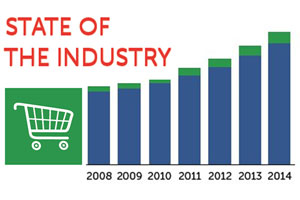
This, too, was mentioned on the show with Ashley from Cascadian. The industry stats look great. Keep buying organic. You are helping to build a remarkable green economy.
Market Analysis
If you’re looking for the latest data on the organic industry, you’ve come to the right place! OTA is the premier source of information about organic. Whether you're looking for the size of the organic market, organic industry trends or insights into the organic consumer, OTA is here to help.
Each year, OTA publishes two flagship research products—the Organic Industry Survey and the U.S. Families’ Organic Attitudes and Beliefs Study, to inform the business, media, government and other communities about the organic trade.
U.S. Organic Industry Survey 2016 With $43.3 billion in total organic product sales, the industry saw its largest dollar gain ever, adding $4.2 billion in sales in 2015, up from the $3.9 billion recorded in 2014. For the fourth year running, the industry saw growth in the double digits at 10.8%. To-date, the industry has shown continuous and steady gains since the economic downturn of 2009 with a growth rate well beyond that of the overall food market at 3.3% in 2015. - See more at: https://www.ota.com/resources/market-analysis#sthash.moSL6DFP.dpuf
U.S. Families' Organic Attitudes and Beliefs Survey 2015
78 percent of organic buyers say they typically buy their organic foods at conventional food stores/supermarkets. Over half also shop organic at the “big box” stores, and some 30 percent also report that it’s not unusual to buy organic at one of the warehouse clubs in the country.
African American and Hispanic families have been steadily increasing among the ranks of organic-buying households.
The OTA survey also looks at the incomes, education and ages of organic buyers, and compares the buying habits of the new organic purchaser to the more experienced organic consumer.
- See more at: https://www.ota.com/resources/market-analysis#sthash.moSL6DFP.dpuf
There's More To Organic Than Meets The Eye
- See more at: https://www.ota.com/resources/market-analysis#sthash.GGEblx7d.dpuf
Yesterday, we recorded an interview with Ashley Minnerath, Cascadian's Site Director and we think you can hear that live today at 1p, ET. If not, it will run this summer. Their story is one of an early pioneer who turned into a great entrepreneur and whose legacy influences the entire organic food industry. Here's more:
You already know that Cascadian Farm® is one of the country's leading brands of organic foods. But Cascadian Farm is also a real place — a working, active, productive farm dedicated to bringing wholesome organic food to your table.
The story of Cascadian Farm begins with the story of our founder, Gene Kahn. 40 years ago, Gene was an idealistic 24-year old grad-school dropout from Chicago, who just wanted to make a difference in the world. He recognized the delicate balance between nature and humans. Inspired by reading “Silent Spring” and “Diet For A Small Planet”, Gene wanted to go back to the land and farm in a way that would not harm the natural beauty of the earth or her inhabitants. So he set out to farm organically on a little stretch of land next to the Skagit River in the Cascade Mountains of Washington.
Today Cascadian Farm has grown beyond our original farm and is recognized as a pioneer in converting conventional farms to organic. Cascadian Farm also realizes that we can make a difference beyond just the food that we produce. That’s why we work with partners who share our mission. Working together, we can help sustain the health of the earth for all living creatures today, tomorrow and for generations to come.
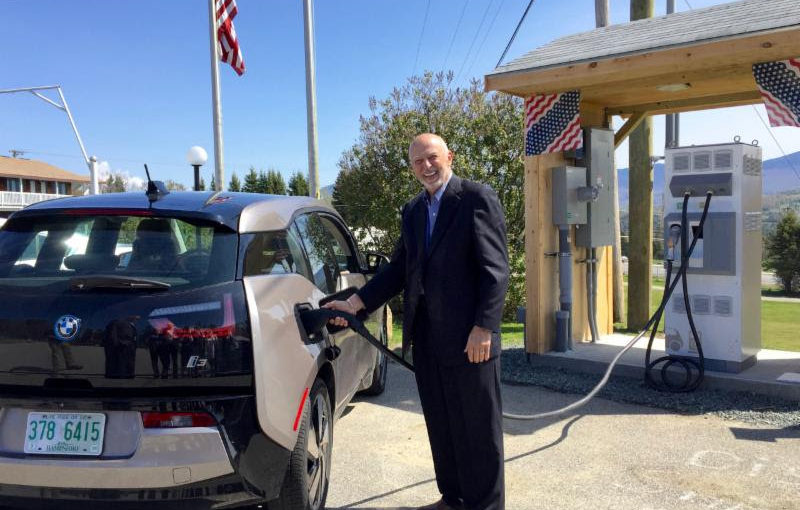
Thank you Jack Gregg, our talented co-host from Boston. Good to see level 3 chargers for EV's of all types. We think this is key to getting more EV's on the road.
The new fast-charging system unveiled Friday at a popular campground in Lancaster, in the part of the state known as North of the Notches, is the first such public facility in the North Country and the first non-Tesla Level 3 charger available in the state for the public. It’s being paid for by what’s called the Forward NH Fund, which is used by Eversource and Hydro-Quebec as part of their sales pitch for the proposed and very controversial Northern Pass transmission lines which would carry hydropower from Quebec into New England.
I’ve long been surprised that electric companies aren’t building car chargers right and left, to goose a market which will use their product, although I realize that the complex regulatory structure around electricity makes that complicated. Using money from Northern Pass, which is a separate, non-regulated entity, is easier.
I have a short announcement about it in today’s Monitor, but many of the details weren’t available when I filed that. A few extra tidbits:
+ It will have one CHAdeMO and one CCS charger, so it can handle all models of non-Tesla cars.
+ It is a behind-the-meter system for Roger’s Campground. The owner, Crosy Peck, was quoted in the press release as saying: “EVs are here and more are on the way. … This fast charger will attract a segment of our tourist population that I expect will continue to grow each year.”
+ It cost about $100,000 to install, according to Eversource spokesman Martin Murray, who wrote in an email: “There were a number of upgrades necessary, between the meter and the station, including new pole, x-arms, and transformer.” No upgrades were needed for the local substation.
+ Murray wrote that the campground owner has customers with electric vehicles that plug into the 110-volt outlets located at each campsite and charge overnight.
Fast DC chargers are usually said to be able to “fill up” an electric car to at least the 80 percent level in 20 minutes. The same thing from a 110 volt home system would take eight hours or more.
By the way, driving past the Hooksett tolls today, I saw a Tesla charging up – the first time I’ve ever spotted one of thedozen Supercharger stations being used.
David Brooks
Dave Brooks is a reporter with the Concord (NH) Monitor who has has written a science/tech column since 1991 and has written this blog since 2006, keeping an eye on topics of geekish interest in and around New Hampshire. He moderates monthly Science Cafe NH discussions, beer in hand, and appears regularly on New Hampshire Public Radio.
Many times we need small steps forward. Here's a good example.
Overlooked Tool to Fight Climate Change: A Tweak in Fuel Standards
One
of the best new opportunities to reduce greenhouse gas emissions might
be to tweak a bureaucratic regulation we’ve had around for close to four
decades.
Changing
vehicle fuel efficiency standards — if done properly — could not only
reduce emissions from cars and trucks, but also set the nation on a path
that textbook economics suggests is the most efficient: by placing a
nearly economywide price on carbon pollution.
The United States has to figure out how to meet the lower emissions targets that nations committed themselves to under the climate change accord reached in Paris in December. In the United States, the centerpiece of climate policy is the Clean Power Plan put forth by the Environmental Protection Agency. It sets limits on carbon pollution from power plants. If this plan survives a court challenge, the nation will take a major step toward reducing greenhouse gas emissions.
But
even this won’t be enough to reach the levels promised in Paris. So
where can other cuts — ideally, not too expensive and not requiring new
laws — come from?
Using
corporate average fuel economy (CAFE) standards might seem
counterintuitive. They are widely regarded as costly and inefficient
because they rely on mandates for achieving emissions reductions, rather
than letting market forces find the least expensive ones. But a big
advantage is that CAFE standards have been required by law since the
1970s and so do not require new legislation.
CAFE
standards were last updated in 2011 and are now up for review by the
E.P.A. These standards have grown more stringent over time but are still
lax compared with those of other nations. America’s vehicles get, on
average, 21.6 miles per gallon; in Britain, where fuel taxes are also
much higher, vehicles average 35.6.
Besides their relative laxity, CAFE standards have loopholes
— for example, based on vehicle size — that limit their effectiveness
at increasing fuel efficiency and reducing emissions. Such loopholes are
made worse by the decline in gasoline prices that is leading to greater
purchases of trucks and S.U.V.s, instead of more efficient cars. The
result is that some observers say that we need to think “outside the box” during this CAFE review period.
One way to think about fuel
economy is to take into account not just how many miles a car gets per
gallon of gas, but how many miles it is likely to be driven over all.Credit
Chris Pizzello/Associated Press
One
way that we could think about fuel economy, but currently don’t, is to
take into account not just how many miles a car gets per gallon of gas,
but how many miles it is likely to be driven over all. Automakers have
plenty of data on the average number of miles driven by each kind of car
over time. Not all cars are driven the same amount.
A
typical Chevrolet Malibu (a midsize car), after seven years on the
road, will have 110,000 miles on its odometer. An average Buick LaCrosse
(a full-size luxury sedan) will have only 78,000 in the same period
(See iSeeCars.com data).
Although their fuel economy is similar, the average Malibu will produce
significantly more emissions than the average LaCrosse over its
lifetime.
With
some simple math, it is possible to calculate the typical lifetime
gasoline consumption of each model of car. Then using the rule that each
gallon of gas leads to 20 pounds of carbon dioxide (CO2) when burned, it is straightforward to determine the expected lifetime CO2 emissions from any group of cars.
This calculation could be the basis for replacing the current form of CAFE with a cap-and-trade market for CO2. Specifically, the government could set a CO2 limit for all cars sold in a given year and issue permits denominated in lifetime CO2
emission. Manufacturers could then trade these permits for the cars
they produce annually. For example, automakers that specialize in fuel
efficient cars could sell permits to companies that concentrate on
S.U.V.s.
Cap-and-trade programs have been shown time and again to reduce regulatory compliance costs. To further reduce the costs for manufacturers, they could receive some of the permits at no charge.
Of
course, more details would need to be worked out. But over all, such a
cap-and-trade system would reduce the costs of lowering CO2
emissions (and gasoline consumption) and spur further research and
development into more efficient cars. Finally, this is not a big leap
legally because trading already takes place under CAFE standards — but
of fuel economy.
The
benefits of reforming CAFE are potentially even greater than just
reducing the costs of compliance in the transportation sector. Subject
to careful vetting of legal issues, one could link a CAFE cap-and-trade
system with the cap-and-trade programs that California and some East Coast states are already using to reduce CO2 and that others are considering adopting to comply with the Clean Power Plan.
Full
integration of the transportation and power sectors in a cap-and-trade
program would cover 71 percent of total United States emissions and
greatly reduce the costs of cutting CO2 across both sectors. Indeed, economists of all political leanings (and even some industry leaders) have been urging the adoption of a widespread CO2 cap-and-trade system.
All
of these changes could be set in motion by a simple change in the
formula for how we set fuel economy standards. No legislation, no votes
from Congress and no presidential signings required. The result:
financial savings and reduced CO2 emissions.
More good news on range. We are quickly getting buses, trucks, cars, driven by hybrids and electric, competitive, in all facets, with gas-powered units.
In a first for electric vehicles, Dubuc Motors announces an unprecedented range of 370 miles per full charge for its Tomahawk electric sports car in initial tests. The subsequent and much awaited 2+2 supercar is set to unveil in 2017 and will provide a wind of change to the market.
To date, Dubuc Motors has gathered over $5 million dollars in indicated interest for the shares of the company through its test-the-water equity crowdfunding campaign on startengine.com. Dubuc Motors believes it is on track to complete its funding goal which is the first step in bringing the Tomahawk EV into production in 2017. This news is sure to please the hundreds of investors who have already indicated interest in the company, and underlines Dubuc Motors' unwavering pursuit of excellence.
"We want to be unequivocally the reference in the electric sports car market. We strive to push the limits and intend to offer the ultimate of what is possible. This announcement today highlights our commitment to bringing an unsurpassed level of engineering and we believe demonstrates our ability to progress quickly within our space," said Mike Kakogiannakis, CEO of Dubuc Motors.
According to Bloomberg New Energy Finance in 2016, sales of electric vehicles are expected to hit 41 million by 2040, representing 35% of new vehicle sales. They also estimate the premium car market has surged 154% as the growing ranks of wealthy consumers want more opulent toys. Dubuc Motors intends to penetrate this niche market and produce the most sophisticated connected sports car yet with its Tomahawk EV.
- See more at: http://renewablenow.biz/the-sustainble-auto.html#sthash.TNGuFn2T.dpuf
We see this as a key indicator that hybrids and electric drive with continue to make in-roads on trucks and buses. These systems are enhanced by regeneration and renewable systems as well that keep the batteries charged. There is lots more stories on our main site this week as well at Renewable Now.biz:
Proterra, the market leader of zero-emission, battery-electric buses in North America, today announced a new battery design for the Proterra Catalyst® XR transit vehicle at the American Public Transportation Association Bus and Paratransit Conference (APTA), a gathering for U.S. transit agencies to showcase the best innovations in mass transit. Within the same energy storage footprint as the original Catalyst XR, the battery-enhanced vehicle now holds 28 percent more energy at 330 kWh and a best-in-market lightweight vehicle body. All current Catalyst XR customers will receive a complimentary upgrade to the higher energy level.
"Our goal is to enable a complete replacement of fossil-fueled transit vehicles," said Ryan Popple, CEO of Proterra. "By steadily improving the range and charging capability of our purpose-built EV transit vehicles, we're broadening the market for EV transit very quickly, enabling more cities and more routes to go Zero Emission sooner."
Since establishing its state-of-the-art battery-engineering lab in Silicon Valley, Proterra has attracted world-class engineers from leading technology companies to design batteries specifically for heavy-duty EV transit. With extensive background in mechanical, electrical and battery systems engineering, the team architected a new Catalyst XR battery pack for optimal efficiency which now delivers additional range while remaining the lightest vehicle in its class.
"By increasing the battery's energy density, the team was able to utilize the Catalyst vehicle's purpose-built design and maintain its light weight," said Gary Horvat, chief technology officer at Proterra. "The improved Catalyst XR marks another step toward Proterra's goal of providing a high-performance bus that can serve any transit route in the United States."
The award-winning bus has already achieved the best efficiency rating ever for a 40′ transit bus at 22 MPGe. Nearly six times more efficient than a diesel or CNG bus, the Catalyst is also significantly more energy efficient per mile than the closest competitors' electric bus. Other performance benefits of the Catalyst XR2 include:
Longest nominal range: capable of traveling a maximum of 194 miles on a single charge, based on Altoona efficiency measures. Actual mileage will vary with route conditions.
Lightest weight: at least 2,000 lbs. lighter than any other 40' battery electric bus on the market, while being more efficient.
Designed for safety: Catalyst vehicles are purpose-built and engineered for the safest location of batteries—outside of the passenger compartment. The batteries are temperature-controlled and incorporate both active and passive safety systems, with ruggedized, reinforced battery packs that are further separated from passengers by a heavy-duty structural barrier.
Transit agencies interested in assessing route-specific range along with the cost savings, performance and environmental benefits of the updated Catalyst XR, can now receive accurate system-level data with the new Proterra® EV Simulator, which will be on display at booth 631 during the APTA conference.
- See more at: http://renewablenow.biz/energizing-transit.html#sthash.gkHVN0h5.dpuf
We are supporters with American Forest and have done many shows on the environmental and economic value of trees. Here's a great article recapping the benefits, and it is a good time of year to plant. .
Trees and Your Environment
We're proud of the thousands of trees we have been responsible for planning through donations to Trees for the Future . Here's a look at why we think that trees are important at Clean Air Gardening, and why we'll continue planting more of them. Planting trees in your neighborhood really is one of the best things
you can do for the local environment and for the planet. It’s no secret
that trees help the environment, but you may be surprised by all the
benefits that planting trees can provide. Besides producing oxygen and
removing carbon dioxide and contaminants from the air, trees have many
other social, economic, and environmental benefits.
Environmental Benefits of Planting Trees
Trees are like the lungs of the planet. They breathe in carbon
dioxide and breathe out oxygen. Additionally, they provide habitat for
birds and other wildlife. But that’s not all trees do for us! To see
just how much trees are essential to the planet and to humans, let’s
look at the following statistics:
CO2 is one of the major contributing elements to the greenhouse
effect. Trees trap CO2 from the atmosphere and make carbohydrates that
are used for plant growth. They give us oxygen in return. According to ColoradoTree.org,
about 800 million tons of carbon are stored in the trees that make up
the urban forests of the U.S. This translates to a savings of $22
billion in control costs. Mature trees can absorb roughly 48 pounds of CO2 a year. The tree in turn releases enough oxygen to sustain two human beings.
Trees also help to reduce ozone levels in urban
areas. In New York City, a 10 percent increase in urban canopy
translated to a reduction of peak ozone levels by around 4 parts per
billion. (Source: Luley, Christopher J.; Nowak, David J. 2004. Help
Clear the Smog with Your Urban Forest: What You and Your Urban Forest
Can Do About Ozone.)
Trees reduce urban runoff and erosion by storing water and breaking the force of rain as it falls. The USDA reports that 100 mature trees can reduce runoff caused by rainfall by up to 100,000 gallons!
Trees also absorb sound and reduce noise pollution.
This is especially important for people who live near freeways. In some
cases, a well planted group of trees can reduce noise pollution by up
to 10 decibels. (Source: New Jersey Forest Service.)
Additionally, trees shade asphalt and trees, reducing what is know as the “Heat Island” effect. The EPA has some great information on how planting trees and other vegetation can help to reduce the urban heat island effect.
How Trees Help to Save Energy
Planting trees can also help cool your home in the summer. The Arbor Day Foundation
states that the overall effect of the shade created by planting a
healthy tree is equivalent to 10 room-size air conditioners running 20
hours a day! In the winter, trees can act as windbreaks for your home and will
help you save on heating costs. The Journal of Horticulture claims that
saving on heating costs can reach as much as 25 percent! Trees shade buildings, streets, and homes. If enough trees are
planted in cities, the overall microclimate improves and total energy
use for heating and cooling is reduced. The EPA
has some great information on how planting trees and other vegetation
can help to reduce the overall high temperature of your city!
Social and Economic Benefits of Planting Trees
Health Benefits of Nature
Just being around trees makes you feel good. Can you imagine your
community without trees? Trees, especially in urban areas, have numerous
social benefits. For example, the addition of trees to a neighborhood
or a business district can greatly improve the mental and physical
health of residents and workers. In fact, the University of Cambridge
did a study on job satisfaction of employees of business with a view of
trees from their office. They found that these employees suffered from
fewer diseases than workers without a view of trees. See here for more information on the study. Another example is with children with learning disorders. As a form
of therapy, children that suffer from Attention Deficit Hyperactivity
Disorder (ADHD) can benefit from the presence of trees and other
greenery. Kids with ADHD have been proven to be calmer, more responsive,
and better able to concentrate when in a space with lots of trees.
(Source: Taylor, A.F.; Kuo, F.; Sullivan,W. 2001. Coping with ADD: The
Surprising Connection to Green Play Settings. Environment and Behavior) Trees and their Benefits for Neighborhoods Additionally, have you considered that planting a tree can
significantly increase your property values? As an example, the U.S. Tax
Court recently calculated a value of 9 percent ($15,000) for the
removal of a large black oak on a piece of property valued at $164,500.
(Source: Neely, D., ed. 1988. Valuation of Landscape Trees, Shrubs, and
Other Plants.) Houses with trees are also more attractive to visitors, potential
buyers, and neighbors. Neighborhoods with lots of trees also report less
crime! (Source: Kuo, F.; Sullivan,W. 2001. Environment and Crime in the
Inner City: Does Vegetation Reduce Crime? Environment and Behavior
33(3).) There is no doubt that if you plant trees in your community,
people will see and feel the difference. As you can see, it's clear that trees are essential to our life on
the planet. The great thing is that we as humans can play an active role
in planting trees to help offset deforestation and urbanization. Not
only can you plant trees in your yard, you can also get involved in local tree planting activities on Arbor Day. If you need more reasons to plant trees, the United States Department
of Agriculture has a complete list of statistics regarding the
environmental, economic, and social benefits of planting trees. Some of
the statistics from this article are included in the PDF file referenced
above, as well as many others.










 To date, Dubuc Motors has gathered over $5 million dollars in indicated interest for the shares of the company through its test-the-water equity crowdfunding campaign on startengine.com. Dubuc Motors believes it is on track to complete its funding goal which is the first step in bringing the Tomahawk EV into production in 2017. This news is sure to please the hundreds of investors who have already indicated interest in the company, and underlines Dubuc Motors' unwavering pursuit of excellence.
 "Our goal is to enable a complete replacement of fossil-fueled transit vehicles," said Ryan Popple, CEO of Proterra. "By steadily improving the range and charging capability of our purpose-built EV transit vehicles, we're broadening the market for EV transit very quickly, enabling more cities and more routes to go Zero Emission sooner."
