Friday, October 14, 2016

English Village Becomes Climate

We love this story as, unlike what we just ran on a large scale--country--level, this is a local community committing to cutting emissions and helping to restore our ecological balance.  Think if we did this in thousands of cities and towns?

English Village Becomes Climate Leader by Quietly Cleaning Up Its Own Patch


Garry Charnock near some of the many solar panels in Ashton Hayes, England. Mr. Charnock, a former journalist, started the town’s emissions-reduction effort about 10 years ago. Credit Elizabeth Dalziel for The New York Times

ASHTON HAYES, England — This small village of about 1,000 people looks like any other nestled in the countryside.

But Ashton Hayes is different in an important way when it comes to one of the world’s most pressing issues: climate change. Hundreds of residents have banded together to cut greenhouse emissions — they use clotheslines instead of dryers, take fewer flights, install solar panels and glaze windows to better insulate their homes.

The effort, reaching its 10th anniversary this year, has led to a 24 percent cut in emissions, according to surveys by a professor of environmental sustainability who lives here.
But what makes Ashton Hayes unusual is its approach — the residents have done it themselves, without prodding from government. About 200 towns, cities and counties around the world — including Notteroy, Norway; Upper Saddle River, N.J.; and Changhua County, Taiwan — have reached out to learn how the villagers here did it.

As climate science has become more accepted, and the effects of a warming planet are becoming increasingly clear, Ashton Hayes is a case study for the next phase of battling climate change: getting people to change their habits.

“We just think everyone should try to clean up their patch,” said Rosemary Dossett, a resident of the village. “And rather than going out and shouting about it, we just do it.”
One of their secrets, it seems, is that the people of Ashton Hayes feel in charge, rather than following government policies. When the member of Parliament who represents the village showed up at their first public meeting in January 2006, he was told he could not make any speeches.
“We said, ‘This is not about you tonight, this is about us, and you can listen to what we’ve got to say for a change,’” said Kate Harrison, a resident and early member of the group.
No politician has been allowed to address the group since. The village has kept the effort separate from party politics, which residents thought would only divide them along ideological lines.

The project was started by Garry Charnock, a former journalist who trained as a hydrologist and has lived in the village for about 30 years. He got the idea a little more than a decade ago after attending a lecture about climate change at the Hay Festival, an annual literary gathering in Wales. He decided to try to get Ashton Hayes to become, as he put it, “Britain’s first carbon-neutral village.”
“But even if we don’t,” he recalls thinking at the time, “let’s try to have a little fun.”

Sometimes, efforts to reduce greenhouse gases involve guilt-tripping or doomsday scenarios that make people feel as if the problem is too overwhelming to tackle.

In Ashton Hayes — about 25 miles southeast of Liverpool, with a 19th-century Anglican church and a community-owned shop that doubles as a post office — the villagers have lightened the mood.

They hold public wine-and-cheese meetings in the biggest houses in town, “so everyone can have a look around,” and see how the wealthier people live, said Mr. Charnock, the executive director of RSK, an environmental consulting company. “We don’t ever finger-wag in Ashton Hayes.”

About 650 people — more than half of the village’s residents — showed up to the first meeting, Mr. Charnock said. Some in the village were less keen, but little by little, they began to participate.

Some have gone further. When they were looking to build their energy-efficient home and heard about Ashton Hayes’s carbon-neutral project, Ms. Dossett and her husband, Ian, thought it might be the perfect village for them.

They moved from nearby South Warrington and found two old farm cottages, which they converted into a two-story brick house, and installed huge triple-glazed windows, photovoltaic cells on the roof, a geothermal heat pump that heats the home and its water, and an underground cistern to hold rainwater for toilets and the garden.

“I wouldn’t want anyone to think we live in a mud hut,” Ms. Dossett said, sitting on a couch in her warm, well-lit living room.

The Dossetts also have a vegetable garden, grow grapes for wine, brew beer and keep two cows, which mow the lawn and may also eventually become food in a few years. They pay about 500 pounds (about $650) a year for electricity and heating.

The success of the carbon-neutral project seems to have inspired other community efforts in Ashton Hayes. The residents, for example, have built a new playing field with a solar-powered pavilion, which is the home of a community cafe three days a week. They have also put photovoltaic solar panels on the roof of the primary school.

Other towns and cities around the world hope to copy Ashton Hayes. Their representatives have contacted the project’s leaders, asking for help in setting up similar initiatives, according to the diary the Ashton Hayes group keeps about the project, chronicling almost everything they have done over the past 10 years.

Eden Mills, a small community in Ontario, Canada, is one of them. Charles Simon traveled to Ashton Hayes in 2007 to learn how to translate their approach to his town, adopting the apolitical, voluntary, fun method.
“Some of the changes are so easy,” Mr. Simon said. “Just put on a sweater instead of turning on the heat.”


Eden Mills has cut emissions by about 14 percent, Mr. Simon said, and has plans to do more. Residents have been working with experts from the nearby University of Guelph, planting trees in the village forest to help absorb the carbon dioxide the town emits, Mr. Simon said.
Janet Gullvaag, a councilwoman in Notteroy, Norway, an island municipality of about 21,000 people, reached out to Ashton Hayes about nine years ago after her political party decided to include reducing carbon dioxide emissions in its platform.

“I think that the idea that Ashton Hayes had — to make caring for the environment fun, without pointing fingers — was quite revolutionary,” Ms. Gullvaag said.
Though her community’s approach is decidedly more political, Ms. Gullvaag said that adopting Ashton Hayes’s mantra of fun had paid dividends: She has seen changes in her community, she said, as people buy more electric cars and bicycles, and convert their home heating from oil to more environmentally friendly sources.

“Whatever you’re trying to do, if you can create enthusiasm and spread knowledge, normally, people will react in a positive way,” she added.
Though deep cuts across the globe are still required to make broader progress, actions to reduce emissions, even by small towns, are a step in the right direction, say experts who study community action on climate change.

“The community-building element of all this has been as important as the environmental impact so far,” said Sarah Darby, a researcher at Oxford University’s Environmental Change Institute.
She added that Ashton Hayes was in a good position to take on these kinds of projects — it is a small village of well-off and well-educated people, so simply taking fewer flights each year can have a big effect.

Residents were able to cut emissions by about 20 percent in the first year alone, according to surveys used to calculate carbon footprints that were developed by Roy Alexander, a local professor, and his students.

Some have had even more significant reductions: Households that participated in surveys in both the first and 10th years shrank their energy use by about 40 percent.
Mr. Charnock said he thought the village could get the cuts in its 2006 carbon footprint to 80 percent in the next few years with the help of grant money to buy and install solar panels on the local school and other buildings.

The next thing they have to do, he said, is to get the county government to be as committed to cutting emissions as Ashton Hayes is.

“There’s so much apathy,” Mr. Charnock said. “We need to squeeze that layer of apathy jelly and get it out.”

Canada Sets the Trend on Climate/Boomberg

Generally, we like implementing a carbon tax that is revenue-neutral--meaning the money gets reinvested in efficiency and clean energy--and shifts dollars away from using fossil fuels.  We see some states in the US taking the lead on implementation, and the US Congress is contemplating a fee on a national basis.

Canada, seen here, is using the tax to help meet their obligations under the Paris agreement.  No doubt this will speed their reduction of emissions.  We hope, though, it becomes a bridge for switching dollars into the green economy and further supports local energy and jobs in all areas.

Canada is an unlikely model for climate-change policy. As things stand, it’s a long way from keeping the promise it made as part of the Paris agreement to sharply cut carbon emissions. But its government is now proposing to make this right -- and with an approach that deserves to be widely copied.


Canada is an unlikely model for climate-change policy. As things stand, it’s a long way from keeping the promise it made as part of the Paris agreement to sharply cut carbon emissions. But its government is now proposing to make this right -- and with an approach that deserves to be widely copied.

This week Prime Minister Justin Trudeau announced a national carbon tax, starting at C$10 ($8) a ton in 2018 and rising to C$50 by 2022. The plan isn’t perfect, but the basic idea is right.

In moving to strengthen national climate-change policy, Trudeau had to contend with the fact that some provinces have already set carbon prices of their own. The government needed a scheme that would encompass those systems while pushing other provinces to catch up. So Trudeau offered a choice: Stick with your own approach, so long as it cuts emissions as deeply as the new national tax, or let Ottawa collect the levy and send you the proceeds.


This accomplishes several things. It tells the world that Canada wants to make good on its commitments. It announces that even an economy dependent on energy extraction can tax carbon. Best of all, it shows that a carbon tax needn’t be a grab for additional fiscal resources: The policy can be revenue-neutral.

Where the plan falls short is the rate of tax. It's unclear how the government arrived at C$50 by 2022, but that’s probably too low to curb emissions as promised. By one estimate, Canada would need a carbon tax of $200 a ton by 2030 to achieve its Paris target.

Bringing the tax up to the right level shouldn’t be rushed, because the economy will need time to adjust -- but promising to pause at C$50 for review introduces uncertainty. A carbon tax works best if it provides a long-term price signal to guide investments spanning years or decades. Not knowing whether the price will increase after 2022 undermines that benefit.


Still, the first and most difficult step for any government that’s serious about climate change is to put a price on carbon. Canada is about to do that, and other countries should do the same. 

To contact the senior editor responsible for Bloomberg View’s editorials: David Shipley at davidshipley@bloomberg.net.


Wednesday, October 12, 2016

US areas most threatened

Interesting list of threatened areas.  The question is, what will these communities do to prepare and survive?  What will the rest of us do to bring the environment and economy back into balance to help safeguard all communities and natural resources?

Perhaps more pointedly, what will you do to sustain our planet now shared by over 6 billion people and billions of other forms of life?

US areas most threatened by global warming


According to a recent study published in Nature Climate Change journal, as many as 13 million people may live in the most vulnerable regions along the coasts of the U.S. by 2100 if sea levels rise by 5.9 feet (1.8 meter). The rising levels are one of the many effect of global warming. Study author and demographer at the University of Georgia Matt Hauer said, “If we don’t have adapted infrastructure to protect people vulnerable to sea level rise, we could see a migration that mirrors the Great Migration (when six million African Americans moved to the Northeast, Midwest and West between 1910 and 1970).” Let's take a look at the counties which are under the most threat.


Alameda County, California
Marin County, California
Orange County, California
San Mateo County, California
Galveston County, Texas
Jefferson County, Texas
Jefferson County, Louisiana
Lafourche County, Louisiana
Orleans County, Louisiana
St. Mary County, Louisiana
St. Charles County, Louisiana
St. Tammany County, Louisiana
Terrebonne County, Louisiana
Brevard County, Florida
Broward County, Florida
Charlotte County, Florida
Collier County, Florida
Duval County, Florida
Hillsborough County, Florida
Lee County, Florida

Manatee County, Florida
Monroe County, Florida
Miami-Dade County, Florida
Pinellas County, Florida
Palm Beach County, Florida
Sarasota County, Florida
St. Johns County, Florida
Volusia County, Florida
Chatham County, Georgia
Beaufort County, South Carolina
Charleston County, South Carolina
Atlantic County, New Jersey
Cape May County, New Jersey
Ocean County, New Jersey
Kings County, New York
Queens County, New York
Nassau County, New York
Suffolk County, New York
Middlesex County, Massachusetts

From: Danielle Nierenberg President, Food Tank

Great overview from Mr. Nierenberg on changes around agriculture.  Will follow up with many of these organizations for interviews.  Stay tuned at Renewable Now.biz
Greetings from Rome where I’m participating at the Milan Urban Food Policy Pact awards!
October 16th is World Food Day and this year’s theme is “Climate is changing. Food and agriculture must too,” and highlights the impact of a changing environment on agriculture and food security. According to the Intergovernmental Panel on Climate Change (IPCC), poor people in the developing world are the most vulnerable to the effects of climate change, due to “impacts on livelihoods, reductions in crop yields, or destruction of homes and indirectly through, for example, increased food prices and food insecurity.”
And farmers around the world are dealing with climate change-related challenges, including higher temperatures, increased frequency of extreme weather events, and changing rainfall patterns. Climate change is expected to lead to declining crop productivity and threats to food security. Maize and wheat productivity is projected to decrease by 3.8 percent and 5.5 percent, respectively, based on global climate model predictions. Adapting to these changes by investing in and adopting innovative farming methods will be critical to farmers’ livelihoods and their ability to meet the needs of growing communities, according to the U.N. Food and Agriculture Organization (FAO).
Nearly 1 billion people are undernourished globally and more than 2 billion adults were overweight or obese, according to the World Health Organization. At the same time, we waste one third of the food produced annually.  
“Nobody on this planet is going to be untouched by the impacts of climate change,” says Rajendra Pachauri, chair of the IPCC. “The world has to adapt and the world has to mitigate.”
While agriculture is the human endeavor most impacted by climate change, it is also a major contributor to greenhouse gas emissions. According to the FAO, livestock contributes to two-thirds of agricultural greenhouse gas emissions and 78 percent of agricultural methane emissions. In addition, agriculture is the biggest driver of deforestation, which accounts for an estimated 10-11 percent of global greenhouse gas emissions.
But agriculture can also play a major role in reducing and even reversing the impacts of climate change. Carbon sequestering techniques like no-till farming and use of cover crops can help sequester carbon in soils and maintain soil health, playing a critical role in climate change mitigation and ensuring future food security. The Rodale Institute’sFarming Systems Trial, a 35-year farm study comparing organic and conventional farming found that “soil health in the organic system has continued to increase over time while soil health in the conventional system has remained essentially unchanged.”
Regenerative agricultural practices mitigate the impact of climate change by “removing carbon from the atmosphere and safely storing it in soils and perennial vegetation,” according to Eric Toensmeier, author of The Carbon Farming Solution.
"Sustainable agriculture is paramount to eradicate extreme poverty and hunger, to sustain natural resources, to adapt to and mitigate the impacts of climate change, to achieve healthier food systems and to build resilience against crises and natural disasters," says FAO Director-General José Graziano da Silva. The Director-General also notes that while past agricultural developments have led to major productivity gains, “greater emphasis must be placed on the social and environmental dimensions of sustainability."
FAO is calling on countries to address food and agriculture in their climate action plans and increase investment in rural development. As representatives from around the world gear up for the UN Climate Change Conference, COP22, in November in Marrakech, Morocco, there is no better time than now to focus on the close relationship between climate change and food security.
Food Tank has identified 16 organizations combating climate change and food insecurity through agriculture:
  • Ag Innovations Network - This organization addresses the crucial agricultural and climate-related issues in California’s farming communities. Relying on the power of democracy for collective change, the Ag Innovations Network encourages stakeholders to connect through shared interests with an eye to managing collective resources, like soil and water, more effectively.
  • Center for a Livable Future - A research program at the Johns Hopkins Bloomberg School of Public Health, this group focuses on the interconnectivity of public health, the environment, food production, and diet. Concentrating on environmental sustainability in food production and the importance of systems-level change, the Center for a Livable Future is on the cutting edge of climate change and food systems research.
  • Center for Food Safety - The Center for Food Safety (CFS) developed the Cool Foods Campaign to show food can be part of climate solutions. The campaign emphasizes eating fresh, unprocessed foods; buying local and seasonal products; choosing organic fare; eliminating industrial meat and dairy consumption; and reducing food waste. The Center also supports rebuilding soil to help producers mitigate and adapt to climate change.
  • EcoAgriculture Partners - EcoAgriculture Partners supports integrated landscape management and the many benefits of climate-smart agricultural landscapes, including food access, improved livelihoods and biodiversity, and the production of energy, fiber, and medicine. Through their programs, EcoAgriculture Partners trains local stakeholders to maintain integrated landscapes and create frameworks to mitigate climate change.
  • Fairtrade International - Fairtrade producers in Latin America and Africa have been severely affected by crop diseases and heavy frost as a result of climate change, according to Fairtrade International. In response, Fairtrade International has developed a global work plan for climate change that focuses on supporting producers in adapting to climate change and helping them mitigate the impacts, including carbon reduction plans.
  • Farming First - Farming First is a coalition of multi-stakeholder organizations that endorses and promotes practical programs and activities to further sustainable agricultural development globally. The coalition is composed of groups of farmers, scientists, engineers, and industry from around the world, totaling over 180 organizations. Farming First highlights “the importance of improving farmers’ livelihoods and agriculture’s potential contribution to global issues such as food security, climate change, and biodiversity.”
  • Food & Water Watch - Governed by the core values of independence, democracy, human rights, and sustainability, this group relies on a grassroots approach to increase individual access to good food, clean water, and sustainable energy. Food & Water Watch has led successful campaigns on country-of-origin labeling, public water supply ownership, and fracking. The organization also encourages more accountability for wastewater and methane emissions from factory farms and supports smarter energy solutions for small-scale sustainable farmers.
  • Food, Agriculture and Natural Resources Policy Analysis Network (FANRPAN) - This organization boasts a vision for “a food secure Africa free from hunger and poverty,” through the encouragement of strategic partnerships and ongoing policy dialogue. Through such programs as Women Assessing Realigned Markets (WARM)—aimed at strengthening the voice of female farmers in policy development—FANRPAN publicizes sustainable agricultural practices that will contribute to food security in the face of climate change in Africa.
  • Friends of the Earth - This global network—2 million members strong—encourages progressive approaches to environmental issues, with a focus on building a just and healthy world. Friends of the Earth advocates for environmentally friendly approaches to climate change and food security through such initiatives as the Bee Action campaign, which endorses beekeeping as part of balanced farming, and the Good Food, Healthy Planet program, which supports plant-based diets for a healthier planet.
  • Groundswell International - Groundswell International is a global partnership between NGOs, local civil society organizations, and communities that aim to strengthen rural communities and promote healthy food systems in Africa, Latin America, and Asia. Groundswell International develops methods to spread agroecological farming practices, as well as promote farm innovation and community health.
  • International Food Policy Research Institute - As a member of the CGIAR consortium, this research institute identifies sustainable ways to tackle hunger and poverty. IFPRI’s initiatives range from research on how climate change affects the quality of health and diet among marginalized populations to policy and advocacy initiatives for more climate-sensitive approaches to agriculture.
  • La Via Campesina - This grassroots group is a network of more than 200 million farmers on the forefront of the food sovereignty movement. La Via Campesina promotes the role of small-scale sustainable agriculture in using climate-friendly farming practices, such as companion planting and integrated pest management, as a way to reduce agriculture-related climate change and strengthen the health and wellness of communities all over the world.
  • Rodale Institute - Rodale Institute conducts independent research focused on building healthy soil through organic practices. The Institute supports farmers and provides them the data and experience to increase soil health and crop quality, improve yields, and sequester carbon through regenerative organic agriculture.
  • Mary Robinson Foundation - Climate Justice (MRFCJ) - Founded by Ireland’s first female president, this organization builds strategic partnerships in security and climate justice by promoting low-emissions agricultural practices and the empowerment of marginalized farmers for nutritional sovereignty. The organization has a strong focus on the role of women as changemakers and has long supported a people-centered vision of change throughout the world.
  • The Savory Institute - The Savory Institute was founded in 2009, to combat climate change and environmental degradation by teaching sustainable, holistic grazing practices to farmers and ranchers worldwide. Led by Allan Savory, the “father of holistic management,” the Savory Institute uses livestock in sustainable ways to restore grasslands. The Savory Institute teams up with private investors to purchase ranch real estate for restoration.
  • The Union of Concerned Scientists - The Union of Concerned Scientists is an advocacy alliance of more than 400,000 citizens and scientists. This organization works towards scientific solutions to climate, energy, and agricultural concerns by providing independent research and linking the scientific community to information about policy change, among other methods of fair dissemination and publication.
Do you know of other organizations working on agriculture and climate change? Please email me at danielle@foodtank.com. 

Tuesday, October 11, 2016

Humans Are Completely Altering The Earth

Interesting follow up to the story we just ran on coffee crops in danger because of climate changes curbing their cultivation.  Here's some good news.  We clearly are getting smarter and much more efficient.  

This is clear motivation to keep making investments in transformation, clean tech and sustainable improvements across the board and globe.  Accelerating the pace of those investments could keep us ahead of the growth in people and use of natural resources.  Our future could go from gloom to rosy with a tremendous surge in economic and environmental gains.

Humans Are Completely Altering The Earth, But There Might Be Some Good News

by Natasha Geiling

It’s bad, but it could be a lot worse.


The urban sprawl of La Paz, Bolivia. CREDIT: AP Photo/Dado Galdieri, File
For anyone interested in how human activity is altering the planet, a new study published Tuesday in Nature Communications has some good news, and some bad news.

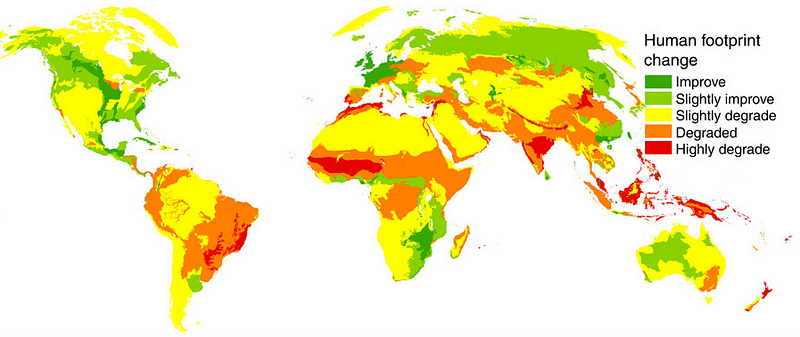
The good news: Despite the fact that both economic activity and human population increased at near-breakneck speeds between 1993 and 2009 — growing at 153 percent and 23 percent respectively — the human footprint has increased at just 9 percent, a significantly slower rate than either population or economic activity. And that, the researchers conclude, is reason for some optimism.
“We are becoming more efficient in how we use natural resources.”
“Seeing that our impacts have expanded at a rate that is slower than the rate of economic and population growth is encouraging,” Oscar Venter, an associate professor at the University of Northern British Columbia and lead author of the study, said in a statement. “It means we are becoming more efficient in how we use natural resources.”
The bad news, however, is that despite the fact that the human footprint has grown at a relatively slow rate, compared to economic and population growth, almost three-quarters of the world is still under measurable pressure from human activity.


Degraded areas are concentrated in the developing world. CREDIT: WILDLIFE CONSERVATION SOCIETY

To get a detailed sense of how human activities have left their mark on the planet, the researchers relied on satellite data to map eight factors: the extent of built environments, crop land, pasture land, human population density, night-time lights, railways, roads, and navigable waters. The researchers then compared the impact that each of these categories had on the environment, relative to the other categories, for every square kilometer of land on Earth (they excluded Antarctica). What they found was that about 75 percent of the planet is under pressure from human activity, with areas that harbor high levels of biodiversity facing the most intense pressure.

That’s consistent with a growing body of scientific literature, which argues that humans have changed the Earth to such an extent that they have actually created an entirely new geologic time period, known as the Anthropocene.

Environmental Damage Is Bad Enough To Create A New Geologic Period
For over a decade, both climate activists and scientists have used one word to describe the mass-level changes humans…thinkprogress.org
“In the context of the Anthropocene, this sort of measure of how the Earth is changing is another facet,” Jan Zalasiewicz, a professor of palaeobiology at the University of Leicester and chair of the Anthropocene Working Group, who was not involved in the study, told ThinkProgress. “All the changes that are talked about will leave some sort of track in the fabric in the Earth.”

Zalasiewicz cautioned that while the findings that humanity’s footprint is increasing at a rate slower than both economic or population growth is certainly means for optimism, the metrics with which the researchers measured the human footprint are fairly narrow in scope. The researchers did not, for example, look at the increase in atmospheric carbon dioxide created by human activity in their calculation of the human footprint — something scientists like Zalasiewicz is certainly a large part of how humans are changing the environment.
“Looking at the parts of the planet that are still wild and finding ways of keeping them as they are…should be something that we’re really thinking about.”
“Some key aspects of the Earth system are not being taken into comparison, simply because of the methodology that they are using,” he said. “Clearly that rise in CO2, when it translates to a rise in temperature, is going to amplify the human footprint effect globally.”

Relying on satellite data — even the increasingly fine data provided by improved satellite technology — misses other human-driven impacts, like water pollution from agriculture or air pollution from cars, power plants, and other pollutants. And while some of these pressures — like pollution, excessive hunting, or invasive species — might be closely associated with factors that the researchers did measure, like urban sprawl or agriculture, the researchers do note that their exclusion does generally limit the study.

The report also notes that human activity is not having an equal impact on all parts of the world, and while some wealthier places have exhibited a decrease in their human footprint, other places — especially most species-rich places on Earth— face an increase in pressure.

“They’re quite unique, and once they’re gone, they’re really gone,” study leader Venter told National Geographic. “I think looking at the parts of the planet that are still wild and finding ways of keeping them as they are, keeping them free of humans, should be something that we’re really thinking about.”

Coffee Production May Drop 50 Percent

We ran a similar story 2 years ago but thought it was time to update as the predictions of reduced coffee production has shifted up again.

As we said back then, this is the essence of our prism around the business side of green.  An entire industry, with a product people love and crave, in jeopardy of mass destruction.  Whole farms and communities at economic risk.  How do you compensate for climate changes if you don't have sufficient water or everything is getting flooded?

Clearly some of those at risk are in impoverished areas and we will be cutting off their primary source of income.  And, of course, the price of morning jo will jump for unhappy consumers.   So, what are the alternatives?  Could coffee growers, as an example, move production inside facilities and containers like many other farmers?  What technology, including weather related, might help mitigate losses?  We will tlry to do a show on the plight of the coffee sector soon.

Coffee Production May Drop 50 Percent Thanks To Climate Change

Climbing temperatures and altered rainfall are affecting coffee yields, quality, and pests.


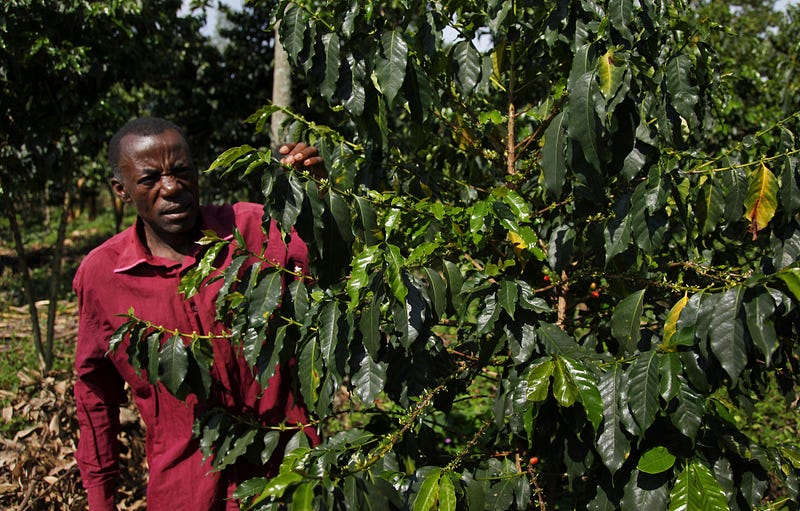
Coffee farmer Luka Kinyere inspects his plants in Kasese, western Uganda. CREDIT: AP/STEPHEN WANDERA

Coffee production worldwide could decline by as much as 50 percent in the next three decades thanks to climate change, according to a new report.

Published late last week, the Climate Institute report says a hotter climate and altered rainfall are colluding to cut the worldwide area suitable for coffee in half by 2050. That would be catastrophic for some 120 million people in more than 70 countries — mostly developing nations — that depend on the coffee trade.

It would also affect billions of consumers worldwide, who together drink about 2.25 billion cups of coffee every day, according to the report, which warns of rising prices. The ecology is also projected to suffer, as coffee production may be forced to move away from the equator, and further up mountains and forests.

Rising temperatures could make Mexican coffee unviable sooner than 2050, while Nicaragua will lose most of its coffee zone by 2050, according to the report.

Brazil, the world’s largest coffee grower, is set to experience “substantial losses,” the report notes. Already, Brazil’s coffee-growing areas are facing a growing number of heat waves, as cold extremes declined between 1960 and 2011.

Abrupt changes in weather patterns poses a significant problem for Arabica beans, which account for 75 percent of the world’s coffee production and require rainy and dry seasons to be well defined. Robusta, the other type of coffee bean, is more tolerant to warming, yet the report notes both types of crop seem incapable of weathering even the mild climate change scenarios evaluated.

In the Congo, the birthplace of Robusta coffee, the wild plant may become extinct by 2050. In fact, the report says that unless climate change is addressed, wild coffee could become extinct worldwide by 2080.

Climate Change Is Already Hurting The World’s Most Consumed Coffee Bean
For years, studies have warned that a warmer planet might mean fewer cups of morning coffee — but a new study claims…thinkprogress.org
“It’s not just the heat, which is a big factor which is driving some of the regions where coffee is produced uphill,” John Connor, Climate Institute’s chief executive officer, told ABC. “We’re also seeing extra diseases increasing and being able to go up into those areas.”
Studies have long warned that a warmer world might mean a pricier morning cup of coffee, as consumption has been on the rise but coffee stockpiles have been dwindling.

U.S. consumption will be up 1.5 percent in the coming year and reach record highs, Bloomberg reported in June. Worldwide demand in various countries like China, Japan, and India also show upwards trends.

“We have a cloud hovering over our head. It’s dramatically serious. Climate change can have a significant adverse effect in the short term,” said Mario Cerutti, the Green Coffee Corporate Relations director at Lavazza, one of Italy’s most important coffee roasting companies. “It’s no longer about the future; it’s the present.”

Other industry officials have shared similar messages over the years. “What we are really seeing as a company as we look 10, 20, 30 years down the road — if conditions continue as they are — is a potentially significant risk to our supply chain,” said Jim Hanna, director of environmental affairs at Starbucks, in 2011. “If we sit by and wait until the impacts of climate change are so severe that is impacting our supply chain, then that puts us at a greater risk.”

The report says that consumers can help ameliorate the problem by choosing brands that are carbon neutral, or help coffee farmers build their capacity to adapt to climate change. Moreover, the report notes people can demand action from companies and governments to ensure all products, business models, and economies are carbon neutral or even better, carbon negative.

“Our concern is primarily for the 25 million farmers out there whose entire livelihoods depend on this incredibly important global commodity,” Molly Harriss Olson, chief executive of Fairtrade Australia and New Zealand, which commissioned the report, according to ABC. “We’ve got to build a new economy that doesn’t threaten things in our lifestyle such as our coffee.”

Friday, October 7, 2016

Mosquito Pesticides Used for Zika Virus Resulting in Millions of Dead Bees

This is a nexus that requires tough decisions.  Here we see a threat to pregnant woman in particular.  We react by releasing more pesticides in the air.  We slow the spread of Zika but kill already declining bees, and, we are sure, sicken and weaken millions of others.

These are difficult choices.  Of course we want to protect people from infection.  Yet we risk greater threats to mankind by killing the source of many of our foods.  We poison our environment and dump more toxins into the air we breath, water supply, communities.  Have we not learned and improved knowledge as we respond to new threats?  

Unfortunately, we undo much good when we thrash the environment with known toxins.  Pollinators are getting assaulted in so many ways.  They are already weak and unable to tolerate difficult conditions.  We put much at risk, our food supply, our health.  We need balance.  We need alternatives on how we combat infections and viruses.  We need an ecological system restored to natural conditions and protections.  


Beyond Pesticides urged the U.S. Environmental Protection Agency (EPA) to immediately alert local and state mosquito control officials, elected officials, and the public throughout the U.S. to the fact that EPA's key data review on the safety of widely used mosquito control pesticides, including naled and synthetic pyrethroids, is outdated and incomplete and the scientific literature raises safety concerns. In a letter to EPA, Beyond Pesticides said, "As local and state officials implement mosquito abatement programs to address the Zika virus, it is critical that they have complete transparent safety information that they are not currently getting from the Environmental Protection Agency (EPA)."

Beyond Pesticides continues, "This information, specific to residential exposure to the insecticides naled and its main degradation product dichlorvos (DDVP), as well as synthetic pyrethroids, is necessary for officials on the ground to make fully informed decisions and for public right to know."

According to EPA documents, the agency did not meet a planned 2015 deadline for a final review decision evaluating residential exposure to naled, a neurotoxic organophosphate insecticide that is currently being used in community mosquito spraying, and its highly toxic breakdown product DDVP In addition to the toxic properties of naled, EPA has stated in review documents that it "has determined that the adverse effects caused by dichlorvos [DDVP] that are of primary concern to human health are neurological effects related to inhibition of cholinesterase activity." There is also "suggestive" evidence of DDVP's carcinogenicity, as well as concerns associated with its neurotoxicity, mutagenicity, and reproductive impacts. Similarly, EPA has recognized in their documents that synthetic pyrethroids, including permethrin and phenothrin (sumithrin), must also have their assessments updated and completed, calling into question safety statements from EPA and the Centers for Disease Control and Prevention (CDC). Several pyrethroids are associated with cancer, hormone disruption, and reproductive effects, and thus have hazard and exposure concerns regarding widespread application for mosquito control. Phenothrin, for instance, "lacks acute, chronic, and developmental neurotoxicity studies that are required to fully evaluate risks to infants and children," and for permethrin there are outstanding concerns regarding its developmental neurotoxicity.

According to EPA's final work plan, published in 2009, the agency planned to begin public comment on a registration review decision for naled in 2014, with a final decision in 2015. "Given the widespread use of naled in South Florida, Puerto Rico and other states and territories over fears of the spread of the Zika virus, it is imperative that an updated risk assessment be presented for public review and comment, especially since there are important outstanding data and concerns regarding naled/DDVPexposures to residential bystanders," Beyond Pesticides told EPA.

The use of naled in a South Carolina community last month also resulted in the death of 2 million bees. In 2012, the European Union banned naled, citing "potential and unacceptable risk" to human health and the environment.

In light of the identified hazards and unknown effects of exposure to both naled/DDVP and synthethic pyrethroids, Beyond Pesticides urges local and state officials to consider more closely the lack of efficacy associated with massive spray programs. Researchers question the efficacy of spray programs for adult mosquitoes, especially given the biology of the targeted mosquito, Aedes aegypti. This mosquito stays close to its breeding sites in residential areas and inside homes, suggesting that community spray programs are the least effective control measure.

Beyond Pesticides encourages an integrated approach to mosquito management that focuses on prevention through public education encouraging frequent removal of standing water, larviciding, and use of repellents. If prevention measures are enforced, the need to spray should be extremely limited, and balanced against the potential public health impacts of hazardous pesticides.  
- See more at: http://www.renewablenow.biz/health-fitness.html#sthash.z0IZIElU.dpuf