Saturday, October 29, 2016

Elon Musk Reveals Solar Roof Made of Glass Tiles in L.A.

Are we on the verge of a new chapter in solar technology?  Do we replace our existing stock?  Will Tesla power most of our needs going forward with glass on the roof and batteries hanging on our walls?

Tesla, it is clear, is going to make a lot of money on products other than cars.  Their investment in over all clean energy and tech is going to pay a huge ROI.  But, not just for shareholders of the co.  But for us and the planet as well:

BY:   Dana Hull
Bloomberg 



Showcases ambitions to make Tesla a clean-energy giant

Solar roof that looks better than normal roof, Musk Says

Elon Musk showcased his ambitions to make Tesla Motors Inc. a clean-energy behemoth Friday, unveiling a new “solar-roof” product at Universal Studios in Los Angeles, California.
As the sun set, Musk told hundreds of guests gathered in an outside courtyard on the “Desperate Housewives” set that Tesla and SolarCity Corp., the company that he chairs and which he aims to acquire, will make solar roofs that look better than normal roofs. He then showcased several houses with solar tiles gracefully embedded. Because the tiles are fully integrated into the roofs, many guests in attendance could not tell that they were solar.
“How do we have a solar roof that is better than a normal roof, looks better, last longer,” said Musk. “You want to pull your neighbors over and say ‘Check out this sweet roof.”’
Musk’s presentation was short on details about the proven efficiency of the solar cells, the roof’s warranty, cost or when it will be available to customers. The solar roof will be offered in four styles: Textured Glass Tile, Slate Glass Tile, Tuscan Glass Tile, and Smooth Glass Tile -- due to a variety of architectural choices. SolarCity’s website says production will begin in mid-2017 and that the tempered glass is as "tough as steel."
"The solar roof consists of uniquely designed glass tiles that complement the aesthetics of any home, embedded with the highest efficiency photovoltaic cells," said Tesla in a statement. "Customers can choose which sections of their roof will contain the hidden solar technology while still having the entire roof look the same."
Paula Mints, chief market research analyst at SPV Market Research, questions the economics of the new offering, which can be combined with a home battery.
“Tesla announced a solar tile -- not new -- with battery that is priced below cost,” said Mints in an e-mail. “Basically Tesla announced another way to lose money.”

Home Batteries

The larger idea is that homeowners will generate electricity for their home with solar power, then store that electricity in a home battery known as a Powerwall. You can “fill up” your battery during the day, then discharge it at night when the sun sets. The latest product iteration, known as Powerwall 2, weighs 269 pounds and is designed to be floor- or wall-mounted inside or outside.
Musk and Tesla Chief Technology Officer JB Straubel have long envisioned a clean-energy future of electric cars powered by an increasingly solar grid, with Tesla’s batteries optimizing both. The company also offers much larger Powerpack systems to commercial and utility customers and has deployed almost 300 megawatt hours in 18 countries to date, according to a blog post Thursday.
Battery-based energy storage has the potential to revolutionize electricity for the world’s poorest citizens in the way mobile technology disrupted the telecommunications industry. Coupled with solar panels or wind turbines, powerful lithium-ion batteries can store energy and provide electricity for the roughly 1.3 billion people worldwide who don’t have access to electricity and face what’s called “energy poverty.”
Friday’s event is part of an effort to make the case for the SolarCity acquisition to investors. More details, including financial information, will be revealed Nov. 1, when Tesla has said it plans to “create a clear picture of how a combined Tesla and SolarCity will make solar and storage as compelling as electric vehicles.”
The proposed merger has been controversial because Musk is the chairman and largest financier of SolarCity, and the boards of both companies are deeply intertwined. Shareholders are to vote on the proposed merger Nov. 17.

Friday, October 28, 2016

Whisky house distills art of eco-living

In an eco-friendly world, what is old is new.  Housing is changing in some many ways.  Not always this creatively, but dramatically with lots of benefits to the planet.  The passion behind these stories is exciting to us.  Proves again individuals make a significant difference in the our fight to live clean.
Whisky house distills art of eco-living

By Matthew Knight


The "Living Machine" -- a biological waste water treatment plant -- helps keep the environmental impact to a minimum.

Wind turbines also provide 20% of the community's energy needs.

"When we bought the caravan park the object was to create a place which would live its life in harmony with the planet as a whole," says Roger Douda, creator of the first whisky house at Findhorn.

Whisky lovers will feel right at home in Findhorn's barrel houses.

Made from giant whisky vats this home -- one of five at the famous Scottish ecovillage -- was the first permanent dwelling to be erected back in 1986. 

"When we bought the caravan park the object was to create a place which would live its life in harmony with the planet as a whole," says Roger Douda, creator of the first whisky house at Findhorn.

Whisky lovers will feel right at home in Findhorn's barrel houses.
Made from giant whisky vats this home -- one of five at the famous Scottish ecovillage -- was the first permanent dwelling to be erected back in 1986. 

Once the site of a caravan park, the ecovillage is now the home for 500 permanent residents with houses of all shapes and sizes but with one common theme -- sustainabilty.
Hide Caption

The Findhorn Foundation has been educating people in the art of living in harmony with nature for more than five decades. 

Story highlights
  • Vats of Scotch Whisky have been transformed into homes
  • Findhorn, in Scotland, is a sustainable eco-village
  • The community now has 500 residents
(CNN)Much like the liquor that once swilled around inside their wooden casks, the barrel houses at Findhorn ecovillage have matured nicely in their surroundings. 

Constructed out of giant whisky vats, the homes were the first permanent dwellings to be built at the famous spiritual community which today supports more than 500 residents.

The idea to repurpose the barrels came from Roger Douda, an American resident whose connections with Findhorn stretch back four decades.

"I thought it was a fairly innovative exercise in recycling," explains Douda, who built the first prototype in 1986.
 
"I went to collect some firewood from a cooperage 10 miles south of Findhorn and they took me aside to this warehouse where they had disassembled six large vats from the Haig and Haig distillery in Fife.

"The question was: what to do with them? The destination was a veneer factory, as I recall. I said thank you but no thank you and then as I was driving away various possibilities entered my mind about how we might use it."

The initial plan was to use the barrels to extend the community center, Douda explains, or house a new school based on the educational ethos of Austrian philosopher Rudolf Steiner.

"Steiner definitely was in favor of organic shapes for kid's education," Douda explains, "but parents had problems with the idea of their kids being educated in whisky vats."

Four more barrel houses followed and today, the 30-acre site has dozens of permanent dwellings on the site of a former caravan park where Findhorn founders Peter and Eileen Caddy and Dorothy Maclean moved in 1962.

Once derided for its hippyish tendencies, Findhorn has come of age in recent years as interest in environmentalism has entered the mainstream. 

To that end it now attracts thousands of visitors every year, with people coming from around the world to educate themselves in the art of eco-living. 

Sustainability flows through every aspect of life, from the "Living Machine" -- a biological waste water treatment system -- to biomass boilers and wind turbines that supply around 20% of the community's energy needs.

Douda, now 73, admits that his way of life has left him less financially stable than he would like, but enriched spiritually and more connected than ever.

"We are part of what's called the Global Ecovillage Network which comprises of several thousand comparable initiatives around the world," he says. 

"When we bought the caravan park the object was to create a place which would live its life in harmony with the planet as a whole. 

"In that respect, I think we have done marvelous things, particularly with the Living Machine and the wind park. We are ahead of the game ecologically speaking."

A conservative Republican tackles climate change

We may have to write Mr. Inglis's name in for president.  We applaud any ones  push to elevate the conversation around pricing carbon.  But, this is more impressive, perhaps more influential, given his conservative bent.

The exchange of carbon credits/levy's, we think, is a key component going forward financing efficiency and clean investments.  It provides great incentives within the business world.  It elevates the discussion around quickly reducing emissions without reducing GNP.

A conservative Republican tackles climate change

Rising sea levels, which scientists attribute to climate change, threaten homes along North Carolina’s Outer Banks, such as these in Nags Head 

His work on climate change won Inglis the John F. Kennedy Profile in Courage Award last year. He appeared in the 2014 documentary “Merchants of Doubt” and was a visiting fellow at Duke University’s Nicholas School of the Environment in 2012.

On Monday, he will be keynote speaker at the Carolinas Climate Resilience Conference, which meets in Charlotte through Wednesday. The conference aims to “foster real-world solutions to climate adaptation.”
From a recent interview:

Q: What’s the Energy and Enterprise Initiative about?
A: We’re essentially calling on conservatives to step forward with free-enterprise solutions to climate. Rather than regulating down the amount of carbon dioxide in the atmosphere, we simply have the government put a price on emissions. That price signal would be sensed throughout the economy, with the result that hundreds of millions of consumers would pursue their own self interest. They would be seeking cleaner fuels because it would be in their economic interest to do so.
It’s something that conservative economists have talked about for quite a while, the idea of not regulating but attaching all the costs and revealing all the hidden costs of a product so the market can judge that product.

Q: What kind of traction are you getting with that argument?
A: We’ve surely got a ways to go, but what appears to some to be impossible will eventually become inevitable. There’s quite a bit of scientific consensus about climate change. There’s even more economic consensus about how to deal with the problem. It’s hard to find an economist who doesn’t think it’s a good idea to attach the hidden costs of emissions to all fuels. That’s why we feel this will become inevitable.

Q: What’s your sense of the temperature of the public and Congress on climate change?
A: Congress of course does exactly what we ask them to do. A lot of us like to complain that Congress doesn’t listen to us, but they listen very carefully. What they’ve heard us saying is that we’re most concerned about the economy and terrorism at the moment, and so that’s what they talk to us about. What we have to do is elevate the importance of action on climate and show that there’s a free-enterprise solution.

We happen to believe that part of the reason people put it low on their list is they don’t think it’s solvable. What we look to do is show that, no, something really can be done about this. It’s an incredible opportunity to light up the world with more energy, more mobility, more freedom because the free enterprise can deliver the fuels of the future if we simply fix the economics.

Q: How effective have billionaire environmentalist Tom Steyer and Charlottean Jay Faison, the conservative clean-energy advocate, been in persuading climate change doubters?
A: Both are having an impact. I’m particularly excited about what Jay Faison is doing because I think he’s starting a conversation that will be a very important change. It’s sort of been stuck for awhile, and then along comes Jay Faison to get this unstuck with a conversation about clean energy.

Q: Donald Trump says climate change is a hoax. Is he raising the number of doubters?
A: I think he’s just affirming people’s doubts; I don’t know that he’s increasing the number of doubters. It’s important for leaders to do more than just reflect back to us our fears, and is surely incumbent upon them not to increase our fears, to amplify them, rather than to show us solutions. And that has sadly been lacking so far.

Q: How do local responses compare to state and federal action?
 A: The best way to avoid the problem is through federal action because we need to get the whole world in on the solution, which is a truer and accountable costing of energy. But adjusting to climate change is best handled at the local level, and of course having an impact on the federal level efforts to head it off. When people start realizing just how much this is going to cost, to try to keep the seawater out of places like Charleston, S.C., they’ll engage more on what could avert the problem as well as how do we adjust to the problem.

Read more here: http://www.charlotteobserver.com/news/local/article100920617.html#storylink=cpy

Wednesday, October 26, 2016

Los Angeles City Council backs planning for 100 percent renewable energy

This is not surprising at all.  Last year we covered a conference at UCLA and interviewed LA's sustainability director.  You will soon see much of that material on our expanded network site, Renewable Now.biz

The city has a great story to tell on their quest to remake LA around sustainable changes.  Waste, energy, traffic, academia, use of natural resources, companies hitting triple-bottom line results, and government leadership.  We think, too, this is a great story in terms of what is going on the US nationally around the presidential election.

Trump is clear on pushing the US energy policy back to fossil fuel.  He would rescind the country's commitment to the Paris agreement.  He would turn back new EPA standards on fuel economy.   For those of us pushing transformation and the growth around a green economy, scary stuff.

Yet, Mr. Trump will "Trumped" in many ways by the work of individual states.  Much power, control, leadership is ceding away from DC, thank God, to communities and municipalities  Like LA, most have stated goals to be 100% renewable within two decades.

So, we applaud LA's City Council and their backing of this aggressive plan..  


Los Angeles City Council backs planning for 100 percent renewable energy


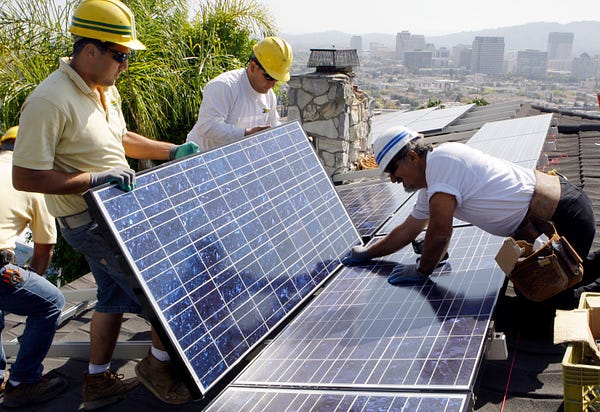
Solar electrical panels are installed on the roof of a home in Glendale, CA. CREDIT: AP PHOTO/REED SAXON

The Los Angeles City Council took a major step Friday toward making the city run on clean energy alone.

The Council directed the Los Angeles Department of Water and Power (LADWP) to develop a plan for going 100 percent renewable, including looking at where, when, and how the city should allocate resources to achieve that goal.

In the motion, Councilmembers Paul Krekorian and Mike Bonin wrote that “the city has an opportunity to re-create its utility in a way that recognizes the potential for a fossil-free future, demonstrates global leadership in its commitment to clean energy, and protects ratepayers from the increasing costs of carbon-based fuels.” It passed unanimously, 12–0, on Friday. (Three council members were not in attendance.)

Before the vote, Krekorian told the council it was an important step for the city in its efforts to help combat climate change. An effort, he added, that can be successful — comparing it to Los Angeles’ efforts to reduce smog when he was a kid in the 1970s.

“During the summer, we would have to curtail outdoor activities because of secondhand smog alerts. It is really noteworthy that we have made a lot of progress by then,” Krekorian said.
He also praised Los Angeles’ previous efforts to combat climate change, including switching to LED lighting, cleaning up the Port of Los Angeles, expanding electric vehicle use, investing in efficiency, and committing to eliminating the use of coal for electricity by 2025.

“Those were all great steps, but the biggest, boldest, most important thing this city can do to improve local air quality and reduce our carbon footprint… is to entirely eliminate fossil fuels as a source of electricity generation in this city,” he said.

Although some speakers during the public comment period of the meeting said the council needed to set a firm date on accomplishing the goal, Krekorian argued moving forward with a plan was more effective than setting arbitrary timelines.

“What this motion does is set this city on a path not just towards setting that goal but toward achieving that goal,” he said.

LADWP will now officially undertake a research partnership with the Department of Energy, local utilities and regulators, and area universities — although work has already begun on the project, city officials said.

For Next Week's Show/


See much more at our Twitter account:  ttps://twitter.com/ReNewableNowTV


For Today's Show/Solar Reserve

Tune in today at Renewable Now.biz (or here at our daily blog) as we interview their CEO, Kevin Smith.  Solar reserve is a world leader in developing, financing, building and owning large scale--think mega-size--solar energy projects.  Great company now powering thousands of homes and companies:

Kevin Smith

SolarReserve logo

ABOUT SOLARRESERVE

SolarReserve is a leading global developer of utility-scale solar power projects, which include electricity generation by solar thermal energy and photovoltaic panels. In addition, SolarReserve has commercialized a proprietary advanced solar thermal technology with integrated energy storage that solves the intermittency issues experienced with other renewable energy sources. This proven US-developed technology generates renewable baseload and dispatchable power and can compete with traditional fossil-fired and nuclear electricity generation. The company currently has more than $1.8 billion of projects in operation worldwide, with development and long-term power contracts for 482 megawatts (MW) of solar projects representing $2.8 billion of project capital
The global demand for renewable energy generation is expected to grow by 45% by 2020 which would require over $1.1 trillion of additional investment 1, after global investments topped $270 billion in 2014. As renewable energy penetration grows, the need for utility-scale renewable generation with storage technology is increasingly important to mitigate intermittency problems, deliver power into peak demand periods, and support transmission system reliability.
Since the company's formation in early 2008, SolarReserve's experienced team of power project professionals has assembled an extensive global development pipeline of 10 gigawatts (GW) across the world's most attractive, high growth renewable energy markets. The robust portfolio is strategically positioned to secure power offtake contracts, and includes advanced solar thermal technology (Concentrating Solar Power or “CSP”), photovoltaic (PV) technology, and hybrid (combined CSP and PV). SolarReserve’s hybrid CSP/PV solutions eliminate the intermittency issues associated with PV-only projects while providing cost efficient and reliable electricity generation.
SolarReserve is headquartered in Santa Monica, California, and maintains a global presence with seven international offices strategically located in Africa, the Americas, the Asia-Pacific region, the Middle East, and Europe to support its widespread project development activities across more than 20 countries. The experienced management team has a proven track record of success in the energy infrastructure sector with over 27 GW and $48 billion of transaction experience in 25 countries. The company deploys the full spectrum of development, engineering, finance, project management, operation and maintenance, and product development expertise.

Tuesday, October 25, 2016

From our friends at Food Tank

When it comes to deciding what is for dinner, eaters’ decisions can be determined by more than taste alone. Food choices affect the environment, the economy, health, social justice, politics, and more. Luckily, there are a number of magazines that can help all of us make better food decisions.
According to Bon Appétit Editor-in-Chief Adam Rapoport, “We as a nation of eaters have evolved. We’ve transitioned away from a world of food TV and celebrity chefs—where you had to be a card-carrying foodie to talk about food with any authority—to one where everyone has a stake in the game. Food has gone wide—it has become, of all things, cool.”
Modern Farmer Editor-in-Chief Sarah Gray Miller says, “if you are a passionate foodie, there is more for you, and if you want to farm, there is enough there, too,” regarding the magazine’s recent rerelease. The magazine promises to highlight “products picked from farmers, not fashion editors.”
We've given you a partial list.  For the balance use this link (and to support them, too, we hope):  http://foodtank.com/

Food Tank has selected 19 magazines that will help inspire eaters, farmers, cooks, and food activists.
  • Acres U.S.A.: Acres U.S.A. is a national magazine focused on sustainable agriculture. With more than 40 years of continuous publication, it draws on its bountiful knowledge to inform readers of growing tips that are both ecologically and economically sound. The magazine draws from the work of both scientists and farmers and features articles on cover cropping, government regulations, rotational grazing, and more.
  • African Journal of Food, Agriculture, Nutrition and Development: The African Journal of Food, Agriculture, Nutrition and Development is a quarterly peer-reviewed journal based in Kenya. The journal was originally started in 2001 by Ruth Oniang’o, an expert in nutrition policy and renewed advocate for women’s health. The journal is one of the first continuously published agriculture-related publications in Africa and offers information on region-specific issues, such as providing water-efficient maize to smallholder farms in Western Kenya and combating aflatoxins in Eastern Africa.
  • Barilla Center for Food & Nutrition Magazine: The Barilla Center for Food and Nutrition Foundation’s magazine debuted in 2013 with its "Food for Health" issue, exploring the social, environmental, health, and economic impacts of lifestyle and diet choices. The foundation is a multidisciplinary, independent think tank that analyzes the various causes and effects of food to help people make conscious decisions about diet, health, and sustainability. The magazine’s article topics range from the social and economic effects of childhood obesity to the impact of hunger on cognitive development.
  • Choices: Published by the Agricultural and Applied Economics Association, Choices is a quarterly online, peer-reviewed magazine exploring economic implications of food, agriculture policy, and resource use issues. Recent themes feature stories on the impacts of water scarcity and the need for economy-wide considerations, cost-effective conservation programs, and the economic prospects of genetically engineered crops.
  • ChopChop: Readers of ChopChop will find nutritious, kid-friendly recipes, fun food facts, games, and interviews inside. It is published in both Spanish and English and was the winner of the 2013 James Beard Foundation Award for Publication of the Year. ChopChop is filled with nutritious, ethnically diverse, and inexpensive recipes like strawberry orange ice pops and roasted eggplant and tomato ratatouille.
  • EatingWell: Originally launched in 1990, EatingWell provides the resources to “make eating healthy a way of life” through recipes, nutrition advice, and cooking techniques. EatingWell appeals to a wide audience by providing healthful receipts that fit a wide variety of busy lifestyles, with articles like “50 Cheap Healthy Lunch Ideas for Work.”