Tuesday, October 10, 2017

Transforming the Real Estate Market: Scaling Net-Zero Energy Homes at No Additional Up-front Cost

This new program,very much like the C-Pace (commercial) funding we've been reporting on, is truly a game change around conversion of residential properties to net zero.  The financing is very favorable.   Cash returns are great.  Combined with the hot real estate market, and constant upgrades to those homes, these retrofits will help convert whole neighborhoods to efficient, smart communities.

We hope you look closely at R-PACE, regardless of your location (domestic), and make these much needed, financially rewarding upgrades.

Transforming the Real Estate Market: Scaling Net-Zero Energy Homes at No Additional Up-front Cost

The U.S. residential real estate market is booming, with new home sales steadily rising over the last few years. In March 2017, over 621,000 new single-family homes were sold at a median sales price of $345,800. Imagine if most of these new home developments were net-zero energy (NZE), which not only delivers the homeowner annual energy savings but also enhances the overall performance, comfort, and resilience of these homes. Now suppose residents could afford these high-performance NZE homes at no additional up-front cost using an innovative financing tool that would annually save them more money than they pay toward the financing.

Rocky Mountain Institute’s (RMI’s) latest insight brief, R-PACE: A Game-Changer for NZE Homes, shows how this dream scenario can be made a reality through a special application of residential property assessed clean energy (R-PACE) financing—a game-changing financing mechanism that has already financed over 158,000 energy and water efficiency retrofits in homes in California, Florida, and Missouri since 2008.
What Are NZE Homes?
NZE homes are smart single-family homes that produce or procure enough zero-carbon renewable energy to offset their annual fossil-fuel energy consumption. These homes present the U.S. real estate sector with an incremental $33 billion market opportunity by 2037, which will not only bring additional investment to the sector and create local jobs but also transform the market trajectory overall.
As policymakers decide on their strategy to build smarter cities and revitalize their aging infrastructure, they must consider the unprecedented opportunity to invest in high-performing NZE new homes, which are more comfortable, affordable, and resilient to power outages and weather extremes. Scaling NZE homes through concerted policy efforts will not only help states and local governments meet their carbon goals but also improve the housing stock and real estate values. Overall, NZE homes are the next big frontier for innovation and competition in the residential real estate market, and they promise a future that is propitious not only for homeowners and real estate developers but also for the U.S. economy and the planet.

What Are the Market Barriers to Scaling NZE Homes?
While the market potential and business case for investing in an NZE home is compelling for both the builder and the homeowner, the up-front incremental cost of developing a new NZE home has been the biggest deterrent for builders and developers looking to invest in NZE development to make it mainstream. According to Rocky Mountain Institute’s research, the average incremental up-front cost of constructing an NZE home is likely to be $24,811 more than an average code-compliant new home (excluding the federal investment tax credit and other state-specific incentives). This estimate was derived by analyzing average code-compliant single-family homes across California, Missouri, Florida, New York, Colorado, and Georgia, which collectively comprise almost one-third of the existing single-family housing market. Builders, who control almost three-fourths of this market, have been unwilling to invest their equity up front during the home construction process since they do not directly benefit from the operational cost savings and have no incentive to maximize them. The misaligned builder incentives and weak market signals coupled with the valuation uncertainty of how NZE home energy performance is presently valued by the market players are some of the main reasons for the latent consumer demand for NZE homes.
We believe that enabling R-PACE for new construction is an effective way to overcome these market barriers and scale NZE new construction around the country.
What Is Residential PACE and How Can It Help Scale NZE New Construction?
Residential PACE, also known as R-PACE, is an innovative financing mechanism used specifically to finance energy efficiency, renewable energy, resilience, and water-saving home improvements. This assessment is typically attached to a property’s tax bill, secured by the same type of lien against the property as tax bills, and repaid through property taxes. It is unique because unlike traditional mortgages, it is transferable upon sale of the property and is tied to the property rather than the property owner. This feature allows seamless transfer and resolves the builder-homeowner cost-benefit split incentive challenge by lowering the need for builders to invest their capital equity into the project. RMI’s research confirms that an R-PACE financed NZE home is also a great investment for homebuyers as it allows them to own a home at the same up-front cost while earning more annual cost savings than the amount they pay for the annual PACE assessments, yielding average net monetary benefits of $160 year-on-year. Thus, R-PACE can enable U.S. homes to be more resilient, affordable, innovative, efficient, and high performing while costing less than an average home.

R-PACE can help scale NZE homes at no upfront incremental cost.

How Can We Enable Residential PACE for New Construction?
R-PACE has been extremely effective in tackling a significant market failure by increasing American households’ access to financial resources so that they can realize the benefits of a cost-saving, high-performance smart home. However, its use is ineligible for new construction and has been limited to home improvement retrofits in the existing state-enabled programs of California, Florida, and Missouri. We believe that with a few minor alterations to R-PACE’s existing policy and implementation framework, it could serve as a transformative tool to scale NZE home development. Our insight brief proposes specific “R-PACE for new construction” recommendations for states and local governments considering policy instruments to bolster new NZE residential development. These include:
  • Amending legal state provisions and the underwriting process to allow R-PACE to be used for new construction
  • Defining limits to the total eligible amount based on construction costs rather than home valuation to catalyze investment in the sector
  • Requiring lender consent for employing R-PACE during construction to promote transparency and credibility and build trust with the mortgage lenders in the process
  • Defining an eligible list of energy and water conservation measures that could count as qualifying expenses under R-PACE for new construction while ensuring that any expenses that do not qualify under the list are not financed through the assessment
  • Mandating performance criteria to ensure that the net savings in energy costs are greater than the cost of the energy conservation measures, and that the project meets or exceeds state energy performance code requirements
  • Certifying post-implementation energy performance to document all the measures installed within the new home to help increase the home’s valuation at the time of sale
RMI is working toward a future where every homeowner in the U.S. has the opportunity to buy an NZE high-performance home for the same up-front cost as an average home while accruing net cost savings on the investment annually. This dream can be a reality if we use R-PACE to finance the incremental up-front costs to scale NZE homes in our states, cities, and communities.

RMI appeals to states and local governments to work together to enable R-PACE for new construction in their jurisdictions to scale new NZE developments and make a concerted effort to facilitate enabling policy design and stakeholder engagement to support the mechanism. This effort would not only promote innovation and development in the real estate sector, but would also help leverage the abundant solar potential in states, encourage more local job creation, and increase employment overall. This is a win-win market-based solution with a business case for states, local governments, developers, and homebuyers across the country. We believe that R-PACE, when thoughtfully deployed for NZE home construction with robust state-level consumer protection measures, will scale NZE home development and set an example for other states to emulate. If you share this dream, we look forward to working with you. You can reach us at financethefuture@rmi.org to learn more about our work on R-PACE for new construction.

Friday, October 6, 2017

St. Lucia Breaks Ground on First Utility-Scale Solar Energy Field

More good news on the solar front, and what better place to capture the power of the sun?


The Caribbean region has become a focal point for renewable and distributed energy advocates and companies in the wake of Hurricanes Irma and Maria. St. Lucia was spared Irma and Maria’s worst this past month, but that doesn’t mean the hurricanes did not take their toll, or galvanize the island nation leadership’s intention to enhance energy security and resiliency. 

The island nation’s power utility, St. Lucia Electricity Services Ltd. (LUCELEC), and solar energy systems developer GRUPOTEC on Sept. 29 broke ground on a 3-megawatt (MW) solar farm – St. Lucia’s first utility-scale renewable energy project. Located outside of St. Lucia’s Hewanorra International airport outside the main southern city of Vieux Fort, GRUPOTEC will install 14,900 solar photovoltaic (PV) panels and associated system components in order to generate emissions-free electricity sufficient to power nearly 3,500 homes while offsetting 3,800 metric tons of carbon dioxide emissions annually.

In addition to anticipated reductions in the cost of electricity, the utility-scale solar field sets St. Lucia on a path towards energy independence. The Hewanorra solar PV power field is also expected to reduce the Eastern Caribbean island nation’s vulnerability to tropical storms and hurricanes and enhance energy resiliency – the ability to withstand and/or recover from the impacts of hurricanes or other natural or man-made disasters. 

Tropical storms, hurricanes, centralized grids and fossil fuel dependence
Nestled between St. Vincent and the Grenadines to the south and Martinique to the north, St. Lucia’s reported 2010 census resident population of nearly 166,000 live on a tropical island volcanic in origin that spans an area of 617 square kilometers (238.23 square miles). St. Lucia is one of the Caribbean island that comprise what’s known as the Lesser Antilles islands, more specifically the southern extenson of the Lesser Antilles known as the Windward Islands. That  positions it at the southern end of the so-called Caribbean “Hurricane Belt,” the broad-based area across which tropical storms and hurricanes often travel as they make their way west and north from southeast Atlantic Ocean waters off the coast of West Africa. 
St. Lucia relies almost entirely on diesel fuel for power generation (>99%), as do nearly all island nations and territories throughout the Caribbean. That leaves them subject to high and volatile energy prices, as well as the chronic challenges of paying for diesel fuel imports and trying to mitigate the human and environmental impacts of diesel and fossil fuel use. In addition, Hurricanes Irma and Maria once again exposed the weaknesses and fault lines associated with the conventional model of centralized power generation coupled with long-distance transmission and local distribution grid infrastructure. 

Government, business, civic and environmental leaders in St. Lucia and across the Caribbean have been mulling over projects and plans that would move them away from fossil fuel dependence and centralized power grids and towards energy and power infrastructure centered on locally abundant distributed renewable energy resources for years now. Progress has been made, but a variety of factors, from logistics and technical capacity to opposition from entrenched, typically state’-owned or sponsored utilities, have proven to be difficult to overcome. 
St. Lucia's first utility-scale solar PV facility
The Rocky Mountain Institute, Carbon War Room and the Clinton Climate Initiative have been instrumental in seeing St. Lucia’s first utility-scale solar power project through to groundbreaking. Joining with Netherlands-based distributed energy technology and project development specialist DNV GL, they provided technical assistance throughout the long project development process. 


That included assisting LUCELEC develop and carry out a bidding process that attracted experienced utility-scale solar project developers with genuinely strong interests in the project, evaluating proposals and facilitating contract negotiations. RMI, Carbon War Room and the Clinton Clmiate Initiative also helped LUCELEC manage an open, international procurement process to help ensure the utility-scale solar PV project meets, if not exceeds, international standards and best practices at the lowest possible cost, RMI highlights in a news release.
“LUCELEC’s efforts to add utility-scale renewable energy to its generation mix began as far back as 2002. It’s been a long, and sometimes challenging road since then. It is, therefore, extremely gratifying to finally break ground on this 3 MW solar farm today,” LUCELEC’s Managing Director Trevor Louisy said.
LUCELEC and the Government of Saint Lucia jointly developed the Eastern Caribbean island nation’s National Energy Transition Strategy (NETS) in 2016. The national strategic plan provides a 20-year energy “roadmap” informed by technical analysis from RMI, Carbon War Room and the Clinton Climate Initiative that sets out the pathway for creating an electricity sector that’s sustainable, reliable, cost-effective and equitable, according to the project partners. 
Maximizing use of locally abundant renewable energy resources in a distributed network without one single point of failure was one of the key facets of St. Lucia’s National Energy Transition Strategy. Building out of utility-scale solar power generation and distribution to achieve the least-cost mix of power generation resources, in turn, is a key means of doing so. The 3 MW Heneworra solar farm marks St. Lucia’s first step along this path. 

LUCELEC and GRUPOTEC signed the contract to build the utility-scale solar power field in June 2017. Construction is expected to be completed by spring of 2018.“Caribbean nations like Saint Lucia overwhelmingly rely on imported fossil fuels for electricity generation,” said Jesse Gerstin, Director of Programs and Policy at CCI.
“The solar farm is the first step in building a more resilient power system that generates electricity from a local, renewable source and reduces Saint Lucia’s dependence on imported diesel. This could also help the country recover more quickly in the case of an extreme weather event, such as the recent hurricanes that have devastated neighboring islands.”
RMI and Carbon War Room was able to offer Saint Lucia project guidance thanks to the support of the UN Global Environment Facility in partnership with the United Nations Development Program. Financial support from the government of Norway facilitated the Clinton Climate Initiative’s participation. 


What Goes Into Making an Earth-Friendly $68 Pair of Jeans

Many industries are quickly ramping up to a green future.  We profiled 3 of them this week on the radio side.  All of them are big and important.

The question we ask to you is will you support these innovators and buy their products?   Even if it means spending more with them?  Our job is to educate and inform...your job is make good buying decisions.

Everlane aims to upend the environmental impact of denim manufacturing.


Denim production is a “dirty business,” says Michael Preysman, chief executive officer of fashion e-tailer Everlane Inc. He’s not wrong. Chances are, those jeans you’re wearing produced 44 pounds of carbon dioxide and took up to 10,000 liters (2,700 gallons) of water to make, much of it ending up in waterways, along with toxic dyes and chemicals deployed in making denim. The desire to do better is why, last month, Everlane embarked on its biggest endeavor to date: an eco-conscious jean. It’s the next step in the brand’s journey of radical transparency.
Everlane’s $68 price tag sits well in the quality green jean market. L.A. brand Reformation’s range of sustainable jeans costs from $118 to $168, Patagonia Inc.’s jeans retail from $99 to $119, Seattle-based Source Denim LLC’s Ethical Raw Jeans for men cost $139, while Swedish brand ReDew, whose jeans will soon be available online, has just debuted jeans in a limited number of U.S. cities, ranging in price from $150 to $195.
As with its bag factories in China, Everlane works hard to find the right factories at the right price, allowing for the disclosures that are going down so well with customers. For those $68 jeans, the “true cost,” according to the brand, is $28, including $7.50 for labor and $12.78 for materials. Everlane’s markup runs from double to triple, compared to an industry standard that ranges from five to six times costs.
T
he LEED-certified Saitex denim factory in Bien Hoa, Vietnam.
Source: Everlane
If Preysman were to start it all again, denim would be Everlane’s second product, after t-shirts, but he says it took him two years to find a manufacturing facility with the right eco credentials. Typically, he says, “factories take advantage of inadequate regulations and dump contaminated water directly into the environment,” with denim manufacturers being particularly egregious offenders. A damning Greenpeace report in 2010 detailed how Xintang, known as the “Jeans Capital of the World,” was polluting surrounding waterways in China’s Guandong Province. “The smell is putrid and unbearable, and any skin contact results in itching and even festering,” said the report (PDF), with accompanying satellite images of dark, disturbing indigo runoff in the Pearl River. “Though villagers once fished and drank water from the river, now they dare do neither of these things and must pay for tap water.”

Thursday, October 5, 2017

Solar Grew Faster Than All Other Forms of Power for the First Time/Bloomberg

Another great milestone in this shift to renewables.  Lot of momentum cresting as we head for many 2025-2050 goals, for companies, communities, states, to get to 100% clean energy.


  • Renewables enjoyed record installations in 2016, IEA says
  • Forecaster sees solar dominating the renewables industry
Solar power grew faster than any other source of fuel for the first time in 2016, the International Energy Agency said in a report suggesting the technology will dominate renewables in the years ahead.
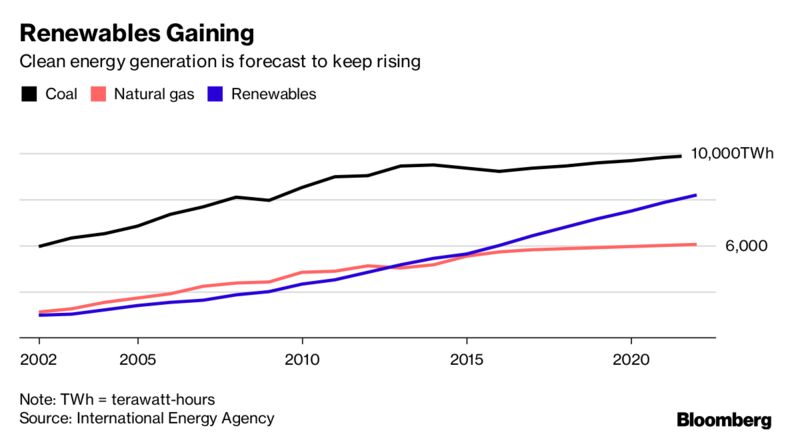
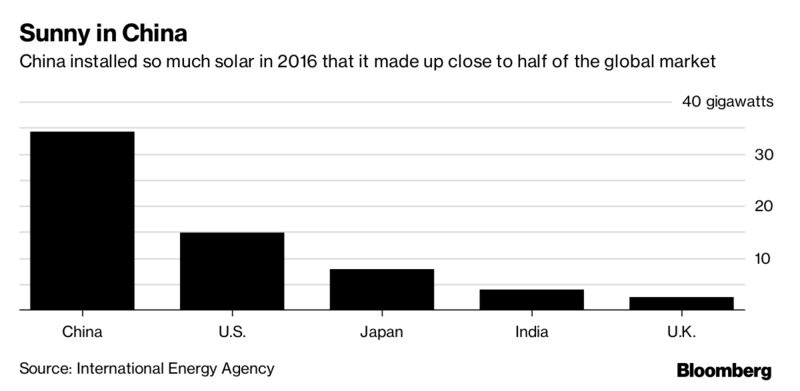
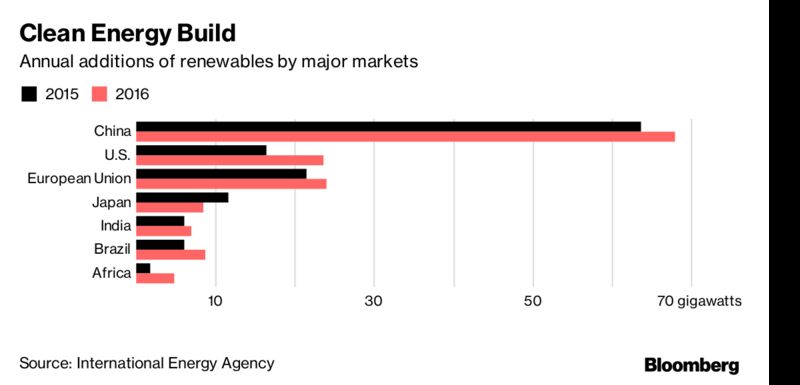
The institution established after the first major oil crisis in 1973 said 165 gigawatts of renewables were completed last year, which was two-thirds of the net expansion in electricity supply. Solar powered by photovoltaics, or PVs, grew by 50 percent, with almost half of new plants built in China.
“What we are witnessing is the birth of a new era in solar PV,” Fatih Birol, executive director of the IEA, said in a statement accompanying the report published on Wednesday in Paris. “We expect that solar PV capacity growth will be higher than any other renewable technology through 2022.”
This marks the sixth consecutive year that clean energy has set records for installations. Mass manufacturing and a switch by governments away from fixed payments for renewables forced down the cost of wind and solar technology.
The IEA expects about 1,000 gigawatts of renewables will be installed in the next five years, a milestone that coal only accomplished after 80 years. That quantity of electricity surpasses what’s consumed in China, India and Germany combined.
The surge of photovoltaics in China is largely due to government support for renewables, which are being demanded by a population concerned about air pollution and environmental degradation that has led to deadly smogs. The country is seeking to reduce its reliance on coal and has become the world’s largest market for renewables, particularly solar.
“The solar PV story is a Chinese story,” said Paolo Frankl, head of the IEA’s renewable energy division. “China has been for a long time the leader in manufacturing. What’s new is the share in the market. This year, it was equivalent to the total installed capacity of PV in Germany.”
The U.S. and India are among other nations pushing renewables. They along with China are projected to make up two-thirds of the clean-energy expansion worldwide. Despite President Donald Trump’s vow to bolster coal’s position in the power market, the U.S. is expected to be the second-largest market for renewables.
The IEA also expects biofuels to take a larger role in the transportation industry, surpassing gains by electric vehicles.
“A lot of attention has been given in recent months to electric vehicles, and rightly so. They are increasingly globally, exponentially,” Frankl said. “But I have to say, we should not forget the biofuels, which at the end of 2016 represented 96 percent of total renewable transport.”
Electric vehicles numbers will double by 2022, but biofuels will still make up 93 percent of renewables consumed in the transport industry, the IEA estimates. The fuels are needed especially for heavier vehicles including planes and ships.
The organization recommends that governments put incentives in place to spur the development of biofuels made from non-edible plants, which would avoid diverting food crops into fuel tanks. The cost of biofuels currently is about double the global price of gasoline, Frankl said.

Wednesday, October 4, 2017

For Today's Show: Amy Braun Senior Sustainability Manager, Kellogg

 Join us live today at 1p, ET as we look behind the scenes at the CSR mission of Kellogg's.


As the Senior Sustainability Manager at the Kellogg Company, Amy leads responsible sourcing including Kellogg’s commitments to sustainable agriculture, women and smallholders.  Responsibilities include embedding sustainability within procurement by working with Kellogg’s supply chain for ingredients, packaging and services. She represents Kellogg in many industry groups including Field to Market, BICEP, and World Business Council for Sustainable Development, as well as working with external stakeholders and partners.  Amy has experience working in both private and public organizations and has a B.S. in the Program in the Environment and an M.S. in Environmental Policy and Planning from the University of Michigan

Amy Braun and Samantha Krause: The Kellogg Company’s Smallholder Sourcing


By Amy Braun, Sustainability Director, Kellogg Company and Samantha Krause, Strategic Initiatives Director, TechnoServe

Kellogg has set bold sustainability and emerging markets growth targets, including supporting the livelihoods of 500,000 farmers and doubling its emerging market sales by 2020. The company recognizes the great potential that developing smallholder-inclusive agricultural supply chains in emerging markets could have in supporting these business and social impact objectives.

Sustainability groups across many multinational companies see similar opportunity in smallholder inclusive supply chains, but often struggle to get traction within the broader company and to win support from external stakeholders--even when the company’s investments will create value beyond their immediate supply chains. So, how can corporate sustainability teams secure both the internal and external support required to successfully pilot and scale smallholder inclusive supply chains?

Using Egypt, where Kellogg had recently acquired two local food processors, as a platform, Kellogg and TechnoServe designed a partnership-driven approach to strengthening the company’s local smallholder supply chains. Through this project, we developed lessons learned around how sustainability teams and other divisions within a multinational company can broaden internal and external support (including co-investment) for developing and scaling inclusive agricultural supply chains:

1. Identify key internal stakeholders early and engage them regularly throughout in the process
Kellogg’s Sustainability team worked with a number of other key business functions in designing the model. It established a multi-stakeholder steering committee to oversee project that included members from Sustainability team as well as Leadership and Procurement representatives from its Middle East Business Unit and local subsidiary, Mass Food Group. These stakeholders were consulted when establishing the project’s social and commercial objectives, commodity areas of focus, intervention design, business case, and determining what to take forward into implementation.

Externally, Kellogg also engaged actors deemed important to the project’s success.  Kellogg and TechnoServe invested time and resources into understanding the priorities of key external stakeholders--particularly potential co-funders--first.  Equipped with this understanding , Kellogg’s approach to strengthening its local smallholder supply chains was designed to align with these priorities whenever possible.

For example, Kellogg selected the project’s focus commodities (rice and date) and key interventions to align with the Egyptian Ministry of Agriculture and Land Reclamation’s Sustainable Agriculture Development Strategy.  Kellogg and TechnoServe also incorporated a horticulture component into its smallholder rice supply chain model so as to address the priorities of a high potential local co-funder, while also increasing the impact of its own investment on the incomes and resilience of smallholder farmers.

II. Define and quantify the business case
In order to secure broad internal support, it is vital to clearly demonstrate the benefit of a smallholder inclusive supply chain to the company. Kellogg’s Sustainability team therefore worked with TechnoServe to articulate the value proposition of inclusive agricultural supply chains to key divisions across the company.
With TechnoServe’s support, Kellogg’s Sustainability team then quantified the return on investment (ROI) of strengthening its Egyptian smallholder supply chains by determining the cost of piloting the approaches developed in Egypt and estimating the value of the security of supply it would generate for the company’s Egypt business unit. This helped a broader group of stakeholders within Kellogg assess investment an inclusive supply chain pilot against other commercial opportunities.

Looking ahead, implementation of the pilot (currently being done in partnership with ACDI/VOCA) aims to serve as an internal proof point for how Kellogg’s sustainability objectives can be achieved in practice while delivering both reputational and operational value to the company.

III. Secure partners that can ensure operational excellence in implementation
Implementation of inclusive agricultural supply chain models often requires skills that fall outside of the core competencies of a multinational company, so identifying and securing the right partners is critical to enabling a pilot to become a compelling proof point for internal and external stakeholders.

An implementing partner like a nongovernmental organization can provide required capacity building for farmers and other supply chain actors, as well as track and measure impact. Additionally, government partners can support the project in different ways--including providing advisory services--which can also reinforce the company’s license to operate and increase a project’s government relations value.

IV. Develop practical tools that others within the organization can use
To ensure that the knowledge gained while building this model continues to benefit the company, the Kellogg Sustainability team developed a how-to guide and toolkit based on the process and lessons from Egypt. This will empower other parts of the company to take a leadership role in advancing its sustainability commitments through local sourcing in emerging markets.

The full case study was prepared as part of the TechnoServe Initiative for Inclusive Agricultural Business Models and is available here.

Tuesday, October 3, 2017

GET THE DIRT: WHAT DOES CLIMATE CHANGE HAVE TO DO WITH SOIL HEALTH?/Climate Realty Project

Great blog and aspect of climate disruptions that often gets overlooked.  Everything in nature is subject to temperature changes.  Seasons change.  Crops that once grew in a geographical area no longer survive as the Earth warms, and they move further north to produce.  Soil restoration and quality is, along with water, one of our most important issues to solve.  

Our soils have already taking a beating--from over use, too much tilling, pesticides, contaminants and, of course, failing to maintain and protect open space.  Now our ground systems deal with floods and droughts.  Good government policy, like carbon reduction, would recognize the urgency of protecting this great asset.

Global temperatures increasing steadily at their fastest rates in millions of years? Very scary. Glaciers calving and collapsing into the sea? Hard to miss. The Atlantic Ocean lapping down the streets of Miami? Front page news almost everywhere.
Others – like declining soil health – may be a little less immediately dramatic, but they can be equally impactful and even more far-reaching. It’s not the sort of thing that inspires a telethon, but over time the toll of erosion, pollution, losses in organic matter, and other soil impacts of the climate crisis imperil a very basic human need – to eat.
The health and vitality of soil everywhere, from the smallest backyard garden to the largest Midwestern farm, plays an integral role in food production – and it’s threatened by climate change.
“I think a big problem that people have when they talk about climate change is they don’t emphasize enough the risks to food production, and I think that really shortchanges some of the arguments and the concerns down the road,” says journalist and author Chris Clayton. “The idea that you could have millions of migrants moving all over the world because they can’t eat, and the disruption and instability that creates doesn’t get enough appreciation in the world.”
Clayton is the agriculture policy director of DTN/The Progressive Farmer and the author of The Elephant in the Cornfield: The Politics of Agriculture and Climate Change, which examines the conflict in rural American farming communities over climate change.
He puts the stakes of the climate crisis on agriculture and food production into stark relief. “[E]verybody has to eat. You know? And if our population is growing as everybody says it’s going to be growing – 9.6 billion people by 2050. That’s two-and-a-half billion more people than now,” Clayton goes on to explain. “How are you going to feed them in a more volatile weather climate? Every single year, every single day. And when that year hits where food production in two or three bread baskets around the world is short a little bit – 10 percent here, 15 percent there – the risk of political instability becomes huge.”

Monday, October 2, 2017

First Rated Securitization of Commercial PACE (C-PACE) Asset in the Nation/RNN

On our front page is a great interview that fits directly with C-PACE financing and why it is an important tool we use to grow the green economy.  Here's a link, and below that is the story:  http://www.renewablenownetwork.com/ris-infrastructure-bank-financing-sustainability-beyond/


Greenworks Lending, a specialty finance company dedicated to commercial property assessed clean energy (C-PACE) announced it has closed the first securitization of its type. The securitization arranged by Guggenheim Securities with TIAA Investments (an affiliate of Nuveen) as the lead investor, will net proceeds of $75 million.
This is the first securitization of solely commercial PACE (C-PACE) assets by any lender in the nation. C-PACE programs are public-private partnerships approved at the state level. They allow for commercial properties, including industrial, retail and multifamily buildings to finance energy saving infrastructure and repay the investment through a property tax assessment. Greenworks Lending has originated C-PACE financing, better known as C-PACE assessments, in seven states across numerous industries and property types since its inception in 2015. Through its national growth and industry leadership, the young firm led by Co-founders Jessica Bailey and Alexandra Cooley anticipates being a frequent issuer in the securitization markets.
“We are pleased with the opportunity to invest in this PACE securitization,” said Chris Miller, Director, Private Investments at TIAA Investments. “We believe this investment benefits from an exclusive focus on commercial properties, property level cash flows that are senior to mortgage debt and strict underwriting criteria...."
MORE AT RENEWABLE NOW NETWORK.com