Tuesday, August 14, 2018

Project Green Schools and UgMO Partner to Inspire Water Conservation and Innovation Through Education/RNN

Is there any greater issue than our use and preservation of water?  Any more valuable resource to protect?

Not really. That is why, on our main network site, we brought you this:


Project Green Schools and smart irrigation specialist UgMO announced a partnership to develop impactful water conservation curriculum for K-12 students. The partners begin curriculum development this month and will sponsor individual projects and the students implementing those initiatives. The goal of this support is to inspire the next generation of environmental leaders to innovate new ways of driving water conservation and sustainability.
Developer of a leading smart irrigation platform, UgMO is committed to significantly reducing water usage without sacrificing landscape health. In addition to collaborating with a number of government agencies, Project Green Schools partners with more than 6,300 schools and 500,000 students from over 43 U.S. states and 9 countries to facilitate the development of student leaders who have engaged in E-STEAM learning and projects and are pursuing higher education and jobs in the green workforce. This combination of expertise, mission and reach will support and sponsor student projects that research and recommend water conservation efforts to their schools.
“Smart Irrigation Month makes the perfect backdrop for a partnership that can have a lasting impact on how the next generation views its ability to protect one of our planet’s most important and diminishing resources,” said Brian Dalmass. “It’s an honor to partner with the amazing team at Project Green Schools who has already made incredible inroads in inspiring young people across the country to do their part to reduce environmental impact and costs. We look forward to helping to move this mission forward by leveraging our expertise, patented technology and unique, soil-based approach to water conservation.”
“Project Green Schools enthusiastically partners with UgMO as a way of putting innovative water reduction tools and solutions directly in our students’ hands,” said Robin Organ, executive director and founder of Project Green Schools. “Our goal is to help students develop the knowledge and skills required for entry to college and later employment focused on developing sustainable solutions. To do so they must be engaged at the intersection of science, technology, engineering and math (STEM), energy, environment and public health. We believe our partnership with UgMO has the formula for success when it comes to developing the next generation of environmental leaders.”

Saturday, August 11, 2018

Ancient climate change may have dragged the wild horses away

Ancient climate change may have dragged the wild horses away

Maybe that's why none exist today.

Przewalski's horse
The endangered Przewalski's horse remains a creature of mystery.

It’s hard to imagine an ice age would be the ideal climate for horses, but almost 12,000 years ago, it was. Swathed in short shrubs and dry grass, the open tundra was a perfect place to gather, graze, and keep an eye out for predators. But when natural global warming turned up the thermostat on the Pleistocene period—or what some refer to as “the Last Ice Age”—the grasslands disappeared, and so did the wild horses.

At least that’s what new research suggests. Ludovic Orlando, a professor of molecular archaeology at the University of Copenhagen, helped create a database of more than 3,000 horse fossils spanning 44,000 years—one of the largest collections to date—and noticed a steep decline in wild horse populations across Eurasia once the Holocene period (the beginning of the warm weather we live in today) hit 11,700 years ago.

Orlando says it was likely the disintegration of habitats that led wild horses to a similar fate (although not so permanent) as fellow prairie animals like the woolly mammoth.

“The results show the consequences of climate change, and that habitat fragmentation and climate are very likely related,” says Orlando, author of the study published last week in the journal Science Advances.

At the beginning of the Holocene, an organic influx of warm weather sprouted dense forests blanketed with moss, which was ideal for some species, but threatened the survival of others. Animals had to adapt quickly, and scatter in search of food—all while avoiding being hunted to extinction by humans.

“What probably happened at end of the Pleistocene, is the global warming that occurred reduced population sizes a lot,” says Pete Heintzman, senior natural sciences researcher at the University of Tromsø, Norway. “It’s a period of some extremely severe climate change—changes of several degrees Celsius over a period of decades. It’s not too different from what’s anticipated to happen in the near future.”

This slow, natural period of global warmth—which along with hunting, wiped out creatures like the woolly mammoth and saber-toothed tiger—was devastating, but as Heintzman points out, it may be nothing compared to what creatures now have to face with human-driven climate change. If we keep up our rapid pace of carbon dioxide emissions (in the billions of tons each year), scientists predict we’ll soon hit a period of warming not seen in 14 million years.
A wild Spanish mustang
Mustang Sally (or Sam?).


This combination of hunting and global warming decimated horses in North America, but it was always thought some of the Eurasian wild horses that crossed the Bering Land Bridge connecting Alaska and Siberia millions of years previous had survived the onset of the Holocene. The sparse grasslands and new forests made vegetation hard to come by, leaving many animals to subsist in isolated clumps until domestic horses appeared. For decades, the critically endangered Przewalski’s horse was thought to be the last of Eurasia’s living wild, but other new research suggests they too come from a tamed timeline. And even that potential discovery—also made earlier this year by Orlando’s team—is now disputed by his most recent findings.

“The origins of modern, domestic horses is unlikely to be related to the 5,500-year-old Botai culture from Kazakhstan, which was most likely the smoking gun for their domestication center due to multiple bodies of evidence such as milking, harnessing, and corralling,” he says.

Orlando proposes Iberia (the tip of southwestern Europe encompassing Spain and Portugal) and Central Asia as potential ground zeroes for domesticated horses, but can’t yet say for certain. Ancient remains have helped paleontologists recently understand much about the wild horses that once roamed the earth, but the origin of horses living and breathing today remains an equine enigma.

Volkswagen Unveils Fully-Electric Super Sports Car/RNN

We continue to report on new products as we race towards a smarter world.


Volkswagen Motor Sport  is charging to the finish line of the Pikes Peak International Hill Climb through the help of a new collaboration with ANSYS (NASDAQ: ANSS) to develop its first-ever, fully-electric race car — the Volkswagen I.D. R Pikes Peak. With a goal of setting a new time record for electric cars, Volkswagen Motorsport is tapping into ANSYS’ Pervasive Engineering Simulation solutions to create a digital prototype of the battery system and optimize the electric propulsion system of the I.D. R Pikes Peak race car.
Behind the wheel of the 680-horsepower sports car prototype, Volkswagen Driver Romain Dumas (F) will attempt a new time record for electric cars at the 96th edition of the legendary Pikes Peak International Hill Climb Race.
The aerodynamics of the I.D. R Pikes Peak car was developed for extreme conditions and to meet the specific challenges of the Pikes Peak International Hill Climb. The unique track is 19.99-kilometers long and features 156 turns — climbing from 2,862 meters above sea level at the starting line to 4,302 meters at the finish line.
High altitude results in about 35 percent lower air density, which creates different aerodynamic conditions than a racetrack on flat land. In addition to real-time data and instantaneous results, ANSYS solutions were used to simulate driving conditions that cannot be recreated in a traditional wind tunnel. With ANSYS solutions, Volkswagen engineers calculated the ideal balance of cooling airflow and aerodynamic loss and determined the best battery cooling strategy for optimal performance of the vehicle.
“Perfect energy management is a critical factor for beating the record in the electric car category at Pikes Peak,” said François-Xavier Demaison, technical director at Volkswagen Motorsport and I.D. R Pikes Peak project manager. “The first test drive at Pikes Peak was successful and demonstrated the accuracy of our simulations. Our team is confident in the vehicle’s performance and eager to set a new record in the category.”
“ANSYS is driving advancements in electrification and next-generation vehicles with multiphysics solutions and Pervasive Engineering Simulation,” said Shane Emswiler, Vice President and General Manager at ANSYS. “The Pikes Peak project demonstrates the importance of ANSYS simulation solutions as customers tackle new challenges and explore new frontiers in electric propulsion.”

Wednesday, August 8, 2018

The EPA's twisted logic argues against environmentally friendly cars

This does seem to be a crude joke coming from the Trump team.  I can tell them, from personal experience, that owning a hybrid does not make me more dangerous on the road.  Incredible to us they'd even suggest such nonsense.


We can tell EPA, though, that driving a hybrid and EV does bring the joy of saving money on fuel, extended range, convenience of "filling up" at home by charging and having a car that gets powered by the sun--if you use renewables at home--and will soon be a back-up generator.

That is the true story of making the switch to environmentally friendly cars.

The EPA's twisted logic argues against environmentally friendly cars

A new proposal wants to cut fuel efficiency standards, and it's going after California to do it.
cars highway sun
Future fuel economy is at risk.

If you'd like to buy a more fuel-efficient car or pickup truck after 2020, think again. The National Highway Traffic Safety Administration and the Environmental Protection Agency just proposed a joint rule that turns future improvements to gas mileage and tailpipe emissions into a pipe dream.

Under new regulations proposed Thursday, advances in fuel economy, or how far cars can run per gallon of gasoline consumed, that began during the Obama administration would plateau after 2020 and remain constant through 2026. That means that in two years time, car manufacturers will no longer need to innovate new technologies for cleaner, more efficient vehicles.

Congress requires the National Highway Traffic Safety Administration to set fuel economy standards for each model year. The Environmental Protection Agency decides how much carbon dioxide, the primary greenhouse gas formed during fuel combustion, can be emitted in the exhaust. The two standards are set at the same time because fuel consumption directly affects the amount of carbon dioxide emitted.

Between 2012 to 2016, the average fuel economy requirements for U.S. manufactured cars and light-duty trucks increased from 29.7 miles per gallon to 34.1 miles per gallon. Gains in fuel efficiency for passenger cars and trucks were supposed to reach an average of about 50 miles per gallon by model year 2025.

But the new rule proposes to freeze fuel economy standards for model year 2020 onwards at an average of 37 miles per gallon for cars and trucks. It also takes away California's right under the Clean Air Act to separately regulate tailpipe emissions for greenhouse gases.
In addition to forcing drivers to lose out on savings at the pump, the "EPA is missing the clear health benefits of having cleaner cars," says Paul Billings, vice president of public policy at the American Lung Association.

Twenty-seven percent of U.S. greenhouse gases come from the transportation sector, making it the second largest source of greenhouse gases after energy generation, according to the EPA.

"Today, we're seeing the enormous impacts of climate change," Billing says, citing increased extreme weather events in recent years from deadly wildfires to potent heat waves and powerful hurricanes. By keeping cars and trucks dependent on the fossil fuels that drive climate change, Billings says the EPA is "sticking their heads in the sand" and "driving us in the wrong direction."

Eliminating California’s right to develop independent tailpipe standards for cleaner cars further endangers public health, says Paul Miller, deputy director and chief scientist at the Northeast States for Coordinated Air Use Management, which represents air quality agencies in the Northeast.

California, with its terrible smog problem, has had the authority to set its vehicle emissions standards since the beginning of the Clean Air Act because its efforts to develop emissions control technology and emissions standards for cars predate the Clean Air Act.

Other states lack this authority, but they can adopt California’s standards to regulate pollutants in exhaust fumes outside of carbon dioxide. This includes nitrogen oxides and volatile organic compounds, which react in the presence of sunlight to form ozone, or smog. Ozone inhalation can cause airway inflammation and reduced lung function, as well as worsen respiratory ailments like bronchitis emphysema and asthma. About two hundred counties in 22 states and the District of Columbia do not meet the most recent ozone standards, according to the EPA. This includes major cities like New York City, Washington D.C., Chicago, and Phoenix, as well as most of California.

Revoking California's authority would be an unlawful and unprecedented attack on state's rights, which the EPA championed under former administrator Scott Pruitt, Miller says.

In its justification, the EPA argued that stricter restrictions on carbon dioxide emissions were "no longer appropriate and reasonable." The agency also reasoned that more fuel-efficient cars would encourage drivers to drive more, increasing the risk of car accidents. Higher sticker prices for cars with better mileage would also deter drivers from swapping their older, more dangerous cars for newer ones with better safety features, also increasing the risk of accidents.

“It's really a tortured logic to say that cars on the road will be less safe if they're more efficient,” Billings says. Consumer research shows that fuel economies have improved while new car prices have stayed about flat in the last 20 years. And though the number of cars on the road has been steadily increasing over time, the accident rate has been going down.

California attorney general Xavier Becerra tweeted that the state “will use every legal tool at its disposal to defend today's national standards and reaffirm the facts and science behind them." The Golden State is already leading a coalition of 17 states in a lawsuit to keep the original emission standards negotiated during the Obama administration.

Mayors from 407 cities also denounced the Trump administration's plan to weaken fuel economy standards and revoke California's right to regulate stronger greenhouse gas standards.

Even car manufacturers weren’t thrilled with the rollback, despite having lobbied for a review of the fuel economy standards set under Obama, which they complained was too strict. Since California and the 16 states that have or are in the process of adopting California’s stricter emissions standards make up about 40 percent of the new car market, car makers are keen to avoid a scenario where they’d have to manufacture two sets of fuel economies for the same model car. The Auto Alliance and Global Automakers issued a joint statement urging the federal government “to find a common sense solution that sets continued increases in vehicle efficiency standards while also meeting the needs of America’s drivers.”

Saturday, August 4, 2018

Climate Taxes and Food Insecurity/RNN

This is a great article.  Many of us have assumed, over the years, that a climate tax could, in fact, boost social and economic equity.  A valuable tool to move money from climate producers to those most impacted by degradation to our environment.

Yet this study suggest something much different.  Not such a happy ending.  See more at renewablenownnetwork.com


New IIASA-led research has found that a single climate mitigation scheme applied to all sectors, such as a global carbon tax, could have a serious impact on agriculture and result in far more widespread hunger and food insecurity than the direct impacts of climate change. Smarter, inclusive policies are necessary instead.
This research, published in Nature Climate Change, is the first international study to compare across models the effects of climate change on agriculture with the costs and effects of mitigation policies, and look at subsequent effects on food security and the risk of hunger.
The researchers, led by Tomoko Hasegawa, a researcher at IIASA and Japan’s National Institute for Environment Studies (NIES), and Shinichiro Fujimori, a IIASA researcher and associate professor at Kyoto University, summarized outputs of eight global agricultural models to analyze various different scenarios to 2050. The scenarios covered different socioeconomic development pathways, including one in which the world pursues sustainability, and one in which the world follows current development trends, different levels of global warming, and whether or not climate mitigation policies were employed.
By 2050, the models suggest that climate change could be responsible for putting an extra 24 million people at risk of hunger on average, with some models suggesting up to 50 million extra could be at risk. However, if agriculture is included in very stringent climate mitigation schemes, such as a global carbon tax or a comprehensive emission trading system applying the same rules to all sectors of the economy, the increase in food prices would be such that 78 million more people would be at risk of hunger, with some models finding that up to 170 million more would be at risk.
Some areas are likely to be much more vulnerable than others, such as sub-Saharan Africa and India.
There is a growing consensus that agriculture, one of the world’s major greenhouse gas emitters, must do more to share the burden of carbon emissions reduction. The new research shows that without careful planning, the burden of mitigation policies is simply too great. All the models showed that deploying measures such as a carbon tax raises the cost of food production. This can be directly, through taxes on direct agricultural emissions, and taxes on emissions resulting from land use change, such as converting forest to expand agricultural land, and indirectly, through the increased demands for biofuel, which competes with food production for land.
The researchers stress that their results should not be used to argue against greenhouse gas emissions reduction efforts. Climate mitigation efforts are vital. Instead, the research shows the importance of “smart,” targeted policy design, particularly in agriculture. When designing climate mitigation policies, policymakers need to scrutinize other factors and development goals more closely, rather than focusing only on the goal of reducing emissions.
“The findings are important to help realize that agriculture should receive a very specific treatment when it comes to climate change policies,” says Hasegawa. “Carbon pricing schemes will not bring any viable options for developing countries where there are highly vulnerable populations. Mitigation in agriculture should instead be integrated with development policies.”
The researchers suggest, for example, schemes encouraging more productive and resilient agricultural systems. The developing world’s ruminant livestock herds produce three-quarters of the world’s ruminant greenhouse gases, but only half of its milk and beef. Using efficient techniques and technology from the developed world would then simultaneously reduce greenhouse gas emissions, promote economic growth, reduce poverty (thereby improving health and living conditions), and improve food security. Another suggestion is complementary policies to counteract the impact of mitigation policies on vulnerable regions, for example, money raised from carbon taxes could be used for food aid programs in particularly hard-hit areas or countries.
“As agriculture is more and more directly associated with the discussion on global mitigation efforts, we hope the paper will show that differentiated solutions need to be found for this sector. As countries are all working at defining emission reduction pathways within the context of the Paris Agreement, it serves as a warning that other development objectives should be kept in mind to choose the right path towards sustainability,” says IIASA researcher and coauthor Hugo Valin.


Friday, August 3, 2018

Trump moves to ease Obama auto-mileage rules, California’s clout/Bloomberg

This, for us, is a sad day. There has been a lot of great technology born out of our need to drive to clean air standards.  Cars are lighter, obviously more efficient and now driven by many power sources using smart technology to control those sources.

At the same time CA has been a leader and an inspiration in building a new economy around sustainability.  Their success has been a testimony to man's innovation and determination.  Good government policies and incentives have helped lead us to this critical moment in time.  Do we really want to turn back?  Has protecting natural resources, and people's health, all of a sudden become less important?

Trump and his team are completely off-base and out of step with the incredible economic--never mind social and environmental--of building a brave and smart new world.


THE TRUMP ADMINISTRATION is proposing to suspend required increases in vehicle fuel economy after 2020 and unwind California’s authority to limit tailpipe greenhouse gas emissions in the state. / BLOOMBERG FILE PHOTO/DANIEL ACKER

NEW YORK – The Trump administration, taking aim at one of former President Barack Obama’s signature environmental achievements, is proposing to suspend required increases in vehicle fuel economy after 2020 and unwind California’s authority to limit tailpipe greenhouse gas emissions in the state.
The Environmental Protection Agency and National Highway Traffic Safety Administration jointly proposed on Thursday to cap fuel economy requirements at a fleet average of 37 miles per gallon starting in 2020. Under the Obama plan, the fleetwide fuel economy would have risen gradually to roughly 47 mpg by 2025.
They also propose to revoke California’s authority under the Clean Air Act to set rules more stringent than the federal ones limiting tailpipe greenhouse gas emissions as well as an electric-vehicle sales mandate.
Taken together, the proposal is an aggressive move to dismantle what some environmentalists have hailed as one of the most potent efforts anywhere in the world to combat climate change. Yet for President Donald Trump, who’s prioritized eliminating regulations, the auto rules represent a grand prize
“We think we can have a win-win, if we lock in at 2020 levels,” Bill Wehrum, the assistant administrator for EPA’s Office of Air and Radiation, said in a call with reporters Thursday. “We’re not imposing undue costs on manufacturers. We’re not imposing undue costs on consumers who want affordable vehicles. And therefore we think as a result of these standards we will be able to have our cake and eat it too.”
Release of the proposal begins a 60-day period of public comment that is sure to attract a spirited response from California’s leaders who have vowed to defend their smog-fighting authority in court and from environmentalists who view the plan as a setback to efforts to curb climate change. Automakers, who had asked to be relieved of some of the mandates, have expressed misgivings about having to accommodate a patchwork of federal and state standards.
In a statement through their trade associations, automakers urged federal and California regulators to reach a consensus on the standards, saying the companies support higher mileage standards that can be met in a variety of ways.
“With today’s release of the administration’s proposals, it’s time for substantive negotiations to begin,” the Alliance of Automobile Manufacturers and the Association of Global Automakers said in a statement. “We urge California and the federal government to find a common sense solution that sets continued increases in vehicle efficiency standards while also meeting the needs of America’s drivers.”
Trump in March 2017 announced his administration would be reopening a review of the Obama automobile rules that he and some automakers said was unfairly cut short by Obama’s EPA. Before a crowd of autoworkers assembled at a decommissioned car factory, Trump said “we’re going to work on the CAFE standards so you can make cars in America again. We’re going to help the companies, and they’re going to help you.”
Thursday’s rulemaking proposal from the EPA and NHTSA also presents several other options for modifying the Obama targets, while recommending the proposed freeze starting in 2020, the most severe of the scenarios.
“The goal is to get it right — to create one national standard that is technologically feasible and economically practicable, while promoting energy conservation, furthering other environmental goals, and preserving consumer choice,” Transportation Secretary Elaine Chao and EPA chief Andrew Wheeler said in an opinion piece in the Wall Street Journal. “Our goal is to ensure that consumers have a variety of safe, fuel-efficient choices so they can decide for themselves which options suit them best.”
The current, Obama-era plan effectively subsidized “expensive electric vehicles at the expense of affordable traditional cars and trucks,” they said.
In a separate move to unwind California’s power to set the pace of auto emissions requirements, the proposal also asserts that a 1975 law prohibits states from setting their own greenhouse gas limits, a view two federal district judges have already rejected.
“Their analysis of the cost savings is based on weak if not faulty arguments,” said Dan Sperling, a member of the California Air Resources Board. “Consumers come out way ahead with the original regulations because they save money on gas.”
Asked where today’s proposals leave room for a dialogue which the administration says it wants with California, Sperling say, “the waiver issue is non-negotiable.”
California Governor Jerry Brown, in a statement, said “California will fight this stupidity in every conceivable way possible.”
Supporters of the Trump administration approach say Congress gave California unique authority under the Clean Air Act to regulate local air pollution problems that contribute to smog. But greenhouse gas emissions are not a local problem, and California’s special powers shouldn’t extend to regulating them, they say.
“What we’re talking about here is something different: greenhouse gases, not the conventional pollutants that cause smog in Los Angeles,” said the EPA’s Wehrum.
California isn’t the only state vowing to fight the proposal. Massachusetts Attorney General Maura Healey on Thursday said a coalition of 19 states and the District of Columbia would challenge the Trump administration’s plan. The group includes all states that have adopted California’s more stringent standards.
The comment period on the proposal released Thursday will begin once it is published in the Federal Register, and a final rule could be finalized by the end of 2018 or early next year.
“Weakening the nation’s clean car standards will not only cost Americans more at the pump,” said Gov. Gina M. Raimondo in a statement Thursday. “It will also hurt children and senior citizens and will hinder Rhode Island’s ability to meet our own emission reduction targets. Rhode Island has been a leader in addressing climate change and we have no intention of retreating.”
Raimondo added that Rhode Island, “will use every tool available to fight the Trump administration’s shortsighted changes and continue our momentum toward protecting public health, advancing our green economy, and becoming a more energy efficient and resilient state.”
“This proposal will substantially increase pollution and will cost the average American family hundreds of dollars a year extra for gas,” said Fred Krupp, president of the Environmental Defense Fund. “It’s a proposal that attacks the states’ right to protect people from dangerous pollution, one that no one – not the American public, not the states, not even most automakers – really wants, and one that’s being presented to the public under the false and easily discredited guise of improving public safety.”
Rhea Suh, head of the Natural Resources Defense Council, said the Trump administration plan runs counter to what consumers want and the environment needs.
“The clean car standards are already saving our families billions at the pump, supporting nearly 300,000 American jobs, and cleaning up dangerous tailpipe pollution,” she said in an emailed statement. “We need to speed up that progress, not slide backward.”
In Thursday’s proposal, the Trump administration argues that its proposed freeze will have a “negligible’’ impact on air quality, and boost the earth’s temperature by 3/1000th of one degree Celsius by 2100. The administration also says that its preferred plan for fuel economy will reduce society-wide spending by $502 billion for vehicles built between 1975 and 2029.
Savings calculation
About a third of these projected savings, or $198 billion, are tied to the agencies’ assertion that, by slowing pace at which new vehicles get more expensive, they’ll allow people to replace older and less-safe cars more rapidly. The agencies say this accelerated fleet turnover will reduce the cost of accidents and avoid 12,700 traffic deaths in vehicles built through 2029. Not everyone’s convinced.
“This would be utterly unprecedented. Nobody in any regulatory agency has ever done a cost-benefit analysis anything like this,’’ said Nic Lutsey, an engineer at the International Council on Clean Transportation. “There’s no evidence that efficiency regulations have depressed sales and added fatalities as a result – in any market in the world.’’
Just over half of the administration’s projected cost savings, $253 billion, come from reducing the plan’s technology requirements. Part of this comes from a big increase in the projected cost of the Obama targets, and so, the expected savings from the Trump rollback.
The Trump administration estimates that Obama’s fuel economy rules would have pushed car prices higher by an average of about $2,700 per vehicle by 2025. This compares to an initial Obama forecast of $1,500 to $1,800. The new estimates are higher in part because the administration asserts that 44 percent of new vehicles will need to be expensive gas-electric hybrids to meet the targets. This compares to a 4 percent estimate by Obama, who expected high-compression engines and other improved gas-only technologies to make a bigger contribution.
Gas prices
The rest of the administration’s projected savings, or $52 billion, derive from the argument that, since higher costs will force consumers to drive less, they’ll avoid the cost of being stuck in traffic.
The administration acknowledged its actions would erase some economic benefits of the Obama plan. For example, consumers would save $133 billion less at the gas pump because engines won’t get more efficient. By driving less, they’ll forgo “mobility benefits’’ worth $61 billion.
Because such forgone benefits from the Obama plan need to be subtracted from the projected cost savings from today’s announcement, the administration estimates that the Trump rollback will reduce total societal spending on improved fuel economy by $176 billion through 2050.
The efficacy of the administration’s cost estimates will shape the plan’s public acceptance and its ability to withstand court challenges. California, 16 states and the District of Columbia have already filed a lawsuit that challenges the plan’s scientific underpinnings.
John M. DeCicco, research professor at the University of Michigan Energy Institute, said the rollback amounted to a “denial of basic science and a denial of American automakers’ engineering capabilities and ingenuity.”
“Michigan’s automakers have the technology and intellectual capital needed to meet ever-tighter MPG and GHG emission targets. The standards are designed with flexibility in mind, and have already adjusted to the shift back to SUVs and other light trucks,” DeCicco said.
Ryan Beene, John Lippert and Jennifer A. Dlouhy are reporters for Bloomberg News.

Wednesday, August 1, 2018

A Microgrid System On Isle au Haut Could One Day Be A Model For The Entire Nation/NPR

This is an exciting moment in building smart, efficient power systems.  Microgrids are changing our world.  They completely change the dynamics, in a good way, of the relationship between us and utility companies.  Control now shifts dramatically to buyers of power who also become generators.  The economics of this evolution are great.

Isle au Haut Concept Plan

Renewable energy sources like wind and solar are muscling their way into the country's energy mix. But they're still pretty unpredictable, creating significant management challenges and big swings in electricity prices.
Now, a small island off Maine's coast is the laboratory for a big solution: islanders and engineers are using artificial intelligence, complex algorithms and a bootstrapping attitude in an urgent effort to design what they are calling the next, next electricity grid.
Islanders and engineers plot the future of the local electrical grid, in what could be a model for much bigger systems
CREDIT FRED BEVER / MAINE PUBLIC RADIO
From the mailboat out to Isle au Haut, about six miles off the coast of Stonington, one can see red-lettered signs warning mariners of an underwater cable. The aging cable brings electricity to the island, and it could wear out at any moment.
"You know if that cable failed, it'd be a disaster for the island,” says Steven Strong, one of a group of engineers, scientists and islanders who are trying to avert that disaster.
Their solution is a flexible microgrid, an array of island-based energy generators and storage systems that would keep the lights on and houses warm when that cable fails. The group is trying to do it for less than the $1.7 million cost of a new cable.
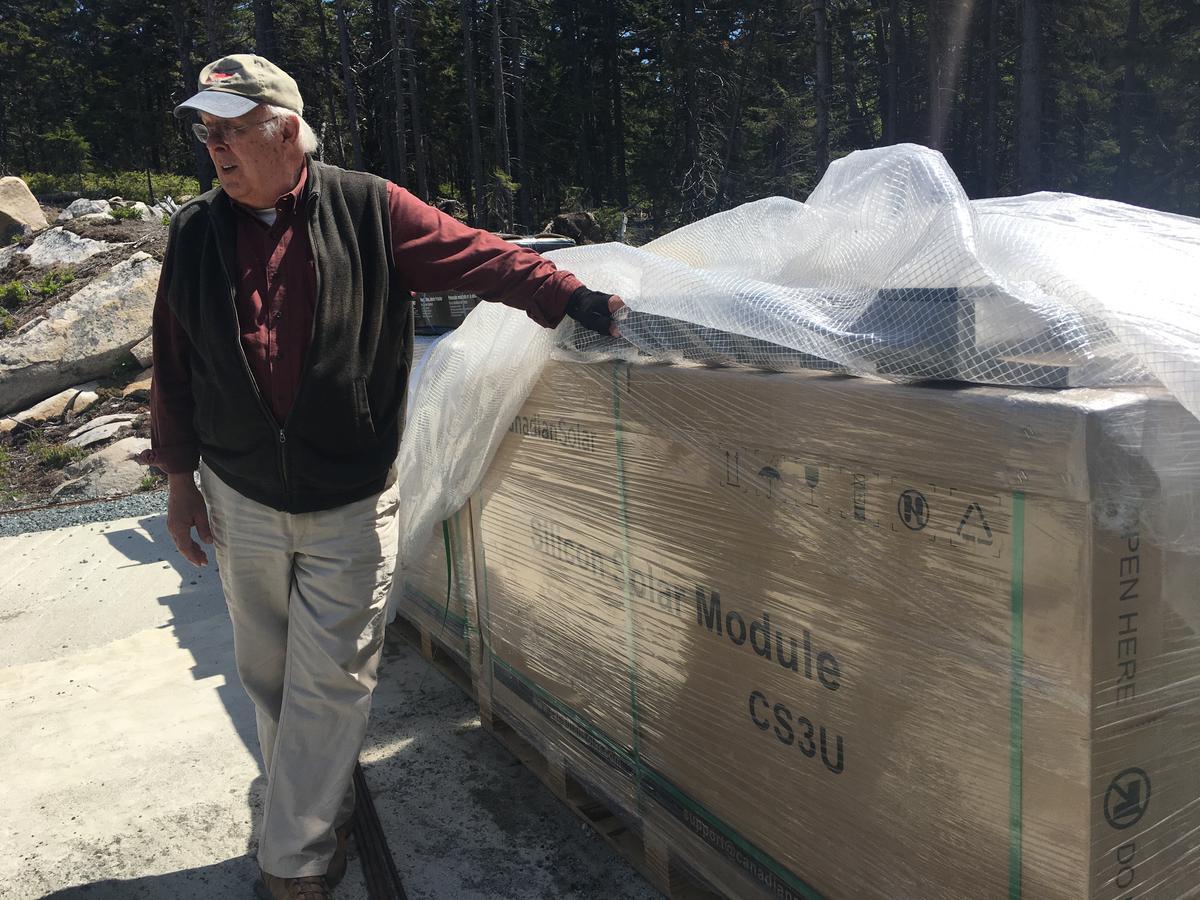
Jim Wilson and Steven Strong
CREDIT FRED BEVER / MAINE PUBLIC RADIO
“The microgrid is less expensive, and they keep the money on the island when they're done," Strong says.
Strong is lead engineer for an electricity system that will be anchored by a hillside acre of solar panels. The system will also include some pretty massive batteries, household electric heat pumps that can store excess energy in basement water tanks and, as a kind of safety net for it all, a diesel generator.
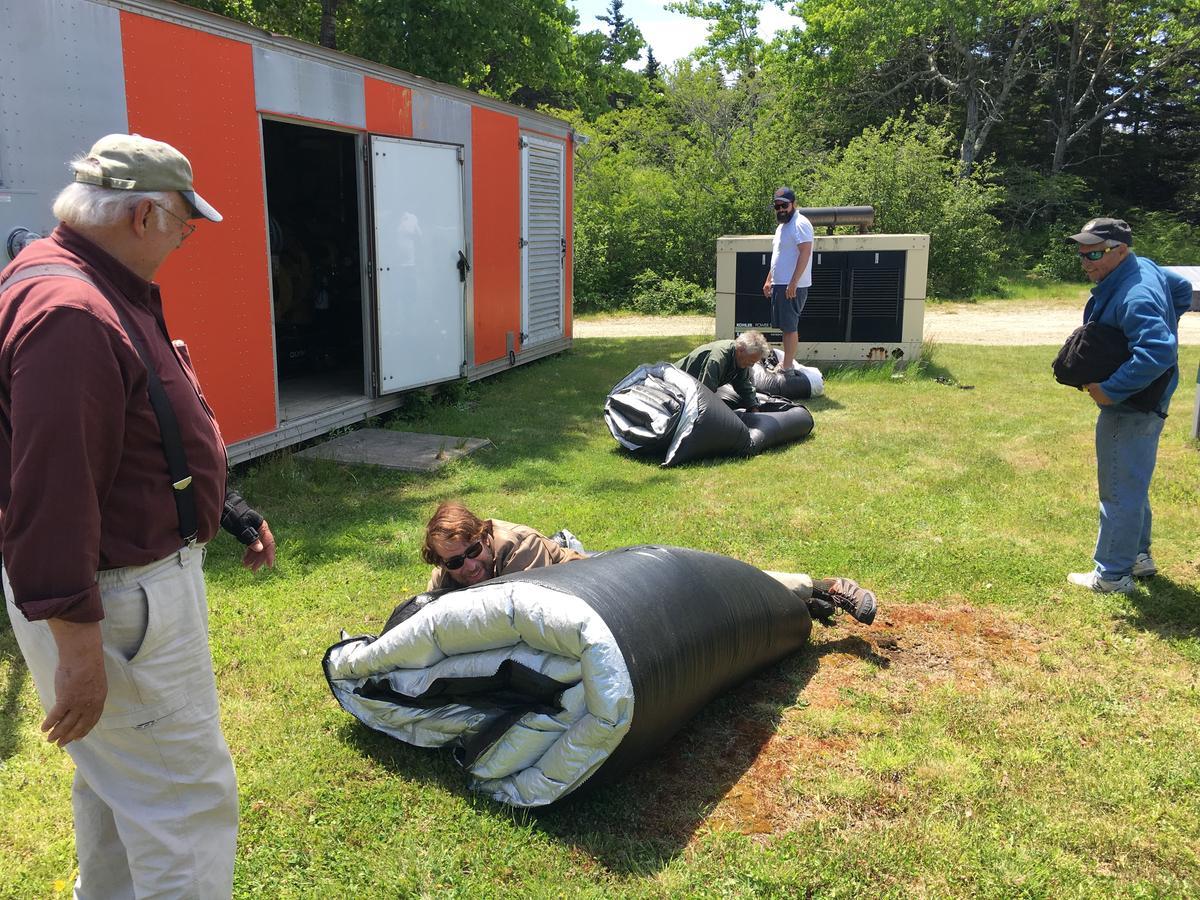
Storing tarps that protect the island's diesel generator
CREDIT FRED BEVER / MAINE PUBLIC RADIO
On a visit to the shed housing that generator, scientist Kay Aikin playfully half-closes a door on the project collaborators.
“Lock him in,” says Aikin. “You're not getting out until out until we have a microgrid.”
Aikin's Portland-based company, Introspective Systems, designs software for artificial intelligence networks that can manage complex systems — or, really, teach them to manage themselves.
"It's like building an engineered ecosystem,” Aikin says. “This is my laboratory."
The company has a $1 million grant from the U.S. Department of Energy to design an electricity ecosystem that is run by artificial intelligence. On Isle au Haut, AI computer chips will let solar panels, batteries, heat pumps and the lot decide for themselves when to make energy, when to take it, use it or store it, depending on what's most cost-effective.
Company cofounder Caryl Johnson says the island's "smart" energy assets will compete and cooperate — sort of the way swamp-dwelling frogs and snakes do.
"A frog has a perspective that involves not being eaten by a snake,” Johnson says. “A snake is quite different, you know; 'how do I catch frogs?'”
Yet the sometimes warring impulses of frogs and snakes, taken together, help keep a swamp balanced, even in the face of complex, swiftly-changing conditions.
"The decisions that are made by the entities in the swamp are all independent, but the result is a stable ecosystem,” she says. “And so that's what we are trying to achieve in terms of the systems we design, a computationally stable ecosystem."
The microgrid on Isle au Haut will be an exemplar of an AI-controlled, computationally-stable ecosystem, the scientists say.  And it could be scaled -- by linking one microgrid to another, and another, then to the electrical network for a region, all the way up to the entire nation's grid.
Instead of today’s centralized command and control system, the next, next grid would be de-centralized. It would be controlled, says Kay Aikin, from the grid's edges by the collective decisions of the electrical swamp’s frogs and snakes -- its AI-enabled devices.
“And you can do the very fine control with thousands and tens of thousands and hundreds of thousands of devices without a super-computer,” Aikin says.
That would more effectively respond to the multiplex of non-polluting energy sources that are proliferating around the country. And, she says, if any one section of the system suffered a catastrophe - maybe from a storm, maybe a cyber-attack - it could quickly be shut off from the rest.
“It's more reliable, it's more robust, it's resilient, failures are isolated,” Aikin says.
For the president of the island's electricity company, Jim Wilson, a sophisticated vision for a renewable energy future is all well and good. But the bottom line is really that the local experiment will protect islanders against the unaffordable cost of replacing an old underwater cable.
Jim Wilson, president of Isle au Haut Electric Co.
CREDIT FRED BEVER / MAINE PUBLIC RADIO
“At a minimum it prevents a collapse of the population,” Wilson says. “But down the road we should have very stable prices and maybe even competitive with mainland ... If we didn't do this project our prices could go through the roof when the cable fails.”
Wilson says the collaborators hope to get this small model of what could eventually be a major change in the nation's energy systems up and running by New Year's Eve.
This report comes from the New England News Collaborative, eight public media companies including Rhode Island Public Radio coming together to tell stories of a changing region, with support from the Corporation for Public Broadcasting.