Monday, November 19, 2018

GET THE FACTS: WHY ARE SEA LEVELS RISING?/The Climate Project

Data is king.  Let's put aside myths and misinformation and deal with real measurements.  

Of all the impacts of climate change, sea-level rise may be one of most well-known – perhaps because of its popularity in TV shows and blockbuster movies.
But – surprise, surprise – reality is a little more complicated than the movies. Don’t worry – we’ve got the facts. Here are your questions about sea-level rise, answered.

SEA-LEVEL RISE: DEFINED

We can talk about sea-level rise in two different ways: relative sea-level rise and absolute sea-level rise. The Environmental Protection Agency (before it was headed up by climate deniers and industry lobbyists, that is) defined it well:
  • Relative sea level change is how the height of the ocean rises or falls relative to the land at a particular location.”
  • “In contrast, absolute sea level change refers to the height of the ocean surface above the center of the earth, without regard to whether nearby land is rising or falling.”
Remember: Our oceans do not work like a bathtub or sink: when you fill up a tub with water, the water rises steadily. But research has shown that seas actually rise unevenly – putting some communities even more at risk than others. Relative sea levels are different because local factors are at play, like land subsidence (or sinking) and wind and ocean circulations.
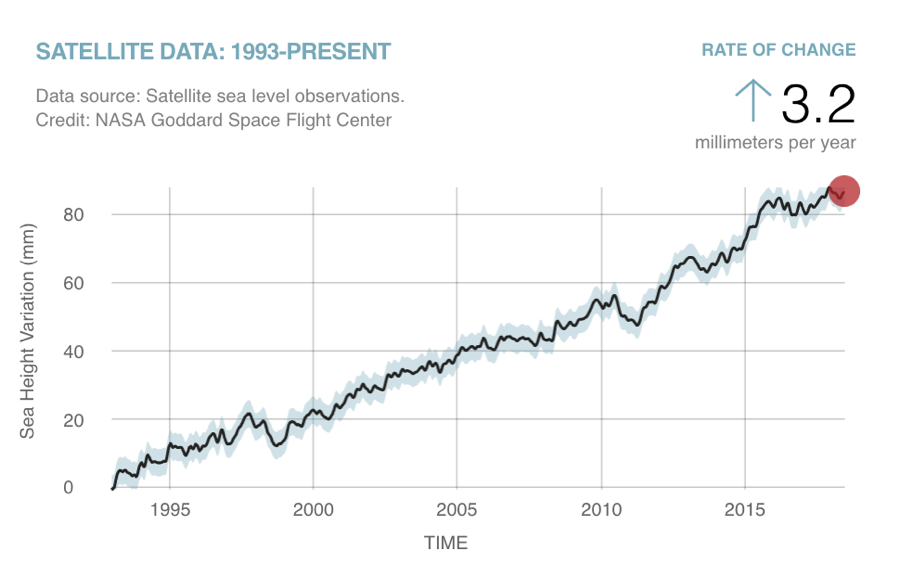
Change in sea level since 1993 as observed by NASA satellites. (Source)

WHY ARE SEA LEVELS RISING?

We can’t overstate this: As our world becomes warmer and warmer, our seas will continue to rise. That’s because the number one cause of sea-level rise is climate change.
Here’s the breakdown:
As humans burn fossil fuels, we add more and more greenhouse gases (like carbon dioxide) to our atmosphere. These gases trap heat sort of like a blanket (or a greenhouse — that’s why it’s called the greenhouse effect) and make our world heat up.
While our globe warms, this added heat directly fuels sea-level rise in two big ways:
  • The added heat melts glaciers and ice sheets.  This means extra water flowing into our oceans, making them higher than they used to be. Massive ice sheets in Greenland and Antarctica – and land ice elsewhere – are weakening, breaking off, and melting. The ice melts and seas rise even more.
  • Water expands as it warms. Imagine a pot of water heating on the stove. The volume of that water in the pot expands as it heats up. Now imagine the entire ocean doing that.

WHY IS SEA-LEVEL RISE BAD?

Get this: Eight of the world’s 10 largest cities are located near a coast. As sea levels rise, millions of people around the world are affected by increased coastal flooding and coastal erosion, as well as higher storm surges moving further inland.
We’re not talking about something happening in 10 years. We’re talking about something happening right now – and unless we act, the danger will only grow.
According to the latest report from the Intergovernmental Panel on Climate Change, if we can limit warming to 1.5 degrees Celsius (instead of the 2 degree target many policymakers use) by 2100, we’ll see slower sea-level rise and give vulnerable island nations and coastal communities more time to prepare and adapt. We have the power to determine what the future looks like for future generations, and it’s our responsibility to use it.

WHAT CAN I DO?

Download our free fact sheet on sea-level rise – then, use it to talk to people you know about sea-level rise, climate change, and why we should take action. Our fact sheets are simple and straightforward, making it easy to understand complicated issues quickly.
If you want to branch out, we also have fact sheets covering renewable energyfossil fuels, and the connections between infectious disease and the climate crisis.

Friday, November 16, 2018

The prettiest Christmas trees are underwater


The prettiest Christmas trees are underwater


Sea worm's tubular homes add a festive touch to coral reefs

Your Christmas tree is nice - really, it is. It's just the right height and shape, so green, and it smells so good. You definitely picked the best one in all of the land.
But that's where you messed up.

The most beautiful Christmas trees don't grow in soil. They're not even plants. And you shouldn't take them home or decorate them.

Allow me to introduce a sea creature that will put your Christmas tree to shame: Its name is Spirobranchus giganteus, but most people call it the Christmas tree worm.
These animals live on coral reefs in tropical and subtropical waters around the world, building tiny, tubular homes with their own secretions of calcium carbonate. They emerge from these tubes to filter feed, procreate and breathe with a part of their body called the branchial crown.
You can't miss these bright, spiral-shaped cones while snorkelling, if you know what to look for. They look like miniature decorated firs.

"They're really pretty, very colourful, very festive and 'Christmas-sy'," said marine biologist Orly Perry, who studies them as a doctoral student at Bar-Ilan University in Israel.
Most of the "trees", which come in pairs, protrude no more than an inch from the tube's opening. But they make up for their small size with colourful displays that look like the work of a talented candy-maker. Many spiral out in a mixture of purple, green and white where Ms Perry works, in the Gulf of Aqaba in the Red Sea near Eilat, Israel. But they come in many other colours too, and some even don an appropriate solid winter white.

Male and female Christmas tree worms reproduce by casting their sperm and eggs into the water in synchrony. Fertilised eggs then develop into larvae that find a coral to make a home.
They don't burrow into it. Instead, they latch on to a dead spot or wound and start making their tubes. By adjusting the tube's growth rate to match the coral's growth, the worm keeps up with the coral growing around its tube and maintains an entrance to its home.

Settled Christmas tree worms stay for life - up to 30 or 40 years. "They cannot say, 'This is not for me' and move," said Ms Perry. "It's crucial to look for the right place."

These places aren't random. The larvae seem to know which corals are which. Some worms of the Spirobranchus genus prefer certain coral species or types, typically less aggressive ones. And a few like artificial surfaces. Ms Perry found a potentially new species in the Gulf of Eilat that prefers plastic buoys and pieces of metal on piers and staircases.

The larvae may follow signals from elderly worms to locations that have worked well for others of their genus. In those preferred habitats, they grow big.
"This is kind of like humans. If you stick around in a place, you feel comfortable, then everything is happy," said Ms Perry. "In the case of the worms, it affects their size."

Corals benefit too. Researchers have found that Christmas tree worms may protect some corals from bleaching, algal smothering and predation from animals like crown-of-thorns starfish.
Once stuck, Christmas tree worms can't run, but they can hide. Sensing touch, chemicals and light, they can perceive danger. When it approaches, the worms retract, vanish into their homes and slam shut an organ called an operculum - just like a door.
But the worms spend most time out of their tubes feeding, all year, day or night - which kind of means for corals, it's Christmas all the time.

For a spectacular display, experienced snorkellers can head out at night with a UV flashlight when their coral neighbourhoods fluoresce.

Wednesday, November 14, 2018

Electric Vehicles: Scary Myths vs Enticing Reality, PART 2/Sierra Club


In our two-part blog series on the myths of electric vehicles (EVs), we address misleading myths  that persist and counter these misrepresentations with a clearer picture of reality. In the first blog, we debunked myths around the true cost and experience of driving an EV, and the lie -- largely invented by the auto industry -- that the public just isn’t that into these clean, fun cars. In this blog installment, we’ll dive into the positive social impact that zero-emission vehicles have on our society by addressing some of the more harmful mischaracterizations about EVs not being ethical or equitable alternatives to vehicles that emit harmful pollution.

MYTH: “EVs are just as harmful to our climate as vehicles powered by oil”

TRUTH: This myth persists despite the evidence to the contrary. Analysis from the Union of Concerned Scientists shows that, no matter where you are in the U.S., charging an EV is far cleaner than driving a gasoline-powered vehicle. Charging an EV has the same emissions as a car with 50 MPG for 75% of U.S. drivers, and the MPG equivalent is higher in regions that have cleaner power grids: 109 MPG in California and 191 MPG in New York.

Thanks to more renewable sources of electricity in the power sector (carbon-based power is down 28 percent since 2007), the average emissions from our plug-in vehicles is declining and will continue to decline over time.

MYTH: “EVs are the main cause of troublesome cobalt mining”

TRUTH: EV battery makers use cobalt, which is largely mined in the conflict-filled region of the Democratic Republic of Congo. About 15 percent comes from so-called “artisanal” mines that exploit child labor. Fortunately, many companies and scientists are focusing on improving the sourcing, re-use, and disposal of EV batteries -- as well as on reducing cobalt use and increasing energy density overall.

Electric cars actually represent a small percentage of the market for mined cobalt, which is largely driven by the demand for laptops, cell phones, airplanes, medical equipment, and military applications (all far more popular than EVs). Regardless of the small role that EVs play in the cobalt market, efforts are underway by companies, policymakers, and scientists to move in a more ethical direction when it comes to EV batteries.

MYTH: “EVs aren’t within reach for disadvantaged communities”

TRUTH: Some hold the belief that zero-emission vehicles aren’t an equitable solution to climate change -- a particularly harmful myth considering that transportation emissions (the largest source of greenhouse gas emissions) disproportionately harm disadvantaged communities.  

The rise of personal EVs alone is not an accurate representation of the scope of EV adoption and the resulting emissions reductions. The rapid acceleration of zero-emission cars, trucks, and buses -- in addition to electric car shares, e-bikes, scooters, walking and bike paths -- expands clean transportation access for diverse communities. The deployment of electric buses and charging infrastructure is on the rise, and historically disadvantaged neighborhoods are being prioritized. State and local policies are beginning to address clean transportation disenfranchisement in meaningful ways, such as California’s Charge Ahead program, Scrap and Replace program, and Oregon’s used EV program.

Electric transit buses are deployed in many cities, with more coming soon to the streets of San Diego, South Florida and Austin. With the majority of transit bus riders being people of color and 55 percent women, 43 percent low-income, 34 percent elderly, and many with a disability -- a swift transition away from buses that run on fossil fuels and toward zero-emission buses is also a strong move for clean transportation justice.

That said, we must continue to make electric mobility even more affordable and accessible to all. The Greenlining Institute has created a terrific toolkit with strong recommendations to achieve this, and the Sierra Club and Plug In America include a few model equity policies in our model EV policy toolkit.

Do electric cars fail our climate and our most vulnerable communities? Only if you cherry-pick data, rely on discredited information, and ignore carbon reductions. EVs can certainly go even further and be even cleaner and more equitable with the help of smart policies and just programs -- but, regardless if analyses are tweaked or projections are ignored, the truth is that electric vehicles offer a significant positive benefit for everyone. That’s why it’s critical we continue to drive a shared, electric mobility future for our planet and the people living on it.

Mary Lunetta is the campaign representative for the Sierra Club's Electric Vehicles Initiative. 

Saturday, November 10, 2018

Electric Vehicles: Scary Myths vs Enticing Reality, PART 1/Sierra Club

Great 2-part series from SC. We'll run the second segment next week:


Electric vehicles (EVs) are at the forefront of a transportation revolution, and evidence shows a mass switch to EVs could help clean the air, slow the pace of climate disruption and, over time, end the era of the internal combustion engine. Thankfully, we’re on our way there -- the U.S. just hit the 1 million mark for EVs on the road this month. Nonetheless, skepticism and myths about EVs persist for a variety of reasons. Corporate polluters like the Koch brothers and Big Oil are known to be behind the spread of misinformation about EVs within our media and public policy. It’s no surprise, given that a switch to electric transportation will lead to less oil use and lower profits. In this two-part series, we look at a few of the most frightening myths about EVs, fueled largely by the fossil fuel industry, and counter them with a clearer picture of reality.

MYTH: “EVs are more costly than vehicles run on oil.”

TRUTH: While many people are under the impression that EVs cost more than internal combustion engines (ICE) vehicles, this is largely untrue, especially if you consider the lifetime costs of the vehicles. It is true that many EV models do have higher sticker prices than those for conventional vehicles; however, federal and state tax credits and rebates help offset the costs of buying or leasing an electric car. EVs also have fewer moving parts, leading to reduced maintenance costs and lower “fuel” costs (electricity is cheaper than gasoline or diesel), making total cost of ownership for EVs far less than for ICE vehicles. In some states, EV owners can fuel their vehicles to capacity for less than a dollar. 

Used EVs are actually some of the fastest selling used cars. Oregon's rebate program includes an incentive for used EVs, and other states are expected to follow suit.

As time goes on, electric cars will become even more affordable as production increases and battery costs decrease. But the data is clear: If you buy or lease many models of electric cars rather than ones powered by gas, you will save a significant amount of money while you drive it.

MYTH: “People just aren’t that into electric cars.”

“Trying to force consumers into less-polluting cars is like trying to make a three-year-old eat vegetables,” said Rhett Ricart, a car dealer in Columbus, Ohio, who serves as regulatory chairman for the National Automobile Dealers Association, a trade association that has lobbied hard against incentives for auto fuel efficiency and EV standards.

TRUTH: The demand for EVs is higher than the supply. One in five Americans wants an electric car, and a survey found that 20 percent of Americans said an EV would be the next car they buy -- up from 15 percent in 2017. A Sierra Club survey found that many auto dealerships make it hard for consumers by often having no EVs on a dealer lot or having salespeople poorly trained on them. Also, the industry is barely advertising the EV models.

Despite that, EV sales shattered previous records in September. The U.S. EV market reached a major milestone last month as automakers reached 1,000,000 EV sales.

MYTH: “EVs could leave you stranded in the middle of nowhere.”

TRUTH: Range anxiety -- the fear that a battery will deplete before a driver reaches a charging station -- remains one of the largest barriers to EV adoption. People don’t want to find themselves stranded on the side of the road, in the middle of nowhere as night falls and coyotes begin to howl....

But studies show that range anxiety is overblown. First of all, plug-in hybrids are able to rely on gasoline after their electric mileage runs out on any given long trip. Also, it turns out that about 60 percent of all vehicle trips in the U.S. in 2017 were under six miles, and average trips are under 40 miles -- far less than the electric range of every full-battery EV on the market. Electric school bus pilot programs are underway in several states, and with ranges up to 100 miles, these buses are able to get school children to and from school safely. Many electric transit buses can travel up to 360 miles per charge.

We’ve seen the acceleration of vehicle charging stations nationwide, and more are coming as a result of the Volkswagen settlement. There are now more than 50,000 charging stations in the U.S., not to mention the home charging that many (though not all) EV drivers are able to do. And just this month, Google Maps now shows where you can charge your electric car. 

Just as any movement for a more just and sustainable world faces challenges and growing pains, so does the movement for clean transportation. Despite real obstacles facing our nation’s swift transition from dirty, polluting engines to clean, zero-emission vehicles, it’s essential that consumers, transit riders, and public officials be informed about what is true regarding EVs and what is invented or misrepresented in a way that only serves to slow the transition to a cleaner transportation future for all. Stay tuned for our next blog in this two-part series addressing other EV myths, including those related to the equity of EVs, the ethical issues regarding their batteries, and whether or not EVs are just as harmful to our climate as conventional vehicles are.

Mary Lunetta is the campaign representative for the Sierra Club's Electric Vehicles Initiative. 

Wednesday, November 7, 2018

CCNY Study Shows Plastic Waste Can Be Converted Into Energy And Fuels/RNN


Plastic waste is flooding our landfills and leaking into the oceans, with potentially disastrous effects. In fact, the World Economic Forum predicts that if current production and waste management trends continue, by 2050 there could be more plastic than fishes in the ocean.
Why is this happening when there are processes and technologies that can effectively recycle, convert to valuable products and extract the imbedded energy from these waste plastics? According to Science Advances, as of 2015, of the 6,300 million tons of plastic waste generated in the United States, only 9 percent has been recycled, 12 percent has been incinerated, with the vast majority – 79 percent – accumulating in landfills or the natural environment.
The Earth Engineering Center (EEC|CCNY) at the Grove School of Engineering of the City College of New York is on a mission to transform plastic waste to energy and fuels.
A recent EEC study titled “The Effects of Non-recycled Plastic (NRP) on Gasification: A Quantitative Assessment,” shows that what we’re disposing of is actually a resource we can use. The study, by Marco J. Castaldi, Professor of chemical engineering Director of Earth System Science and Environmental Engineering and Director of the EEC|CCNY and Demetra Tsiamis Associate Director of the EEC|CCNY, explores how adding NRPs to a chemical recycling technology called gasification – which transforms waste materials into fuels – adds value.
Adding NRPs to the gasification process helps reduce greenhouse gas (GHG) emissions while significantly reducing the amount of waste byproduct to landfill – by up to 76 percent.
In the study, published by the American Chemistry Council, the effects of increasing the percentage of non-recycled plastics (NRPs) are measured at Enerkem, a Montreal-based energy company, in collaboration with the City of Edmonton in Alberta, Canada.
“This study demonstrates that because carbon and hydrogen rich plastics have high energy content, there is tremendous potential to use technologies like gasification to convert these materials into fuels, chemicals, and other products. We were fortunate to engage a couple of students and engineers from our team enabling them to learn about this novel process,” said Castaldi.
Tsiamis added: “Plastics have an end of life use that will be turning waste into energy, which is something we all need and use.”

Recycled Plastic for Wood Plastic Composite Lumber is Continuing to Grow/RNN

As always we bring updates on good technology.


GreenMantra Technologies, a rapidly growing clean technology company that produces value-added waxes and polymer additives from recycled plastics, is introducing its Ceranovus additives for wood plastic composite (WPC) lumber at the Deck Expo 2018 this week in Baltimore.
Ceranovus A-Series polymer additives can provide WPC manufacturers with both formulation and operational cost savings. And since they are made from 100 percent recycled plastics, Ceranovus additives increase the recycled content of a finished product, enhancing its sustainability profile.
“We are excited to offer the benefits of these additives to the WPC market,” said Carla Toth, senior vice president, sales and marketing for GreenMantra. “Industry trials combined with third-party testing validate that Ceranovus polymer additives generate value for WPC manufacturers who are seeking to lower overall formulation costs and improve operational efficiency.”
Ceranovus A-Series polymer additives can provide WPC manufacturers with both formulation and operational cost savings. And since they are made from 100 percent recycled plastics, Ceranovus additives increase the recycled content of a finished product, enhancing its sustainability profile.
“We are excited to offer the benefits of these additives to the WPC market,” said Carla Toth, senior vice president, sales and marketing for GreenMantra. “Industry trials combined with third-party testing validate that Ceranovus polymer additives generate value for WPC manufacturers who are seeking to lower overall formulation costs and improve operational efficiency.”
In WPC lumber, Ceranovus polyethylene and polypropylene polymer additives can:
  • increase strength (modulus of rupture) and stiffness (modulus of elasticity)
  • enable formulation flexibility and broader feedstock selection to offset virgin plastics
  • increase the recycled content and sustainability profile of finished products
GreenMantra’s Ceranovus polymer additives are also used in polymer-modified asphalt roofing and roads as well as in rubber compounding, polymer processing and adhesive applications. The company has received numerous awards for its innovative technology, including an R&D100 Gold Award for Green Technology. Its Ceranovus A-Series waxes and polymer additives are certified by SCS Global Services as being made with 100 percent recycled post-consumer plastics.

Climate change? Global warming? What do we call it?

Climate change? Global warming? What do we call it?

Both are accurate, but they mean different things.
You can think of global warming as one type of climate change. The broader term covers changes beyond warmer temperatures, such as shifting rainfall patterns.
President Trump has claimed that scientists stopped referring to global warming and started calling it climate change because “the weather has been so cold” in winter. But the claim is false. Scientists have used both terms for decades.

2.How much is the Earth heating up?

Two degrees is more significant than it sounds.
As of early 2017, the Earth had warmed by roughly 2 degrees Fahrenheit (more than 1 degree Celsius) since 1880, when records began at a global scale. The number may sound low, but as an average over the surface of an entire planet, it is actually high, which explains why much of the world’s land ice is starting to melt and the oceans are rising at an accelerating pace. If greenhouse gas emissions continue unchecked, scientists say, the global warming could ultimately exceed 8 degrees Fahrenheit, which would undermine the planet’s capacity to support a large human population.

3.What is the greenhouse effect, and
how does it cause global warming?

We’ve known about it for more than a century. Really.
In the 19th century, scientists discovered that certain gases in the air trap and slow down heat that would otherwise escape to space. Carbon dioxide is a major player; without any of it in the air, the Earth would be a frozen wasteland. The first prediction that the planet would warm as humans released more of the gas was made in 1896. The gas has increased 43 percent above the pre-industrial level so far, and the Earth has warmed by roughly the amount that scientists predicted it would.

4.How do we know humans are responsible
for the increase in carbon dioxide?

This one is nailed down.
Hard evidence, including studies that use radioactivity to distinguish industrial emissions from natural emissions, shows that the extra gas is coming from human activity. Carbon dioxide levels rose and fell naturally in the long-ago past, but those changes took thousands of years. Geologists say that humans are now pumping the gas into the air much faster than nature has ever done.

5.Could natural factors be the cause of the warming?

Nope.
In theory, they could be. If the sun were to start putting out more radiation, for instance, that would definitely warm the Earth. But scientists have looked carefully at the natural factors known to influence planetary temperature and found that they are not changing nearly enough. The warming is extremely rapid on the geologic time scale, and no other factor can explain it as well as human emissions of greenhouse gases.

6.Why do people deny the science of climate change?

Mostly because of ideology.
Instead of negotiating over climate change policies and trying to make them more market-oriented, some political conservatives have taken the approach of blocking them by trying to undermine the science.
President Trump has sometimes claimed that scientists are engaged in a worldwide hoax to fool the public, or that global warming was invented by China to disable American industry. The climate denialists’ arguments have become so strained that even oil and coal companies have distanced themselves publicly, though some still help to finance the campaigns of politicians who espouse such views.