Monday, February 20, 2017

Fears Grow That Climate Conflicts Could Lead to War/Bloomberg

Perhaps this is the ultimate confrontation, beyond politics and science, around climate change...as laid out here, does it lead us to conflict and wars?

We know most nations long ago turned their military attention to control resources, including natural capital.  Global environmental changes threaten those very important assets.  Some communities lose them, others gain them.  That is why taking a global cooperative effort around balancing eco protection with economic growth is paramount.  Anything less fails.

Note how a switch to renewables threatens the financial future of big exporters like Russia.  Of course we see that shift of energy production back to local resources as a huge gain for the rest of us.
  • Trump’s threat to quit Paris reverberates on national security
  • Senator urges countries to tell president, ‘don’t you dare’


Among the 21st-century threats posed by climate change -- rising seas, melting permafrost and superstorms -- European leaders are warning of a last-century risk they know all too well: War.
Focusing too narrowly on the environmental consequences of global warming underestimates the military threats, top European and United Nations officials said at a global security conference in Munich this weekend. Their warnings follow the conclusions of defense and intelligence agencies that climate change could trigger resource and border conflicts.
“Climate change is a threat multiplier that leads to social upheaval and possibly even armed conflict,” the UN’s top climate official, Patricia Espinosa Cantellano, said at the conference, which was attended by the U.S. secretaries of defense and homeland security, James Mattis and John Kelly.
Even as European Union countries struggle to assimilate millions of African and Middle Eastern migrants and refugees, security officials are bracing for more of the same in the future. Secretary General Antonio Guterra named climate change and population growth as the two most serious “megatrends” threatening international peace and stability.

Source: Met Office Hadley Centre and Climatic Research Unit, University of East Anglia
“Ground zero” for armed conflict over the climate will be the Arctic, where record-high temperatures are melting ice and revealing natural resources that some countries might be willing to fight for, Finland’s President Sauli Niinisto said on a panel.
“We have already seen flag planting and already some quarrels on the borderlines,” Niinisto said, pointing to new Russian military bases on its Arctic border. “Tensions will rise.”
The Arctic climate paradox -- where countries could fight for rights to extract the very fossil fuels that would cause even more global warming -- underscores energy’s role as a cause and potential moderator of climate change, according to Niinisto. 
For Russia, the world’s biggest energy supplier, European nations switching to renewables represents an economic threat. At the same time, European over-reliance on Russian energy exposes them to coercion, according to Kelly Gallagher-Sims, a former climate and energy adviser to President Barack Obama.

Peaceful Coexistence

“Climate change is already exacerbating existing stresses that contribute to instability and insecurity,” Gallagher-Sims told Bloomberg last week before leading a policy meeting on Arctic security at the Fletcher School at Tufts University near Boston. “The main relationship between renewable energy and trans-Atlantic security” is that clean power “permits Europe to rely less on Russian gas,” she said.
For their part, Russian leaders in Munich said they want peaceful coexistence with Europe and will abide by the Paris accord on climate change -- even if it’s unlikely they’ll try convincing U.S. President Donald Trump to do the same.
It’s not clear when and if Trump will make good on his frequent campaign promises to pull the U.S. out of the Paris accord, a 2015 UN agreement to curtail greenhouse-gas emissions that was adopted by nearly 200 countries. Since he took office, the administration has rolled back U.S. rules to combat climate change and eased restrictions on fossil-fuel companies.
U.S. Democratic Senator Sheldon Whitehouse, a member of the committee on the environment and public works, told officials in the Bavarian capital they may have to fight to preserve the 2015 Paris agreement from global warming skeptics in the White House.
“The response of the international community will be significant,” Whitehouse said. While the probability of abandoning Paris may be small, they “decrease further if the response of the international community” to the U.S. “is not only, don’t you dare but, that there’ll be consequences in other areas” if you leave.

Saturday, February 18, 2017

U.S. growers can’t keep up with consumer demand for organic and non-GMO grains / by Envirothin

This is how we make a difference and affect change.  We demand better.   We buy smarter.  We use our massive consumer pocketbook to reward organic, healthy choices.  These are milestone moments that no president, on country, on individual or single entity can reverse.

Walmart misrepresents products as Organic - again

A growing number of consumers are looking for healthier choices, particularly when it comes to grains. According to a new report from CoBank, a $120 billion cooperative bank that provides loans, leases, export financing and other financial services to agribusinesses and rural power, water and communications providers in all 50 states increased consumer demand for organic and non-GMO foods. This led to a sharp rise in organic grain imports in 2016, prompting food manufacturers to explore new incentives for U.S. growers transitioning to organic production.

“Domestic supplies of non-GMO corn and soybeans increased steadily in 2016, as growers converted acreage and captured moderate market premiums,” says Dan Kowalski, director of CoBank’s Knowledge Exchange Division. “Transitioning to organic production, however, is a multi-year, risk-reward calculation that’s likely holding some U.S. growers back from taking advantage of the market opportunity.”

non-gmo-soybeans

Imports of organic grains from countries such as India, Ukraine, Romania, and Turkey surged in 2016 to meet the burgeoning U.S. demand for organic food products. Organic corn imports more than doubled from 2015 to 2016 and accounted for nearly one-half of the U.S. organic corn supply. The domestic shortfall for organic soybeans was even greater. In 2016 roughly 80 percent of soybeans supplying the U.S. organic market were imported.
The two main markets for organically produced grain in the U.S. are animal feed for organically raised dairy, beef, pork and poultry products, and ingredients used in organic consumer packaged goods. Analysts estimate that between one and five million U.S. acres would have to be transitioned to organic production in order to meet demand.
The report notes that some leading food manufacturers are finding new and innovative ways to incentivize growers for transitioning to organic production to help bolster domestic supply and reduce reliance on imports. Those include:
  • free agronomic services to contract growers
  • premiums for goods grown on transitional acres.
non gmo grunge retro red isolated ribbon stamp

Growers and food companies can also use a new transitional certification to market their products for a price somewhere between that of organic and non-organic crops.
Demand for both non-GMO and organic crops will continue to grow said Kowalski, and, ultimately, monetary incentives will determine whether U.S. growers choose to step in and close the supply deficit. For growers in close proximity to a market and with options for multi-year contracts, non-GMO and organic production might be worth considering, he said.
This is encouraging news. Once again, consumers voices are making a difference – food producers are listening.

Friday, February 17, 2017

For a future show/Woman of Wind Energy

For a future show.  Stay tuned at Renewable Now.biz.


WOWE - Women of Wind Energy

WoWE Mission & Goals

WoWE's Mission: Women of Wind Energy (WoWE) promotes the education, professional development, and advancement of women to achieve a strong diversified workforce and support a robust renewable energy economy.

Photo Courtesy of National Renewable Energy Laboratory

The rapid growth of the wind industry holds great promise for the world's energy future and green careers of today and tomorrow. But historically, women have been under-represented in the wind industry.  This fact affects not only women in our field or contemplating it, but also the wind industry as a whole.  How will wind energy reap the full advantage of women's talents, energy, and ideas?  
Women of Wind Energy, or WoWE (pronounced WOW-ee) was founded in 2005 to ensure that women can play a full, productive role in the development of wind power.
Building women’s place in wind energy is not only the right and fair thing to do; it’s a solid strategy for success. The equal engagement of women in the work force and in senior management have been linked to greater organizational communication and efficiency, broader consumer awareness, and increased profitability.
In 2011 WoWE began a preliminary effort to better understand the gender demographics of U.S. wind energy companies. The study included review of existing research and data, a survey of members of the AWEA Human Resources Working Group, and polling of WoWE program participants.  The early results were published in WoWE's WINDPOWER 2011 poster.

Become part of Women of Wind Energy

WoWE invites everyone – women and men alike – to help us accomplish our mission. We support wind energy education, training, and inclusion for women entering our industry; offer professional and career development tools for women already in the field; provide numerous opportunities for networking; and publicly celebrate stories of women in wind.
For both newcomers to WoWE and long-time friends, we invite you to join our public email list and to become a member of WoWE if you haven't already. It will only take you a minute or two to join the WoWE network and be the first to hear about news, opportunities, and programs.
Please join WoWE today!


Flurry of State Bills Introduced, Likely Backed by Oil Industry, to Penalize Electric Car Drivers

So, we post some good news on the on-going expansion of wind energy, but get hit with this--states penalizing EV drivers.  Why?  This, to us, looks like crappy public policy.

Do we really want to encourage more fuel use?  The best we can the rest of our lives is to live on gas taxes?  Then why not tax people and companies for installing renewables on their homes and buildings since they use less oil or gas?  Preposterous, right?  Ridiculous.

Not much appreciation for EV owners who fuel efficiently at home, can use their EV's as back up generators, we see in Japan and other nations, and have the building blocks for tying in their car battery systems to their building units as well.  Time to vote in new leadership in everyone of these states.

How do we get to smart transportation and smart grids with stupid old technology?   Shame on these states and their law makers who clearly lack knowledge, foresight, creativity and even a basic understanding of building a cleaner, healthier future within their borders.

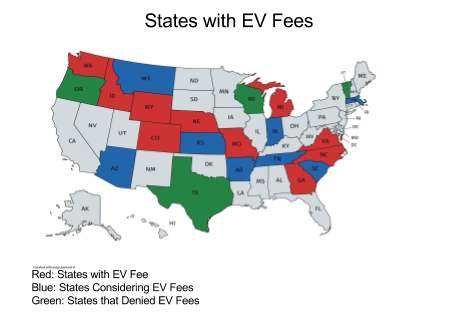
"States across the U.S. have been introducing legislation that would punish people for switching to electric vehicles. Since the start of 2017, six states (Indiana, South Carolina, Kansas, Tennessee, New Hampshire, and Montana) have introduced legislation that would require EV owners to pay a fee of up to $180 a year.


Sadly, this isn’t the first time people have been penalized for driving green. Wyoming, Colorado, Virginia, Nebraska, Missouri, Washington, North Carolina, Idaho, Georgia, and Michigan have all implemented yearly fees on electric and hybrid vehicles that vary from $50 to $300 per driver per year.  Arizona’s and Arkansas’ respective Department of Transportations are also suggesting  legislators cast a fee for EV ownership. Georgia, formerly the state with the second most EV sales, used to offer a tax credit of up to $5,000, but replaced the program with a $200 yearly fee that led to an 80 percent drop in EV sales.  


This attack is coming at a time when EVs are just starting to take off within the larger auto industry--and it’s likely no coincidence this attack is coming now. Reportedly, for more than a year, Koch Industries has spent nearly $10 million dollars, and plans to do so every year, on a campaign to boost petroleum-based transportation fuels and attack government support for electric vehicles. This campaign was presumably created because of the risk EVs place on the oil and coal industry. American Legislative Exchange Council (ALEC), a right-wing state legislation machine funded by the Koch brothers and several other multinational corporations, introduced in December of 2015 a resolution to discourage states from providing subsidies for EVs at their States and Nation Policy Summit.

When oil tycoons consider a rise in EV drivers to be a threat to their wallets, you know EVs are taking off. They’re right to be scared--between 2015 and 2016, U.S. electric vehicle sales jumped an impressive 37 percent. According to The Guardian, by 2020 the prices of electric vehicles are expected to fall, which will cause a significant reduction in the demand for oil. A study done by the Grantham Institute for Imperial College London and the Carbon Tracker Initiative found that EVs will account for approximately 35 percent of the road transport market by 2035. They predict that by 2050, EVs will account for more than two-thirds of the road transport market, where they could displace 25m barrels of oil per day.

The proponents of these EV fee bills argue that EVs are causing a drop in gas tax revenue. The gasoline tax was created in 1957 to create funding streams for projects such as roads, transit, and bridges.  But the tax hasn’t risen with inflation since 1993, so the revenue covers only a little more than 40 percent of project costs, causing states to search for their lost revenue. But, EVs aren’t the correct source to replace this lost funding. Composing just  a tiny slice U.S. auto sales, it is more fuel efficient conventional vehicles that account for a much bigger loss in gas tax funds.

A gas tax, as currently implemented, is an outdated revenue source for funding transportation infrastructure. Multiple states have proposed and even developed ways to modernize funding sources for funding public road services, transit, and other projects.

Some states have considered a carbon tax, a vehicle miles travelled fee, and vehicle weight fees in order to create modern revenue sources for transportation infrastructure funds. Oregon considered an EV fee of $100 per year back in 2013, but the legislation didn’t succeed. Instead the state created OReGo, an optional road traveled tax that saves conventional gas vehicles money while still encouraging consumers to go electric. Massachusetts and Illinois have also considered vehicle miles traveled tax programs. Wyoming is considering raising registration fees by a vehicle's weight, something that Washington State has been similarly doing through a fee that changes depending on the weight of the vehicle. Experimenting with these kind of alternatives to the gas tax is a much better approach than penalizing drivers of cleaner cars.

Massachusetts just passed legislation to study if an EV purchasing fee would be financially beneficial enough to compensate for low gas tax revenue. Without having to recreate the wheel, they should look to Vermont’s Department of Transportation’s recently published report that found that until electric vehicles make up at least 15 percent of car purchases, it’s within the state’s best interest to incentivize consumers into buying EVs, not penalize them for doing so.

If you’re opposing an EV fee bill in your state (first of all, thank you!), here are some key points to keep in mind when talking to legislators, allies, and the media:

The main reasons for the decline in gas tax revenue are a) most states haven’t raised gas taxes in many years; and b) conventional cars have become more efficient.

Vermont leaders have recommended holding off on an EV fee until EVs make up at least 15 percent of the state’s vehicle fleet.

Now is the time to incentivize, not penalize, people to driver cleaner, greener vehicles that benefit all of us by reducing air pollution dangerous to our health and climate.

Similar EV fee bills have been introduced recently in many states, and oil industry backed groups (like the Koch brothers and ALEC) have indicated their plans to back such efforts. Rather than a genuine push for a fair solution to fund our roads, bridges, and transit, this is a coordinated attempt to defend the financial interests of the oil industry.

Cleaner, greener and fun to drive, electric vehicle  are, not surprisingly, rising in popularity. We should not let the Koch brothers or Big Oil slow this momentum. If there is an EV fee proposed in your state, please reach out to Sierra Club’s Mary Lunetta for materials on how to fight back." 


Gina Coplon-Newfield is the director of the Sierra Club's Electric Vehicles Initiative.
See more stories by this author
Maggie Newshan is an intern with the Sierra Club's Electric Vehicles Iniative.
See more stories by this author

Report Shows New Transmission Can Help Wind Energy Supply a Third of U.S. Electricity

Why, in Washington, can we not agree, across party lines, that renewables are working.  In fact, based on their pricing going down and production going up, they are winning the energy wars.  We should be proud of this moment of living the next, great industrial revolution.

Below is more evidence of thier growing importance and potential.  This dovetails with a great interview we did with reps from DOE which outlined a new, national (in the US) delivery system of renewables that would get us to 80% clean energy by about 2050.  Talk about milestone in our history.

Report Shows New Transmission Can Help Wind Energy Supply a Third of U.S. Electricity

The Energy Department today released a report which confirms that adding even limited electricity transmission can significantly reduce the costs of expanding wind energy to supply 35% of U.S.electricity by 2050. The report, titled Reducing Wind Curtailment through Transmission Expansion in a Wind Vision Future and authored by the National Renewable Energy Laboratory (NREL), affirms the findings of the Energy Department’s 2015 Wind Vision, which showed that a future in which wind provides 20% of U.S. electricity in 2030 and 35% in 2050 is achievable and would provide significant economic, energy security, and health benefits to the nation.

For the study, NREL simulated operation of the electric power grid under a scenario where 35% of electricity comes from wind in the year 2050 using PLEXOS, an integrated modeling tool commonly used by utilities and transmission organizations. The study focuses on the Western Interconnection grid, which includes 11 states, two Canadian provinces, and parts of northern Mexico where the U.S. grid crosses the border. The study includes a baseline scenario assuming no significant transmission expansion across the western grid, as well as three scenarios with varying levels of transmission buildout.

In the baseline scenario with no transmission expansion, substantial renewable energy curtailment—times in which wind farm operators are told not to produce energy due to limited capacity on the grid—could become a major issue. In this scenario, about 15.5% of wind energy capacity goes unused with consequent increases in system costs as a result of idled wind generation. The study also finds that if just four currently proposed transmission projects are built, wind curtailment can be reduced by about half, cutting lost generating potential to 7.8%. If the nation deploys additional transmission beyond those four proposed projects, wind curtailment can be reduced even further—allowing full use of wind energy, reducing generation costs, and unleashing additional economic and societal benefits.

This report quantifies on a regional scale what we’ve seen happen in Texas in recent years; wind curtailment on Texas’s grid ranged from 8% to 17% between 2009 and 2011, but fell to only 1% after new transmission lines and other upgrades were completed under Texas’s Competitive Renewable Energy Zone initiative.

Wind power is one of the fastest growing sources of new electricity generation in the United States and is already providing substantial economic, energy security, and health benefits. This study affirms that even limited additions to transmission capacity would allow more wind energy from the Mountain States to power load centers on the West Coast. On the other hand, a lack of new transmission capacity could limit the growth of wind energy and its potential benefits. Overall, the results of the study underline that utility grids can reliably operate with more than 35% wind energy and 12% solar energy, and emphasize that even limited transmission expansion can significantly ease the path to a renewable energy future.

Read the report, or join us Tuesday, January 10, for a webinar with the report authors.
The Energy Department’s Office of Energy Efficiency and Renewable Energy (EERE) accelerates development and deployment of energy efficiency and renewable energy technologies and market-based solutions that strengthen U.S. energy security, environmental quality, and economic vitality. EERE’s Wind Energy Technologies Office leads the nation’s efforts to research and develop innovative technologies, lower the costs, and accelerate the deployment of wind power through activities such as enhancing our understanding of how wind energy is integrated and transmitted on the electric grid. Read more about our support for grid integration research.

Thursday, February 16, 2017

The Most-Hated Bear in Solar Isn’t Backing Down/Bloomberg

OK, who is right?  Should we be bearish or bullish on solar's prospects?  Or, should it matter to us at all?  What if we invest in solar systems that perform great, give us a good return and fix our costs?  What else matters?

Not much, as far as we are concerned.  Solar will survive and thrive if they do a great job, like any company or vertical.  Yes, they are subject to market swings, like the price of oil.  But it is because so many other sources of power are unpredictable and out of our control that we love fixing our energy future with renewables.  In addition, of course, to the environmental benefits and being part of the solution.

 Better others speculate while we make all clean energy work well on a very fundamental, economic basis.  Then we'll be in a great position to add storage, energy management systems and evolve into our own micro grids in which we will fully control our use of electricity.


  • Everybody hates me,’ says analyst Gordon Johnson in jest
  • Critics say he’s an ally of hedge funds and short-sellers

When Elon Musk’s SolarCity hosted stock analysts about a year ago to gush about its prospects in the solar industry, Gordon Johnson was nowhere to be found.
It seems that Johnson, a 36-year-old analyst at boutique advisory shop Axiom Capital Management Inc., wasn’t invited. This may not have been an oversight; it happens to him a lot.
“Everybody hates me,” says the New York-based analyst in jest, acknowledging his reputation as solar’s notorious bear, a soundbite-ready contrarian among a group of analysts generally bullish on the industry’s long-term prospects. “Companies don’t like me because I have sell ratings on their stocks.”
Turns out Johnson was right about solar-panel company SolarCity, bought by Tesla Inc. last year. And SunEdison Inc., the now-bankrupt clean-energy giant, before that. He also forecast troubles for SunPower Corp. years before. His bearishness sometimes gets him in trouble, as when he once stayed negative too long on First Solar Inc.
But given his generally good track record, “People are inclined to listen,’’ says Michael Morosi, an analyst at Avondale Partners LLC in Nashville. “He’s pretty much two-for-two the last two cycles.”
These days, Johnson has a sell rating on every stock he follows (including some steel companies), and he has a fresh reason -- Donald Trump. Johnson figures the president, a renewables critic during the campaign, may attempt to revoke federal subsidies for solar -- a minority opinion, to be sure. “It would be a big negative for renewables, particularly solar,” Johnson says. Tax reform would also hurt.

Solar Returns

Investors may share this view. The Bloomberg Global Large Solar Energy index has dropped about 5.6 percent since Trump was elected, compared with a 9.8 percent gain in the broader S&P 500 index.
A solar skeptic since his tenure at Lehman Brothers a decade ago, Johnson isn’t beloved among the companies he covers, not to mention other Wall Street solar analysts. Some observers view him merely as an ally of the hedge funds and other short-sellers that are his clients, and sometimes just lucky in playing what they call the solar-coaster.
“Research analysis is best done without a prevailing bias,” says Brad Meikle, an analyst at Craig-Hallum Capital Group LLC in San Francisco. “It’s pretty clear that Gordon’s got a pretty negative view of the clean-energy space.”
Johnson dismisses talk that he is, as he puts it, similar to a broken clock that gets it right twice a day. “There’s no luck in making a short call,” he says. While most companies ignore his questions, SolarCity is among the exceptions, even if it didn’t invite him to a conference. His bearishness certainly doesn’t diminish his standing where he works, he says.
“My boss doesn’t care about my negativity,’’ says Johnson, who says he has about 400 clients, mostly hedge funds. “He just cares that I make commission.”
A spokeswoman for SolarCity declined to comment.

Wind Energy Testing Site Harnessed For Wave Power/Renewable Now.biz

Another step towards a milestone breakthrough in harnessing the clean power of our waves/tidal shifts.


In the first ever trial of its kind in the U.S., the huge dynamometers housed at the National Wind Technology Centre (NWTC) in Boulder, Colorado, will be used to help bring a breakthrough wave energy system to fruition.

Usually set aside for testing the latest in onshore and offshore wind turbine technology, engineers from the National Renewable Energy Laboratory (NREL), which operates the NWTC facility on behalf of the U.S. government, will work with Columbia Power Technologies to develop its StingRAY system.

“Though designed to benefit the wind industry, the NWTC’s large dynamometer facility is being leveraged to help advance new ocean energy technology,” said NWTC Director Daniel Laird.
“While still in the early stages of development, ocean energy is progressing rapidly. Over the coming decades, ocean energy could become a major source of electricity powering high-population-density areas near the coasts.”

Columbia Power’s StingRAY wave power system harnesses ocean energy by using two forward and aft floats coupled to low-torque, high-speed generators located in the nacelle of the StingRAY. As each float rotates in response to passing waves and ocean swell, electricity is produced and sent via offshore substations to the mainland grid....

- See more at: http://renewablenow.biz/renewable-science.html#sthash.G0W3aAO9.dpuf