We believe this is a temporary set back for tidal energy development. The potential of this technology is too great to leave it on the sidelines much longer. Ocean waves are, for the planet, part of the breath of life. Working off that natural rhythm and power would breath new life into our grids, and help feed the world our needed support of life. Tidal energy is clean and reliable—but expensive
KICKING off a tour of the United Kingdom’s four increasingly disunited nations ahead of Brexit negotiations, Theresa May arrived in Swansea on March 20th bearing gifts. The prime minister announced that the Welsh and British governments would together invest £241m ($300m) in a regional plan to put Wales at the “forefront of science and innovation”.
Boosters claim this could be a “transformative” deal for Wales, which has long suffered from industrial decline.
But among the promises, there was one omission: no mention of the Swansea Bay tidal lagoon, a pilot project for a new method of generating electricity. When pressed, Mrs May said that officials were still looking at the idea. Local politicians and manufacturers expressed their disappointment at more procrastination. The government, though, worries about the price tag.
If it went ahead, the project could be the first of its kind in the world (there is another tentative tidal-power proposal in the Bay of Fundy in Nova Scotia). A tidal lagoon works by using the rise and fall of the tides to generate electricity. At Swansea, a 10km (6 mile) seawall would capture the water created by the high tide, which would then be released to drive 16 turbines embedded in the wall. The company behind the proposal, Tidal Lagoon Power (TLP), selected Swansea Bay because it has the second-highest tidal reach in the world, after Nova Scotia, and a shallow seabed.
TLP has lined up the required £1.3bn of private finance, a manufacturing supply chain and cross-party support in the Welsh Assembly, which likes the look of the jobs that it could bring. A report on the potential of tidal power commissioned by the previous government and chaired by Charles Hendry, a former energy minister, endorsed the idea last December. But before it can get under way, Mrs May must sign a deal to buy its electricity.
Attempts to make marine power—that is, wave and tidal energy—commercially viable have lagged behind other renewables such as wind. A few tidal barrages, built across rivers or estuaries, have been operating for years at various sites around the world. But they have never been widely deployed because of the disruption they cause to shipping and the damage they do to the environment.
Proposals for a giant barrage across the River Severn, in south-west England, were shelved in 2010. Backers of tidal lagoons say that because they stretch out into the open sea, they interfere less with shipping and bird life—though Swansea’s anglers fret that the turbines would turn their salmon into pâté.
This is where the accounting around emissions, carbon credits, levies gets tricky. Countries, it seems here, can manipulate the system by buying outside sources of material and preserving their own natural capital. Complexity obscures too many variables. We need a system that is true, transparent and we can trust? Is that too much to ask in the world of collaboration and community?
The burning question
by Warren Cornwall
Moves to designate wood as a carbon-neutral fuel have alarmed environmentalists and divided scientists.
The Drax power plant in the United
Kingdom can burn both coal and wood to produce electricity. Forests in
the southeastern United States are a major source of its wood fuel.
It took half a century for an acorn to grow into
the 20-meter-tall oak tree standing here in a North Carolina hardwood
forest near the banks of the Northeast Cape Fear River. But it takes
just seconds to turn the oak into fuel for the furnace of a European
power plant.
A logging machine—a cross between a tank and
a one-armed crab—grabs the tree with a metal claw. With a screech, a
spinning blade bites through the trunk. Ultimately, the thickest bits of
this tree and hundreds of others from this forest will be sliced into
lumber. But the limbs from large trees like this, along with entire
small or crooked trees, go to a specialized mill to be squeezed into
tiny wood pellets. Shipped across the Atlantic Ocean, they will likely
end up fueling a giant power plant in the United Kingdom that supplies
nearly 10% of the country's electricity.
Over the roar of
the logging, Bob Abt, a forest economist at North Carolina State
University (NC State) in Raleigh, explains why this trans-Atlantic trade
in wood pellets is booming: a push by policymakers, industry groups,
and some scientists to make burning more wood for electricity a strategy
for curbing carbon dioxide (CO2) emissions. Unlike coal or
natural gas, they argue, wood is a low-carbon fuel. The carbon released
when trees are cut down and burned is taken up again when new trees grow
in their place, limiting its impact on climate.
The idea
is attractively simple, says Abt, a member of an expert panel that is
studying the concept for the U.S. Environmental Protection Agency (EPA).
“Another tree will grow here and sequester carbon again. So we're just
recycling carbon.”
Yet moves by governments around the
world to designate wood as a carbon-neutral fuel—making it eligible for
beneficial treatment under tax, trade, and environmental
regulations—have spurred fierce debate. Critics argue that accounting
for carbon recycling is far more complex than it seems. They say
favoring wood could actually boost carbon emissions, not curb them, for
many decades, and that wind and solar energy—emissions-free from the
start—are a better bet for the climate. Some scientists also worry that
policies promoting wood fuels could unleash a global logging boom that
trashes forest biodiversity in the name of climate protection.
“It
basically tells the Congo and Indonesia and every other forested
country in the world: ‘If you cut down your forests and use them for
energy, not only is that not bad, it's good,’” says Tim Searchinger, a
senior fellow at the World Resources Institute in Washington, D.C., who
has studied the carbon impacts of wood energy.
OAK TREES IN NORTH CAROLINA are heading for a U.K. power plant largely because of a single number: zero. That's the amount of CO2
that European power plants can claim they emit when burning wood. It's
not true, of course, and in some cases wood-burning furnaces actually
puff more CO2 from their smokestacks per unit of electricity
produced than those burning coal or natural gas. (In part, that's
because wood can have a higher water content than other fuels, and some
of its energy goes to boiling off the water.) But under the European
Union's ambitious 2009 plan to produce 20% of its electricity from
renewable resources by 2020, regulators endorsed an earlier decision to
designate wood as a carbon-neutral fuel for the purposes of emissions
accounting.
In response, some countries—including the
United Kingdom, Belgium, Denmark, and the Netherlands—have built new
wood-fired plants or converted coal-fired plants to wood. The United
Kingdom has been one of the most enthusiastic, with the government
providing subsidies for wood pellets that make them competitive with
fossil fuels. At the country's largest power station, a 4000-megawatt
behemoth in North Yorkshire, owner Drax Group has converted half of the
furnaces to burn wood pellets.
For fuel, Drax and other
firms have been eyeing forests around the world. Those of North Carolina
and other states in the southeastern United States, filled with
fast-growing pines as well as hardwoods and just a short freighter trip
from Europe, have become a major source of wood pellets. U.S. exports,
nearly all from the southeast, grew from zero in 2005 to more than 6.5
million metric tons in 2016, according to Forisk Consulting, a firm in
Athens, Georgia. Pellet exports are expected to grow to 9 million metric
tons by 2021.
The boom has caught the attention of U.S.
policymakers. Lawmakers in Congress, with backing from parts of the
forest products industry, have proposed legislation that would follow
the European Union's lead and declare wood pellets a carbon-neutral
fuel, which might encourage U.S. power companies to shift to wood. So
far, those proposals haven't made it into law, in part because of
skepticism from the Obama administration.
But they have
alarmed some environmental groups and divided scientists. This past
February, 65 scientists, many from major universities, penned a letter
to Senate leaders warning that the carbon-neutral label would encourage
deforestation and drive up greenhouse gas emissions. But a month later,
more than 100 scientists took the opposite view in a letter to EPA,
stating that “the carbon benefits of sustainable forest biomass energy
are well established.”
Abt and his colleagues on the EPA
expert panel are trying to sort out those starkly different
perspectives. The son of a forester for a Georgia logging company, Abt
can deftly switch from talking about machinery with a logger to
describing the complex computer models he builds to simulate what might
happen in a world with more wood-fired power plants. The bottom line,
researchers say, depends on multiple assumptions about forest ecology
and the economic behavior of landowners, as well as on the time horizon
of the calculations. “There are four or five different approaches that
you can use in order to measure the greenhouse gas implications of
forest biomass energy,” says Madhu Khanna, an environmental economist at
the University of Illinois in Champaign, and chair of the EPA expert
panel. “There are huge differences in the answers you can get.”
ONE SPECIES OF MODEL
focuses on the biological picture, tallying how much carbon is emitted
when biomass is burned, and how long it will take for an ecosystem to
reabsorb that carbon. The calculations are relatively straightforward.
But the details—such as what kinds of trees are cut, and whether the new
trees are fast-growing pines or slow-growing hardwoods—can influence
how big that initial carbon debt appears to be, and how long it will
take to pay back.
Because of the lag between emissions
and uptake, studies taking this approach often find that widespread use
of wood fuel will cause emissions spikes that could last for decades,
hastening the pace of global warming. Researchers working with the
Natural Resources Defense Council (NRDC), an environmental group,
concluded that a wood-burning plant would have higher net carbon
emissions than a comparable coal plant for the first 4 decades or more
of operations. A similar study in the Journal of Sustainable Forestry
in 2013 found that greenhouse gases from a power plant fired by wood
from New England forests would outrank emissions from a similar
coal-fired power plant for nearly half a century.
The
bottom line for climate can shift depending on how far into the future
researchers peer. The EPA panel on which Abt and Khanna sit has endorsed
a long view. In its latest draft, the group recommends doing carbon
accounting over a 100-year timeframe, based on research suggesting that
it takes that long for the planet to feel the full impact of cumulative
greenhouse gas emissions. Such long tallies give new forests plenty of
time to mature and recapture carbon, making wood appear closer to carbon
neutral.
But some scientists object that such long
timescales gloss over the risk that the near-term spike in emissions
produced by large-scale wood burning will cause damage that can't be
undone. “If we melt Arctic ice in the next 20 years, that's not going to
come back,” says William Schlesinger, a biogeochemist and president
emeritus at the Cary Institute of Ecosystem Studies in Millbrook, New
York, who sits on EPA's Science Advisory Board.
Such
issues suggest policymakers should proceed with caution, says Sami
Yassa, a forestry scientist with NRDC in Kittery, Maine. “Our belief,”
he says, “is that these uncertainties need to be resolved in favor of
avoiding damage” to today's forests.
Meanwhile, Abt and
some other researchers are pursuing modeling approaches that attempt to
take into account the important role that economics and human behavior
play in shaping future forests. At one extreme, logged forest might be
converted into farmland or housing lots, never getting a chance to
regrow and soak up carbon. Or a booming pellet trade could have the
opposite effect: encouraging farmers to plant trees where crops or
pasture grasses once grew, amplifying the carbon benefits.
One
study using Abt's approach has offered a counterintuitive conclusion:
that an expansion of the southeast's pellet industry might offer a net
benefit, in terms of carbon, in the long run. That's because it could
prompt landowners to plant more trees, leading to more carbon storage.
And shipping pine pellets to Europe to produce electricity can make both
economic and environmental sense, Abt and Khanna concluded in a 2015
study in Environmental Research Letters. Compared with coal,
wood fuel cut carbon emissions by 74% to 85% when they took into account
the entire life cycle of both fuels, including emissions from
production and transportation, and possible land-use shifts. The point,
Abt says, is that “you can't just tell a biological story. My thesis is
that ignoring markets gives you more of a wrong answer.”
That's a view seconded by Tommy Norris, a North
Carolina timber supplier in Rocky Point. His company, Tri-State Land
& Timber LLC, bought the rights to log the Duplin County site.
Demand for wood, he says, creates incentives for landowners to manage
forests for the long term, and can prevent them from being converted to
other uses. “If you don't have markets,” he says, “people are just going
to ignore their forests.”
ROUGHLY 160 KILOMETERS NORTHEAST
of the logging site, NC State ecologist Asko Noormets is investigating
what he believes is another important—and often overlooked—part of the
wood fuel puzzle. It's right beneath his feet. Under loblolly pines on a
plantation owned by timber giant Weyerhaeuser, Noormets crouches next
to a white plastic pipe embedded in the forest floor. A motor whines as a
mechanism drops a small plastic dome over the end of the pipe, and a
sensor takes a deep breath of the CO2 inside, rising from the soil.
The
measurements, taken every 30 minutes for the last 11 years, have
Noormets worried. They suggest that logging, whether for biofuels or
lumber, is eating away at the carbon stored beneath the forest floor.
Every square meter of this forest is losing roughly 125 grams of carbon
annually into the atmosphere, the data suggest. Over time, he predicts,
logging could wear this fertile, peat-based soil down to the sandy layer
below, releasing much of its carbon and destroying its long-term
productivity.
When he has looked at emissions from other
managed forests around the world, he's found similarly elevated rates
of soil carbon loss. Noormets isn't certain what's driving the losses,
but he suspects that by disturbing the soil, logging alters the activity
of soil microbes that release CO2.
The
soft-spoken scientist tends toward technical jargon. But he says that
when he first saw the numbers a few years ago, “I was terrified.” That's
because soil carbon accounts for a significant portion of the total
carbon stored in forests, so over time a decline could have major
implications for the climate.
Other studies of managed
forests have found less worrying carbon losses, or little evidence of
long-term declines. Still, if Noormets's findings are upheld by further
research, they might force a rethink of wood-fuel accounting, which
often assumes no soil carbon loss, Abt says. “Then just modeling the
aboveground carbon is going to give you a wrong answer.”
THE PELLET TRADE
could also have more immediate ecological impacts. In the Roanoke River
National Wildlife Refuge near Williamston, North Carolina, Adam Macon
strolls down a dirt path past oak trees so thick he couldn't encircle
one with his arms. Towering cypress trees splay their roots into the
boggy soil. It's a textbook example of a bottomland hardwood forest,
says Macon, who works for the Dogwood Alliance, an environmental group
based in Asheville, North Carolina. It hosts dozens of plant species,
more than 200 kinds of birds, and mammals including muskrats and black
bears.
As a wildlife refuge, these trees are beyond the
reach of the saw. But just a few kilometers away it's a different story.
Unlike forests in the western United States, which are mostly owned by
the U.S. government, more than 80% of southeastern forests are in
private hands. Macon fears that if demand for wood pellets keeps
growing, it will create yet another incentive for landowners to log
relatively diverse hardwood forests—which already account for
approximately a quarter of the pellets coming from the South—and convert
them into less diverse but faster growing pine plantations
A recent study in the journal Global Change Biology Bioenergy
concluded that increased demand for wood fuel could cause some North
Carolina hardwood ecosystems to shrink by about 10% by 2050. A companion
study found that some species living in those forests could decline as
well, including the cerulean warbler, a little blue songbird whose
populations have fallen by nearly 75% since the mid-1960s. “We see this
biomass industry as one of the biggest threats, if not the biggest
threat, to these forests,” Macon says.
Officials in the
wood products industry say the fears of sweeping habitat destruction are
unfounded. So far, predictions of a huge surge in European demand for
wood pellets haven't been borne out, says Seth Ginther, executive
director for the U.S. Industrial Pellet Association in Richmond,
Virginia. Only a handful of European countries are subsidizing wood
pellets, he says, and a number of proposed U.S. pellet plants have never
materialized. “The way the market has shaken out, there's just not that
much demand,” Ginther says.
Overall, pellets consumed
3% of the wood cut in the southeast in 2013, far less than what goes to
pulp or lumber. Still, at least seven new pellet plants are expected to
start operating in the region over the next 5 years, according to Forisk
Consulting.
Both boosters and critics of labeling
pellets as carbon-neutral now wonder how the incoming administration of
President-elect Donald Trump might view wood fuels. With the Republican
Party soon to be in control of both Congress and the White House, NRDC's
Yassa predicts that industry groups and politicians from timber-rich
states will again press their case that a carbon-neutral designation for
wood would be good for the economy. But with Trump and his appointees
vowing to dismantle domestic climate rules and withdraw from
international agreements designed to promote the use of
climate-friendlier fuels, it's not clear just how much cachet a
carbon-neutral label will carry in the United States.
Elsewhere
in the world, however, wood appears to be winning support. Demand for
pellets is increasing in Japan and South Korea as those nations seek to
meet renewable energy quotas. And at the end of November 2016, the
European Commission recommended extending the European Union's existing
wood-fuel policies until 2030, with some minor changes. Such policy
decisions suggest the debate over wood and climate is far from over.
Here's the sub heading to this story: Elon Musk rewrites the playbook for launching a new car Wonderful, we rejoice. Let's disrupt the market place. Let's kick fossil fuel cars to the curb and make room for hybrids and EV's. We wish you well, Tesla, Elon Musk. We hope you make a great car, too:
One year ago this week, Elon Musk took to a stage to unveil his most important vehicle yet: the $35,000 Model 3. The electric five-seater accelerates as fast as the the best-selling luxury sport sedans in America—the BMW 3 Series and the Mercedes C Class—and costs about the same.
The value proposition was the best ever for an electric car, and the crowd ate it up.
But none of his pronouncements that night were as audacious as those to come. After taking in about 400,000 deposits at $1,000 a piece, Musk ramped up production plans. And then he ramped them up some more. Now, three months from the official start of production, the billionaire Tesla CEO seems to think he can not only match the performance of those top luxury brands, but outsell them in the U.S., too—in just one year.
Tesla has a number of tricks in store for the Model 3 launch, but first it’s worth taking a moment to appreciate just how high Musk has set the bar: With unusual specificity for an automaker, he disclosed detailed production targets in a call with investors last month that begin to paint us a picture.
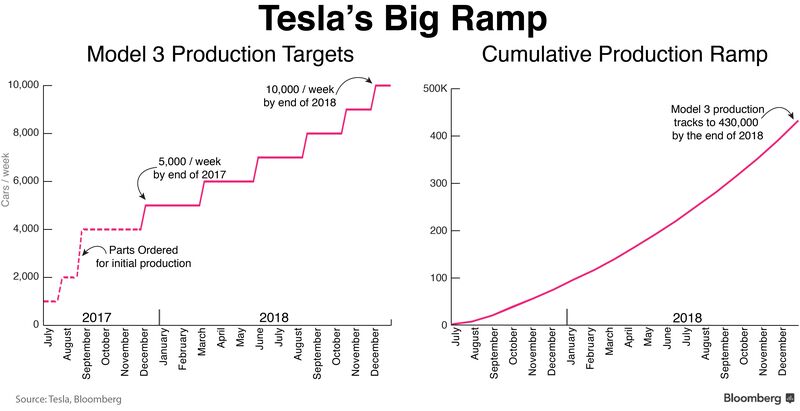
First, Musk said the company is placing orders with suppliers for “1,000 cars a week in July, 2,000 a week in August, and 4,000 a week in September.” 1 Tesla then plans to increase production to 5,000 cars a week by the end of the year, and 10,000 a week by the end of 2018. For context, the company is currently able to make about 2,000 Model S and Model X cars a week.
Here’s what the Model 3 ramp begins to look like.
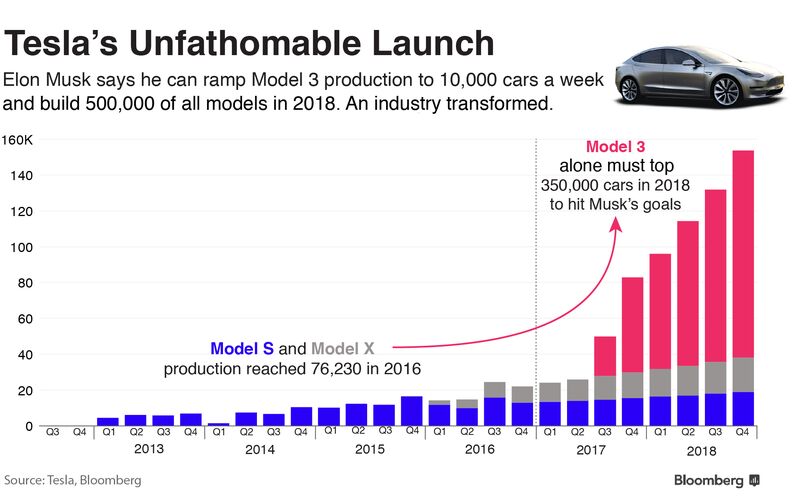
For Musk to hit all of his targets, Tesla would need to build about 430,000 Model 3s by the end of next year. That’s more than all of the all-electric cars sold planet-wide last year. The rollout will begin in California and move east, focusing on U.S. reservation holders. Even if half of the Model 3 inventory shipped to other countries, 2 U.S. sales under Musk’s targets would outpace the BMW 3 Series and the Mercedes C class—combined.
Another forecast Musk reiterated is that Tesla thinks it can build 500,000 total cars next year. 3 Model S and Model X growth would continue, but at a slowing rate. The chart below, as far as we can figure, is the ramp that Tesla is forecasting.
To sell that many $35,000 sedans in the U.S. “would be absolutely unprecedented based on what we know about car markets today and how people spend their dollars,” said Salim Morsy, electric car analyst at Bloomberg New Energy Finance. “It could happen. I’m pretty sure it won’t.”
Virtually every Wall Street analyst agrees. Even the most bullish among them don’t think Tesla can sell half a million electric cars next year, and Musk has a long history of never setting a deadline that he’s likely to keep. But it’s still important to understand the lofty targets Musk is setting, and some of the crafty ways he’s trying to make it happen.
Rewriting the rules for a car launch
Tesla is redefining how cars are developed, built, sold, and updated. Some of the tricks Musk plans to speed up the launch can only be done once. Others may transform the automotive industry much like Telsa’s over-the-air software updates. Here’s what we know:
Tesla is skipping “beta”—sort of. On Friday, Musk fired off a barrage of 50 messages on Twitter while on a flight to Cape Canaveral, Florida. Among them was a six second 4 , the first glimpse of what he calls a “release candidate” Model 3. The term is more typically used in the software industry, referring to a final version that’s almost ready for public release.
Musk is condensing the typical timeline for a car release. A traditional auto manufacturer spends about six months testing a beta cars prior to a rollout. Musk seems to have skipped a step, and is building test vehicles using the same equipment line that will feed mass production. If that’s the case—and this truly is a “release candidate”—then it implies that production is on track. The car looks very much like the vehicles Musk showed a year ago, and that fidelity to the original prototype will have helped keep engineers on schedule.
A standing army of testers. There’s tremendous demand for the Model 3 among Tesla’s 30,000 employees—most of whom are probably unable to afford the pricier Model S and Model X. Musk is putting that interest to use, releasing the first several thousand Model 3’s to employee reservation holders.
This is a huge advantage unique to the Model 3. As early problems are identified, they can be fixed at the work site. If there’s a hardware problem that requires a recall of the fleet—as happened with a seat defect in the first 2,700 Model Xs—employees need only drive to work to have them fixed. This means that even while Tesla shortens pre-launch testing, by the time production ramps up to a wider audience, the Model 3 may have nevertheless undergone more rigorous internal troubleshooting than most cars.
Features are being stripped down. One of the primary goals of last week’s Twitter barrage appears to be downplaying expectations for new features. Musk said there will only be one display—the car’s 15-inch touchscreen—with no additional gauges or heads-up-display projected at the windshield.
This is not good news for the Northeast part of the US. Winning the race of leading global warming does not come with any prizes.
Ironic, too, that an area of the US that is leading the way in use of renewables, efficiency, clean air standards, implementation of smart grids and demand response improvements could suffer more than most as the planet heats. Yet, their regional dedication to reducing emissions might, in fact, be there saving grace as they try to protect their cities and towns.
We like how this writer breaks out the discussion on a regional basis. There is no one blended solution. Each of us faces an individual risk. But, none of us can escape potential disaster and disruption unless we work in commuity to restore the Earth's balance and protect our one eco-system.
Parts of United States are heating faster than globe as a whole
On the other hand, no one lives in the average
climate. We live spread out north, west, east, and south. On islands,
large continents, inland or in coastal regions. Many of us want to know
what’s going to happen to the climate where we live. How will my life be
affected in the future?
This type of question is answered in a very recent study
published by scientists from the University of Massachusetts at
Amherst. The team, which includes Dr. Raymond Bradley and researcher Dr.
Ambarish Karmalkar looked specifically at the Northeastern United
States. They found that this area will warm much more rapidly than the
globe as a whole. In fact, it will warm faster than any other United
States region. The authors expect the Northeast US will warm 50% faster
than the planet as a whole. They also find that the United States will
reach a 2 degree Celsius warming 10–20 years before the globe as a
whole.
So why does this matter? Well first, it matters because
some of the effects people will experience are directly tied to the
temperature increase in their region. For instance, we know that warmer
air leads to more intense precipitation. In fact, we are already
observing increases in very heavy rainfall across the United States
(especially in the Northeast). Based on this new research, that trend
will only get worse. It means that winters in this region will get
warmer and wetter – more winter precipitation will likely occur as rain
rather than snow. This affects the availability of water into the spring
months. It also means that summers will have more intense heat waves
which will lead to more severe droughts.
However, there is another
impact to this study. We often hear that it is important to avoid
increasing the Earth’s temperature by 2°C if we want to prevent the
worst risks of climate change. This 2-degree target is somewhat based on
science and somewhat based on messaging and politics. There’s nothing
magic about this number. It isn’t like everything will be fine so long
as we stay below 2 degrees; similarly the world won’t end if we exceed 2
degrees.
It turns out that staying below a 2°C warming means
we think we have a reasonable chance of avoiding some of the worst
climate impacts and some of the potentially disastrous tipping points.
But this is really just an educated guess. Some people have argued
convincingly that our target should be lower, perhaps 1.5°C. Others
argue that even 2°C is not achievable.
Regardless of the
so-called temperature target, what this study shows is that even if we
do keep the globe as a whole to a 2°C temperature increase, some
regions, like the Northeast United States will far exceed this
threshold. So, what is “safe” for the world is unsafe for certain
regions.
Not to muddy the waters, but the whole issue of
“safe” versus “unsafe” also depends on what climate effects we are
concerned about and where we live. As an example, if you are concerned
about heavy precipitation and flooding in your area, then local climate
change (in your area) is pretty important to you. Conversely, if you are
concerned about sea level rise (which is a global phenomenon), then the
global temperature change is of most interest.
So really,
what this latest paper does is provide sound evidence that we need to
keep in mind BOTH the global and the regional climate effects. We need
to think about which effects we care about most and how the global and
regional temperature changes will cause those effects. Furthermore, we
cannot simply be lulled into a sense of safety even if we reduce
emissions dramatically and keep global temperature changes small. There
still could be large effects in our neighborhood.
Tremendous growth in a fairly new technology. Chillers are tremendously efficient. Good news for the economy...as that market grows--and environment: The key players in the chillers market are Daikin Industries Ltd. (Japan), Johnson Controls (U.S.), Trane Inc. (Ireland), Carrier Corporation (U.S.), Smardt Chiller Group (Canada), Thermax Inc. (India), Climaveneta S.p.A. (Italy), and other local players.
This report covers the chillers market, in terms of value, and forecasts its market size till 2021. The report includes the market segmentation by type - screw, scroll, centrifugal, absorption, and reciprocating; by end-use industry – chemicals & petrochemicals, food & beverages, medical & pharmaceutical, plastics, and rubber; and by region – Asia-Pacific, Europe, North America, the Middle East & Africa, and Latin America. Regions are further segmented by key country markets such as China, India, Japan, South Korea, Indonesia, Thailand, Taiwan, the U.S., Canada, Mexico, Germany, the U.K., France, Italy, Russia, Turkey, Italy, Brazil, Saudi Arabia, Qatar, U.A.E., and South Africa. The report also provides company profiles and competitive strategies adopted by the key players in the global chillers market.
Chillers are manufactured from various raw materials such as steel and non-steel compounds. These raw materials are supplied to the major manufacturers of chillers such Daikin Industries, Ltd. (Japan), Johnson Controls (U.S.), and Trane Inc. (Ireland). These manufacturers are also focusing on increasing their geographical presence by undertaking strategies such as joint ventures, expansions, and acquisitions. They are also providing advanced technology and effective cooling equipment by introducing new products.
Small wind applications have been talked about for many years now. Happily we are starting to see them. Wind is a great source of energy. Incredibly efficient. It was fast growing before. Now that it does not need to be big, ugly, hidden in remote locations, it will boom as we've never seen.
Wind Power is one of the fastest-growing energy industries in the world — and for good reason. Wind energy is 100 percent clean, and doesn’t pollute the air or water like fossil fuel-based power plants; it’s based upon an endless supply of energy that does not need to be imported and it is one of the most cost-efficient renewable energy technologies that exist today.
With all these advantages, one might ask, why we don’t see thousands of new wind turbines popping all around us. The answer to this question lies in a number of inherent challenges wind power engineers have been trying to resolve for decades.
Traditional wind turbines are quite large and therefore are usually installed in relatively remote locations, which, in turn, creates additional costs of building transmission lines to route the generated electricity back to the city. Noise and aesthetic pollution also ply their part: people are often reluctant to install tall industrial-looking turbines within city limits because of their noise and visual impact on the landscape.
However, one company is trying to change that by reimagining the traditional wind turbine design. New Wind, a France-based company will soon install a “garden” of their very unconventional tree-shaped turbines in the city of Paris at the Place de la Concorde. Unlike traditional long-bladed turbines, the new concept relies on an abundance of small cone-shaped generators capable of capturing the faintest winds (as low as 4.5 mph) to accumulate power.
The new 26-foot-high turbines are inspired by nature and are meant to blend in with the city landscape. In addition, their small size and vertical-axis rotation make them virtually unobtrusive.
The company’s founder, Jérôme Michaud-Larivière hopes that his tree-like turbines can be planted in urban areas next to real trees and generate electricity from small air currents flowing along buildings and city streets.
Although less efficient overall than conventional wind turbines, the ~ $30,000 power plants can still be profitable in just a year of average wind speeds of 7.8 mph.
If you've been following us for awhile, you know why: renewables are very competitively priced, as you will see here; they ifx costs long-term; they move production local and cut transmission; they allow you to build a mircrogrid, including storage, and garners a lot of independence from the grid. We think fixed cost is the greatest benefit. Every company hates unprictable expenses. Energy can be a huge hit to the bottonm line. Properly managed, though, it can be a huge asset.
Why Apple and Google are moving into solar energy
Silicon Valley’s biggest
companies are investing in renewable energy in a serious way – a sign,
perhaps, of rapid changes in the energy market.
By Chris Baraniuk
Most people think of Apple as a company
that makes phones, computers and smart watches – not an energy provider.
But in August all of that changed when the firm was given permission to
sell energy from a Californian solar farm that it acquired last year. Apple
has invested in renewable energy before and says it ultimately wants
all of its operations to be powered by 100% renewable sources. It’s not
alone in such efforts, either. Online retailer Amazon just announced the
construction of a new, 253-megawatt wind farm in West Texas.
Google, meanwhile, has invested in the Ivanpah Solar Electric
Generating System pictured above, and it recently joined forces with the
company SunPower to provide solar panels to home-owners. Why are tech companies so interested in renewables? “For
these big corporations, electricity is one of their biggest costs,”
says Ash Sharma, a solar energy analyst at IHS Technology. “Locking that
in at a low price is really critical for them.” It takes a lot of energy to power modern data centres.
Besides running servers 24/7, all that machinery needs to be kept cool –
a huge cost by itself.Why, though, would Google be interested in
putting solar panels on people’s homes? The firm says it wants to map
“the planet’s solar potential” – the data from these panels, including
their uptake, could inform future energy strategies. And yet the price of solar energy has been falling more quickly than some expected. At an energy auction in Abu Dhabi in the United Arab Emirates
last month, a Japanese and Chinese consortium bid to build a solar farm
that would produce energy at less than 2.5 cents per kilowatt hour –
that’s significantly cheaper than the average cost of energies like gas
and coal in the US, and by far the lowest bid for a solar farm yet.
Amazon is investing in wind farms to power its servers (Credit: Getty Images)
Sharma thinks the falling cost of solar energy has a lot to do with a boom in solar panel manufacturing. “There’s
been huge manufacturing capacity added in China,” he explains. “[The
country] accounts for roughly 80% of all the world’s manufactured solar
panels.” And as the cost of building a solar farm plummets, the
world has witnessed a rise in jaw-droppingly big installations. Only a
few years ago, says Sharma, a 50-megawatt project might have been considered big. But there are now several facilities poised to produce a few hundred megawatts or more. This includes the world’s largest – a 750-megawatt power station in Madhya Pradesh in India. It’s been modestly named “Rewa Ultra Mega Solar” and authorities hope it will be finished in 2017. While
all of this is going on, some exciting research into better solar cells
is also underway. Some new, experimental panels use synthetic materials
that mimic the crystal structure of perovskite, a mineral. This makes
the cells cheap to produce and, although still in development, such
panels are increasingly efficient. Solar still only accounts for about 1% of the world’s total energy resources,
but with a continuing rise in supply, that looks set to change. And
Sharma adds that there will be an ongoing effect on prices. IHS
Technology expects the cost of solar energy to plummet “by about 30%”
next year, he says. The tech giants are some of the largest and
most powerful companies in the world. Maybe it’s not really a surprise
that they’re getting into energy because, as they know very well,
everything else depends on its production.