Thursday, January 25, 2018

Claire DiMattina on McDonald’s New Packaging Goals

Continued good news on the food and corporate side.  As you know McDonald is suck a big player.  When they get green, it is very meaningful and sets the tone for others:

McDonald’s director of U.S. Public Affairs sat down with Food Tank to discuss the world’s largest restaurant company’s new 2025 goals for packaging and recycling.

McDonald’s, the world’s largest restaurant company, has announced two new goals focused on packaging and recycling that it plans to meet by 2025 in each of its 37,000 restaurants.
First, the company hopes to make 100 percent of its customer packaging out of renewable, recycled, or certified sources, up from
50 percent today. This goal dovetails with McDonald’s previous promise to stop using packaging that contributes to deforestation by 2020, which is currently on track at 64 percent deforestation-free, according to CNN.
Second, the company plans to provide access to recycling in all of its locations, up from only 10 percent of them today. Many regions in which McDonald’s operates do not currently have recycling infrastructure, meaning that this pledge could have a significant impact in changing how waste is dealt with in communities globally.
Ahead of the announcement, Food Tank had the opportunity to sit down with Claire Benjamin DiMattina, McDonald’s senior director of U.S. Public Affairs, to discuss the process by which McDonald’s arrived at these goals, the challenges they predict will arise, and the impacts they hope to see from their success.
Prior to her position with McDonald’s, DiMattina was the executive director of D.C.-based Food Policy Action (FPA), an organization committed to holding legislators accountable for actions that affect food and farming. DiMattina led FPA through the development of the annual National Food Policy Scorecard, which grades lawmakers on votes and sponsorships that impact public health, food access and affordability, farmer and farmworker livelihoods, and the environment.
Food Tank (FT): What prompted McDonald’s to make this move now and what has the immediate response been? Do customers and the public think you are going far enough? Are you getting any resistance from franchisees, suppliers, or shareholders?
Claire Benjamin DiMattina (CBM): We are in the process of evolving our 2014 Global Sustainability Framework into a new set of forward-looking strategies for 2030. Collectively, we made great progress against our 2014 goals and learned a lot. We’re taking those lessons learned and pushing our goals even further, in line with our customers’ expectations, our major business priorities in the company’s Velocity Growth Plan, and our areas of greatest responsibility and opportunity to drive transformational change.  
Our journey in packaging sustainability started several decades ago when we transitioned away from the polystyrene foam sandwich box in the early 1990s as part of broader efforts to minimize waste. We know our customers care about recycling and more sustainable packaging, and clearly it is a critical environmental issue. McDonald’s global packaging and recycling goals demonstrate our commitment to become a better company and an example of how we can make a positive impact in the communities we serve.
We’re taking the opportunity to bring together our existing work on sustainable fiber packaging and restaurant recycling into a more holistic strategy that addresses the packaging lifecycle from design to recovery. We’re also taking an ambitious step forward by expanding our sustainable packaging scope to include all packaging (not just fiber).
Our approach to recycling has evolved from a volume-based goal to an activity-based goal specifically focused on customer-facing recycling. With these changes comes a greater potential to drive action and track progress.
We’re looking at these opportunities globally and thinking through how we can help drive innovation and collaboration to support local waste infrastructure improvements. From design to implementation, we can’t do it alone, and we’re excited to partner with others along the journey.
McDonald’s cannot do this alone. Therefore, it will be imperative for McDonald’s to work with suppliers, franchisees, municipalities, and other industry leaders to affect change and influence action. We’re just getting going on the new strategy—more to come in this area.
As one of the largest restaurant companies in the world, we have a unique opportunity to influence change. Our 2025 goals are ambitious and we look forward to effecting change by leveraging our scale and reach to help drive capacity in the recycling sector, innovation in responsible package design, and environmental awareness among millions of guests and restaurant employees each day.
We know it will be hard, but together with our suppliers, franchisees, municipalities, and other industry leaders, we’ll be able to affect change and influence action.
Our new packaging and recycling goals are something that our customers want. We know they care about recycling and more sustainable packaging and we believe our owner-operators are relentlessly focused on meeting customer needs, as well. We’re also providing resources like bin design, customer education, and new packaging design to help our franchisees around the world.
FT: Beyond the 2025 goal, how do you think McDonald’s will continue to evolve? How are food trends like organic produce, improving animal welfare, and reducing food waste changing the game?
CBM: Today, we’re focused on our announcement on packaging and recycling, but this is just one piece in a much broader conversation around our efforts to be a responsible leader on a variety of topics.
We want to use our scale for good and always keep raising the bar on what it means to be a responsible company committed to people and the planet. There will be more news to come later in the year, and we can’t wait to show you what’s next.
FT: How does McDonald’s respond to the criticism that your corporate sustainability platform, including this commitment to more sustainable packaging, is a form of greenwashing?
CBM: Operating in 37,000 communities across more than 100 countries, there are going to be a range of opinions about our work. We make a point to listen to our customers’ feedback and stakeholders across the system.
McDonald’s works closely with a number of stakeholders to inform and collaborate across our sustainability efforts. We are excited to partner with credible NGOs to inform our strategies and set goals, acknowledging the latest research and data. We will track and share progress against our commitments on a regular basis. And we will continue to listen to and work with these stakeholders as we make progress on this journey.
We know that there are going to be a lot open questions throughout this process. We’re depending on collaboration and partnerships with other industry and NGO partners to ensure we are collectively making progress.
FT: What were some of the challenges that McDonald’s learned from while achieving 50 percent of guest packaging coming from renewable, recycled, or certified sources?
CBM: Packaging represents a large and complex supply chain. Partnership and engagement with stakeholders from forest land owners through processers and distributers is paramount to achieving these goals. Reaching our targets is an evolving and iterative process that requires continual engagement, learning, and partnering across the supply chain in order to be effective.
The sourcing of materials is just one part of sustainability with packaging. Our new approach addresses both ends of the life cycle—design, sourcing, and recovery—whereas our prior packaging goal was focused only on sourcing. We’ve taken this approach because while we can design for packaging to be recycled, we depend on infrastructure for recycling and on guests to participate in recycling programs, at restaurants and in communities.  
As described in our 2016 packaging report that you can access here, making progress on any sustainability issue hinges on a collaborative approach. Sustainable fiber sourcing is no exception. So we work closely with experts, industry leaders, and producers—large and small—to identify lasting solutions and make them a reality.
A great example of this is our participation in WWF’s Global Forest & Trade Network(GFTN). McDonald’s joined GFTN in October 2014 as the group’s first global restaurant company member. The GFTN is an initiative convened by WWF to bring together companies across the global forests product supply chain with a shared goal of eliminating illegal logging, improving forest management, and making the global marketplace for forest products a force for social and environmental responsibility.
McDonald’s participation in GFTN brings us access to technical experts and industry leaders to help us achieve our 2020 fiber-sourcing goal and our Commitment on Forests. In return, we bring to GFTN our global reach and influence to help WWF expand their protection of global forests and increase demand for and awareness of responsible forestry practices, particularly those detailed within FSC forest certification standards. We also commit to setting and reporting annually against our fiber-sourcing targets.
FT: How will McDonald’s eliminate deforestation from their fiber-based packaging supply chain
CMB: As with all aspects of our sustainability strategy, we’re focused on the most high-risk—and high-impact—areas of fiber sourcing to drive progress. In 2015, we continued our collaboration with WWF to map the majority of our consumer-facing paper packaging fiber supply chain against countries where pulp plantations for paper are known drivers of deforestation. As of 2014, we found that less than 12 percent of the fiber for our consumer packaging may have come from these high-risk countries. To address this risk and to avoid deforestation in our packaging supply chain, we will prioritize pursuing Forest Stewardship Council (FSC) certification for any fiber sources from these high-risk countries, and achieve that by 2020 at the latest.
We’ve made significant progress on fiber-based packaging, which comprises around 80 percent of what we use. As of 2016, 64 percent of our fiber packaging comes from certified or recycled sources.
Although the majority of our packaging is fiber-based, approximately 20 percent remains in plastic mainly for functional property needs. Now, we are expanding our goal to include renewable and recycled plastics. This is an important area for innovative solutions going forward.
FT: How does McDonald’s plan to confront the fact that recycling infrastructure is different in every municipality, and non-existent in many?
CMB: We acknowledge that recycling infrastructure, regulations, and consumer behaviors vary city to city and country to country, requiring a variety of solutions. As a baseline, we will work with our franchisees to phase in sorting and recycling options, beginning with the most practical solutions, such as adding options for recycling one material such as paper cups, and eventually expanding the program to recycle paper, plastics, and cans where relevant.
McDonald’s cannot do this alone, therefore it will be imperative for McDonald’s to work with suppliers, franchisees, municipalities, and other industry leaders to affect change and influence action. McDonald’s is working with communities and engaging in partnerships to reach these goals. In markets without recycling infrastructure, we will implement a plan that includes:
  • Establishing a market lead devoted to recycling and packaging efforts
  • Conducting a market assessment of infrastructure and exploring the viability of recycling via backhauling with distribution partners
  • Engaging in conversations and partnerships with NGOs and other companies to advance the dialogue on increasing recycling infrastructure in market
  • And developing a roadmap to establish recycling in restaurants, starting with one packaging item, based on information learned from activities above
Because we have restaurants in more than 100 countries around the world, we can learn from markets that already offer recycling to understand what has worked best for them in order to help markets where infrastructure may not exist yet.
Current policies such as China’s National Sword program have disrupted the recycling market, causing prices of recyclable commodities to fluctuate, as well as the ability to recycle certain items in some markets. This announcement has resulted in some headwinds to reach our target. However, it has also catalyzed the waste industry to innovate and identify different possibilities for recycling locally. We will continue to partner with other businesses and NGOs to advance the circular economy.

Wednesday, January 24, 2018

Moe on the new tariffs from BBC

Trump says no trade war despite Asia outcry over tariffs


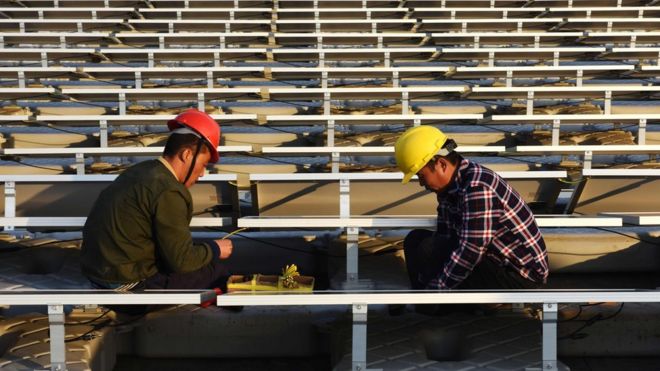
Men in hard hats work on a solar power plant in China

US President Donald Trump has brushed off concerns that new tariffs the US has imposed on imported washing machines and solar panels will lead to a trade war.
The announcement of the tariffs - of up to 50% - have prompted outcry from China and South Korea, the primary targets of the measure.
Some US businesses that rely on the imported products are also concerned.
Mr Trump dismissed the talk and said the tariffs would add jobs in the US.
At a signing ceremony on Tuesday, he said they "demonstrate to the world that the United States will not be taken advantage of any more."
"There won't be a trade war," he later added.
The action is part of US President Donald Trump's "America First" trade policy, which aims to protect local manufacturers from foreign competition.
South Korea said it would complain to the World Trade Organization (WTO).
China, the world's biggest solar panel producer, said the move was an "overreaction" and pledged to "work with other WTO members to resolutely defend its legitimate interests".
India's Prime Minister Narendra Modi spoke against tariffs at the World Economic Forum in Davos in an apparent reference to the US measures, although India's own finance ministry is planning a 70% tariff on Chinese solar panels.
"Forces of protectionism are raising their heads against globalisation. Their intention is not only to avoid globalisation themselves but they also want to reverse its natural flow," Mr Modi said.
Samsung, a South Korean company, said consumers in the US would be negatively affected by the measures.
"Everyone will pay more with fewer choices," a company statement said.
South Korea's LG Electronics also said the move would harm employment prospects at its new factory.
Mexico said it was "regrettable" that it was not excluded from the tariffs, adding that it would "use all available legal resources in response to the US decision".
In the US, the Solar Energy Industries Association, which campaigned against the decision, estimated that 23,000 American jobs would also be lost. It believes the US will not be able to keep up with demand for panels, meaning there will be less work for those producing complementary technology and fittings.

Why have the tariffs been imposed?

The tougher policy was approved by President Trump after the US International Trade Commission (ITC) found local manufacturers were being hurt by cheaper imports.
Manufacturing companies - Whirlpool, a US-based maker of washing machines, and the solar firms Suniva and Solar World Americas - had complained to the ITC and it found in their favour.
The ITC said that China had been selling "artificially low-priced" solar components in the US, assisted by state subsidies.
Mr Trump has talked about taking the action ever since coming to office. In his inauguration speech a year ago he promised to protect US borders from other countries "making our products, stealing our companies and destroying our jobs".
The actions are being seen as the president's most significant trade moves since his decision to pull the US out of the Trans-Pacific Partnership deal (TPP) and renegotiate the North American Free Trade Agreement (Nafta).
However, some pointed out that the US has been moving increasingly towards protectionism in recent years. According to research by international law firm Gowling WLG, the US has made 1,085 more protectionist measures than liberalising ones since 2009.

How will the tariffs work?

The first 1.2 million imported large residential washing machines in the first year will have a 20% tariff imposed on them, while there will be a 50% tariff on machines above that number.
By the third year, these will drop to 16% and 40% respectively.
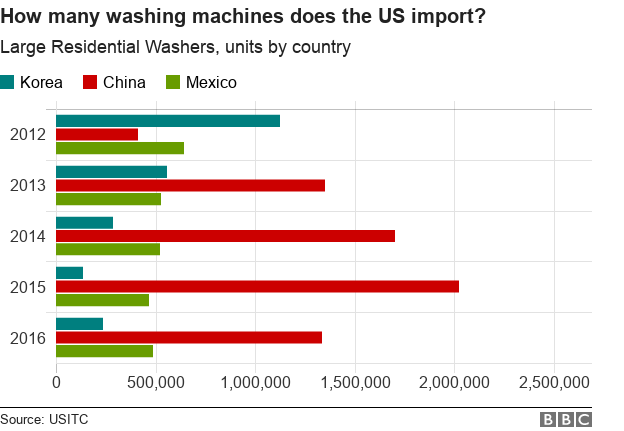
In a report published last month, the ITC found that high numbers of imported washing machines were damaging domestic manufacturers, and that Chinese imports had overtaken those from South Korea.
chart of washing machine imports to the US by country, showing growth for Chinese imports
Meanwhile, the tariff increase on imported solar cells and modules in the first year will be 30%, falling to 15% by the fourth year, although 2.5 gigawatts (GW) of imported cells - enough for about 11.5 million panels - will be allowed in tariff-free annually.
Environmentalists argue that making solar panels more expensive risks holding back the development of renewable energy in the country.

What does it mean for the solar industry?

Taylor Kate Brown, BBC News, Washington
The Trump administration has imposed these tariffs as part of a larger promise to protect American manufacturing - including the solar industry firms that brought the original complaint to the trade commission. But what the "solar industry" means in this context is complicated.
The tariffs were opposed by America's largest solar industry group - the Solar Energy Industries Association (SEIA). SEIA said Suniva and Solarworld had used the complaint to cover for bad business practices - and pointed out the two companies are actually foreign-owned even though the produce panels in the US.
SEIA's position was also driven by the fact the group represents thousands of solar installers - an industry that's seen explosive growth, driven in part because of the dropping cost of panels. Firms that specialise in larger solar "farms" that sell their energy to US utilities are particularly worried about the decision, as they compete directly with coal, natural gas and wind producers.
Ironically, the decision could mean more competition for Suniva and Solarworld, as several foreign firms may be interested in moving production to the US.

What has the reaction been?

South Korea's trade minister, Kim Hyun-chong, said the tariffs "put political considerations ahead of international standards".
"This government will actively respond to the spread of protectionist measures to defend national interests," he said.
South Korea said it would complain to the World Trade Organization (WTO), calling the tariffs "excessive" and "regrettable". Its manufacturers, including Samsung and LG, compete in the washing machine market with US firms such as Whirlpool.
Samsung called the tariffs "a tax on every consumer who wants to buy a washing machine".

Trump Declares SOLAR TARIFFS on China. Is This Smart Business?/RNN

Today's show focuses on the possible ramifications--for the solar industry, for job creation, for the US economy and for the resurrection of fossil fuel?  Tune in today from 1-2p as we talk with experts on what you should expect from this decision.

SEE MORE AT OUR MAIN NETWORK SITE:  http://www.renewablenownetwork.com/trump-declares-solar-tariffs-china-smart-business/


Is a trade war about to start? Is job growth in the U.S. about to slow down? What is President Trump thinking?
The Solar Energy Industries Association (SEIA) – the national trade association for the U.S. industry – and its members expressed disappointment in the decision by President Trump to impose 30 percent tariffs on imported solar cells and panels.
The decision effectively will cause the loss of roughly 23,000 American jobs this year, including many in manufacturing, and it will result in the delay or cancellation of billions of dollars in solar investments.
“While tariffs in this case will not create adequate cell or module manufacturing to meet U.S. demand, or keep foreign-owned Suniva and SolarWorld afloat, they will create a crisis in a part of our economy that has been thriving, which will ultimately cost tens of thousands of hard-working, blue-collar Americans their jobs,” said Abigail Ross Hopper, SEIA’s President and CEO.
The impact of the decision will be far-reaching across all sectors of the solar economy, SEIA members said.
“It boggles my mind that this president – any president, really – would voluntarily choose to damage one of the fastest-growing segments of our economy,” said Tony Clifford, chief development officer, Standard Solar. “This decision is misguided and denies the reality that bankrupt foreign companies will be the beneficiaries of an American taxpayer bailout.”
SEIA estimates that a tariff at this level will eliminate, not add to, American manufacturing jobs. There were 38,000 jobs in solar manufacturing in the U.S. at the end of 2016, and all but 2,000 made something other than cells and panels, the subject of this case. Those 36,000 Americans manufactured metal racking systems, high-tech inverters, machines that improved solar panel output by tracking the sun and other electrical products.
“There’s no doubt this decision will hurt U.S. manufacturing, not help it,” said Bill Vietas, president of RBI Solar in Cincinnati. “The U.S. solar manufacturing sector has been growing as our industry has surged over the past five years. Government tariffs will increase the cost of solar and depress demand, which will reduce the orders we’re getting and cost manufacturing workers their jobs.”
“This is a bad day for the U.S.,” said Costa Nicolaou, president and CEO of PanelClaw, an American racking company. “What’s most disappointing is that the president sided with two foreign-owned companies and didn’t listen to Americans from across the country and political spectrum who understood tariffs will cause great economic pain for so many families in the solar sector.”
While the case will undoubtedly have negative effects on the industry, SEIA pointed out that the tariffs were nowhere near as bad as what Suniva and SolarWorld requested. SEIA also looks forward to working with interested parties to achieve a positive outcome in the existing antidumping and countervailing duty cases.
“While we believe the decision will be significantly harmful to our industry and the economy, we appreciate that the president and the administration listened to our arguments,” Hopper said. “Our industry will emerge from this. The case for solar energy is just too strong to be held down for long, but the severe near-term impacts of these tariffs are unfortunate and avoidable.”


Monday, January 22, 2018

Which countries are achieving the UN Sustainable Development Goals fastest?

Is this a race?  It is.  It is critical, in fact, that countries race to complete the Development Goals.

Interested in who is winning?  Here's a good article for you:


The ultimate aim of the Sustainable Development Goals, which replaced the Millennium Development Goals in 2015, is to end poverty, protect the planet and ensure prosperity for everyone. Each goal has specific targets that need to be met by 2030.
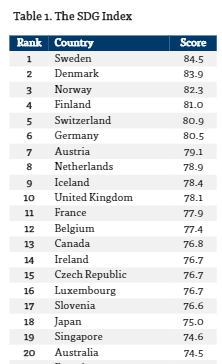
So how close are countries to meeting them? To find out, non-profit organization Bertelsmann Stiftung and the UN Sustainable Development Solutions Networkhave created a prototype index that measures their performance.


The SDG Index measures 149 countries, comparing their current progress with a baseline measurement taken in 2015.
Here are the top performers this year:


Across all 17 goals, Sweden tops the list of countries surveyed. It is, on average, 84.5% of the way to achieving the targets envisaged for 2030.
Following closely were Scandinavian neighbours, Denmark and Norway, with Finland in fourth place. Western European countries, plus Iceland (ninth), took the remainder of the top 10 slots and four of the top 20.
Also in the top 20 were Canada (13th), the Czech Republic (15th) and Slovenia (17th). Asia-Pacific’s top performers Japan, Singapore and Australia rounded off the list at 18th, 19th and 20th, respectively.


Friday, January 19, 2018

Save the Snowpack, Save the Water Supply/Bloomberg

Water, too much, too little, continues to loom as our greatest environmental and, very likely, economic challenge. Protecting natural capital, without disrupting natural habitat and infrastructure, particularly around growing urban centers, is key to our balance and quality of life.

Here's a good piece looking at snow fall, how its changing, and whether it will be sufficient to provide ample water to the southwest of the US:


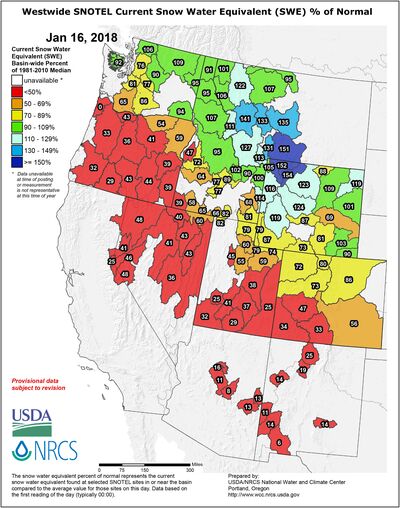
Snowpack is 50 percent lower than the average at this point in the winter at dozens of basins in the region. It’s a major concern in a region with a growing population where water supplies are often pushed to their limits, even in good years. In addition to fueling the West's winter tourism industry, the snow provides a steady supply of water for the Colorado River, which serves 40 million people spread from Denver to Los Angeles.
The problem is not just a lack of snow, but changes in how it is falling and melting. Think of the snowpack as a natural reservoir. During the winter, it freezes in place. When temperatures rise in the spring, the water within is released gradually, filling reservoirs through the rest of the year. That pattern is fracturing around the world. A studyreleased Wednesday by the University of Potsdam also found less available water from snowpack in High Mountain Asia from 1987 to 2009. 


In the western U.S., the snow line is receding to higher elevations—typically above 8,000 feet. Below that line, rain is often falling instead of snow, meaning less precipitation is stored in the snowpack. A big storm might send water to reservoirs, but many pools weren’t built to hold a deluge of rain. As a result, they often have to release the water to avoid flooding.


Without predictable snowpack melts, “it reduces reliability on the supply side,” said Demetri Polyzos, a senior engineer for the Metropolitan Water District, the wholesale water agency for Southern California.
There have been bad starts to the snow season before, and climatologists say it’s too early to rule out the possibility that the Western snowpack will bounce back. But even if it does return to average—or above average—levels, researchers said it is unlikely that critical waterways like the Colorado River would get their normal runoff.
“As it warms, you get less runoff,” said Jonathan Overpeck, a climate scientist at the University of Michigan who co-authored the Colorado River drought paper with Udall.
The short-term effects may be manageable. Because 2017 was a wet year, most reservoirs have enough stored water to satiate municipal and agricultural demand through even a dry, hot summer. But water managers still need to respond to the long-term threat.
Western snowpack could decrease by an average of 60 percent over the next 30 years due to anthropogenic warming and natural climate trends, according to an article published last year in Nature.
Climate change will require a coordinated effort in how vital water supplies such as the Colorado River are distributed. Southern California, for instance, has diversified its portfolio with local supplies (desalination plants, recycling water and adding groundwater storage), invested in infrastructure and urged conservation. Arizona, California and Nevada are in the process of negotiating a drought contingency plan to reduce the burden on Lake Mead, the reservoir behind the Hoover Dam that has dropped to 39 percent of capacity.
Pat Mulroy, a Brookings Institution senior fellow known as the “water czar”  for her blunt assessments as head of the Southern Nevada Water Authority, said the drought plan is but one arrow in a quiver, not a silver bullet.
"For water managers in the West, it means if there has ever been a time for partnership and creative solutions, that time has come,” Mulroy said. “The time to dance around it is over.


Schneider Electric Working to Restore Power to Puerto Rico With a Unique Off-Grid Solution/RNN

We know micro grids are part of our new energy future.  We see it here in the aftermath of great devastation, and lack of power, in Puerto Rico.


Hurricane Maria swept through Puerto Rico over 90 days ago and many residents are still without power, making this the longest major blackout in U.S. history. Officials have estimated it could take four to six months to restore the power grid to full functionality. Schneider Electric is supporting the rebuild of several major solar and energy storage plants and aiding the locals by rapidly deploying off-grid products to regain power to their homes.
One thousand Conext XW+ hybrid inverters at 5.5 kW and 6.8 kW power levels are being made available to distributors in Puerto Rico. “Schneider Electric is continuing to support relief efforts in Puerto Rico. The Conext XW+ hybrid inverter is a unique off-grid solution. Our intent in supplying these units is to retrofit the existing non-functional photovoltaic systems that can provide much-needed power immediately. When the grid comes back online, the Conext XW+ units will work in conjunction with the grid and support its capabilities over the long term,” said Evan Vogel, vice president of marketing, Schneider Electric Solar.
As a business with a large local presence in Puerto Rico, local Schneider Electric teams are working with customers to offer relief to the affected areas. The primary focus is to ensure people regain access to reliable, safe energy as soon as possible.