Wednesday, October 3, 2018

New Study Shows Climate Change Could Reduce Scallop Population/NPR

Here we see, again, concurrent environmental and economic damage from coastal water changes.  As we see the risks continue to increase.


Researchers in Massachusetts say under the worst case scenario, climate change could reduce the scallop population by more than 50 percent in just a few decades, which could be bad news for New Bedford’s lucrative fishing port.
n 2016, commercial fishermen landed more than $300 million worth of fish at the Port of New Bedford, and 85 percent of that value came from scallops.
A new study from Woods Hole Oceanographic Institution shows as carbon emissions in the atmosphere increase, so does the acidity in the ocean.
Jennie Rheuban, lead author of the report, said that could affect how well scallops can grow.
"Adults may actually be growing slower and calcifying less quickly under these acidified conditions because it’s more difficult for them to lay down calcium carbonate as a shell," Rheuban said. 
Rheuban said ocean acidification could also cause scallops to become more vulnerable. 
"They aren’t able to swim quite as well when they’re experiencing acidified conditions, and so we hypothesize that under acidification, scallops may be more susceptible to predation," she said. 
Rheuban said reducing carbon emissions and continued management of the fishery could prevent the scallop population from declining so drastically.
The results of this study are estimates based on how ocean acifidication could impact related shellfish species since scallop-specific reports have never been published, Rheuban said. 

Wednesday, September 26, 2018

Antarctica's big secret: Active volcanic heat found under Pine Island Glacier

Antarctica's big secret: Active volcanic heat found under Pine Island Glacier

by Chris Ciaccia

Researchers have made a shocking discovery under the Pine Island Glacier in Antarctica — an active volcanic heat source, which they say has played a "critical role" in the movement and melting of the glacier.

The scientists were looking at the role the ocean plays in causing glaciers to weaken when the discovery was made.

“We were looking to better understand the role of the ocean in melting the ice shelf,” Assistant Professor Brice Loose of Newport, R.I., a chemical oceanographer and lead author of the paper, said in a statement.

Loose added that the group was "sampling the water for five different noble gases, including helium and xenon," when the discovery was made.
“We weren’t looking for volcanism, we were using these gases to trace other actions,” Loose said. “When we first started seeing high concentrations of helium-3, we thought we had a cluster of bad or suspicious data.”

Loose said the presence of helium-3 is a "fingerprint for volcanism," noting it's relatively abundant in the seawater at the Pine Island shelf.

University of East Anglia Professor Karen Heywood, who also worked on the study, said the presence of volcanoes just means there's an additional source of heat to melt the ice.
"It will be important to include this in our efforts to estimate whether the Antarctic ice sheet might become unstable and further increase sea level rise," Heywood said.

Last year, significant parts of the Pine Island Glacier separated from the main shelf. In February 2017, a piece of the glacier approximately 1 mile wide separated. And in September 2017, a chunk of ice nearly four times the size of Manhattan separated from the Pine Island Glacier, according to LiveScience.

The amount of ice going into the ocean is staggering, measured in gigatons, Loose said. A gigaton is equal to 1 billion metric tons.

It's well understood that the West Antarctic Ice Sheet lies on top of a large or major volcanic rift system, but there has been no current magmatic activity, Loose noted. The last recorded activity was 2,200 years ago, but the volcanic heat discovered is new. Loose said it's impossible to measure the normal indicators of the volcanism, including heat and smoke, because the rift is so far below the ice.

Despite the discovery of the volcanic heat, the researchers noted that climate change is still the driving force for melting the ice, something other studies have repeatedly backed up, Loose said.
“Climate change is causing the bulk of glacial melt that we observe, and this newly discovered source of heat is having an as-yet undetermined effect, because we do not know how this heat is distributed beneath the ice sheet," Loose said.


Tidal stream turbine generates more than 3GWh in first year of testing

Tidal stream turbine generates more than 3GWh in first year of testing

Scotrenewables tidal unit 
A 2-MW floating tidal stream turbine deployed at the European Marine Energy Centre has generated more than 3 GWh of electricity in its first year of testing.

During 12 months of continuous operation, the SR2000 turbine supplied the equivalent annual electricity demand of about 830 UK households, according to a press release, and at times has been supplying more than 25% of the electricity demand of the nearby Orkney Islands.

“The team at Scotrenewables believes that this, combined with Meygen’s generation of over 8GWh over the past year from four tidal turbines deployed in the Pentland Firth, is convincing evidence of tidal power’s market readiness,” Scotrenewables said.

“The ability to easily access the SR2000 for routine maintenance has been a significant factor in our ability to generate electricity at such levels over the past 12 months, including over winter,” said Andrew Scott, chief executive officer of Scotrenewables Tidal Power. “In addition, accessing the SR2000 using “RIBs” and other similar types of low-cost vessel means that our operating costs and outage times are kept to a minimum.”

The deployed technology is a floating unit housing two 1-MW turbines each connected to a 16-m-diameter rotor. The SR2000 weighs about 600 tons and is 64 m long. It was designed to DNV-GL standards with a 20-year design life. Scotrenewables says this unit can be installed in water depths of more than 25 meters and can be deployed with a range of anchoring systems to suit most seabed types.

While a very small percentage of homeowners actually have solar photovoltaic systems on their roof, chances are they have already been exposed to solar energy.

The company plans to start building a 2-MW commercial production unit later this year, with support from the EU’s Horizon 2020 scheme. This unit also will be tested at EMEC before the company “targets sales of the turbine.”

Saturday, September 22, 2018

27 Organizations in New York City Combating Food Waste/


,

The 2nd Annual New York City Food Tank Summit on October 3rd entitled “Focusing on Food Loss and Food Waste” is only two weeks away and now completely sold out! It’s going to be an incredible, inspiring, and unforgettable day! 

Food journalists from CNN, The Wall Street Journal, The New York Times, New York Magazine and more will be leading conversations on stage with more 30 incredible speakers!

If you (or please pass the word to someone you think might be interested) still want to attend the event—the only way to get in now (other than if you are a journalist) is through volunteering! We still have 25 volunteer shifts to fill and most roles will allow you to see either most or all of the event live (also includes breakfast, breaks, and lunch)! Interested in helping? Please email vanesa@foodtank.com. 

We will be streaming the entire event live completely free at FoodTank.com and on Food Tank’s Facebook page. If you can’t join us live, we will be airing some of the sessions on our podcast “Food Talk with Dani Nierenberg” and posting videos on Food Tank’s YouTube channel. If you still want to attend in person, we will do our best to accommodate: please join the waiting list and we will fill those spots on a priority basis as we get word of cancellations. 

If you can’t join us in New York City, you can still get tickets for our first ever San Diego Summit called “Growing the Food Movement,” with 30+ speakers in partnership with the Berry Good Food Foundation and University of California—San Diego. Click HERE to purchase your tickets—this summit will sell out! 

As we count down to October 3rd, Food Tank is highlighting 27 organizations in New York focusing on food loss and food waste: BK ROT, City Harvest, The Cornell Waste Management Institute, Excess NYC, The Foodstand, Food Recovery Network, The Food Waste Reduction and Diversion Reimbursement Program, Green Bronx Machine, GrowNYC, Harlem Grown, Hunger Action Network of New York State, Hunter College NYC Food Policy Center, James Beard Foundation, Long Table Harvest, The Lower East Side Ecology Center, Natural Resources Defense Council, New York Food Bank Association, NY Common Pantry, NYC Food Waste Fair, New York State Food Recovery Campaign, Rescuing Leftover Cuisine, Rethink Food NYC, The Rockefeller Foundation, Square Roots, Sustainable Restaurant Corps, Two Birds, One Stone, and Ugly Produce is Beautiful.

Read more about these organizations and share this article on Food Tank by CLICKING HERE.

The Summit is held in partnership with the Hunter College NYC Food Policy Center, Natural Resources Defense Council, NYU, ReFED, and The Rockefeller Foundation. Food Tank NYC Summit event sponsors include the Barilla Center for Food and Nutrition (BCFN), Driscoll's, Edible Manhattan, Food For All, the Food Recovery Network, Great Performances, Mother Jones, Nature's Path, Niman Ranch, Organic Valley, and Sealed Air.

Which organizations and food heroes inspire you to limit food loss and food waste? Please email me at danielle@foodtank.com to share with us!

Rich Americans are last in sustainable investing, UBS says/Bloomberg

This is sad and frustrating.  Some of the people who could most help fuel our clean growth remain on the sidelines.  Why?  Do they not see and like the returns thrown off by ESG-style funds?  Do they now recognize transformation in corporate America and believe the best companies, going forward, will manage to triple-bottom line results?

Shifting investments into new tech, smart grid, waste reduction, efficiency, clean energy, eradication of waste of all kinds, specially on the food side, is key.  How do we get wealthy individuals on board and part of the change?

 UNITED STATES millionaires lag behind the global average in environmental, social and corporate governance-related investments. / BLOOMBERG NEWS

NEW YORK – American millionaires are lagging behind wealthy counterparts elsewhere when it comes to sustainable investing.
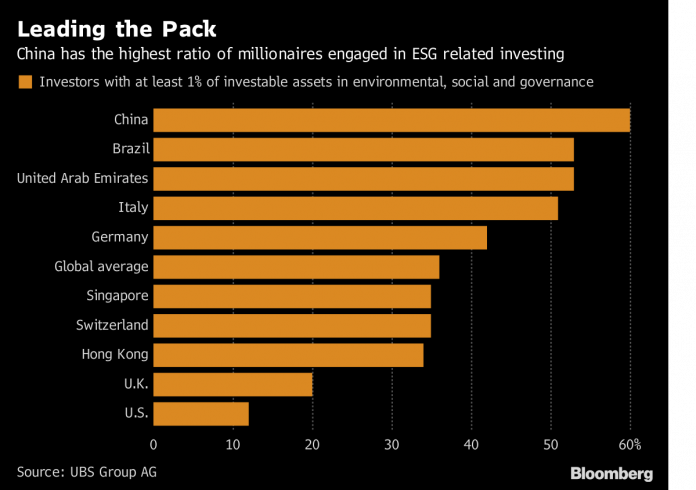
United States investors ranked last among those surveyed in 10 countries with at least $1 million of investable assets, with only 12 percent claiming to have put money into environmental, social and corporate governance-related holdings, according to UBS Group AG. That compares with 60 percent of respondents in China and 53 percent in Brazil.
“Americans are focused on making money,” said Cary Krosinsky, who teaches sustainable investing at Yale and Brown universities. “Business is business.”
Sustainable investing incorporates broad societal concerns and personal values into investment decisions, while generally still trying to make a market-rate return. This can include such areas as investing in renewable energy, development debt or strategies aimed at promoting gender diversity.
While pension funds and other institutional investors control a large part of the market and have been leaders overseas, individuals in the U.S. haven’t had the same sort of direction, said Andrew Lee, head of Americas sustainable and impact investing at UBS’s global wealth unit.
Still, while a smaller percentage of Americans allocate assets sustainably, those who do put almost half into such investments, according to UBS.
“Once people are convinced, they do it with high conviction,” Lee said.
Defining sustainable investing can prove difficult, with more than two-thirds of respondents saying the terminology around the topic is confusing. Investors are also unsure what sort of returns they’ll get.
“The term sustainability itself means different things to different people,” said Christine Harada, president of impact-investing company I(x) Investments and former chief sustainability officer in the Obama administration. “There’s also a political perception issue – when people think about sustainability they think of it a bit as a California kind of fringe-y thing, when in reality there are very compelling economics.”
Reade Pickert and Suzanne Woolley are reporters for Bloomberg News.

Thursday, September 13, 2018

CLIMATE CHANGE AND HEALTH: HURRICANES/The Climate Reality Project

Our pending hurricane on the doors of the East Coast of the US is a brutal reminder the growing data around storm intensity, and the costs of these devastating events.

blog-hurricane-head.jpg

This blog is a part of a new series from Climate Reality on the many ways that climate change is impacting human health. Check back often for content on topics like wildfiresheat waves, asthma, and more.
In the wakes of hurricanes Maria, Irma, and Harvey, one question has been hard to escape. Is the climate crisis making weather more extreme?
The simple answer is yes – and it puts the health of millions and millions of people all around the world in jeopardy.
“Within the last three years, when global sea surface temperatures have been at their highest, we have seen the strongest hurricane globally, the strongest hurricane in the northern hemisphere, the strongest hurricane in the southern hemisphere, and the strongest storms in both the Pacific and the open Atlantic.”
That’s according to Dr. Michael E. Mann, distinguished professor of atmospheric science at Penn State University and author of The Hockey Stick and The Climate Warsand, more recently, The Madhouse Effect, who explained the connection between warmer seas and stronger storms to Climate Reality in 2017.
Put simply, with more heat energy in the oceans and trapped in the atmosphere thanks to climate change, powerful storms are becoming both more likely and more dangerous.
That danger takes many forms. According to the World Health Organization, “Climate change is among the greatest health risks of the twenty-first century. Rising temperatures and more extreme weather events cost lives directly, increase transmission and spread of infectious diseases, and undermine the environmental determinants of health, including clean air and water, and sufficient food.”
Hurricanes specifically arrive on shores across the planet with their own unique threats and long-term health consequences. Read on to uncover how climate change adds more fuel to the fire and makes hurricanes even more devastating to our health and well-being.

A VIOLENT STORM

Average global sea surface temperatures are rising, and as sea surface temperatures become warmer, hurricanes can become more powerful. Warmer oceans, and especially warmer water deep in the ocean, can fuel rapid intensification too, so a once-relatively weak tropical storm can cross the right stretch of water and become a major hurricane in a matter of hours.
“For a long time, we’ve understood, based on pretty simple physics, that as you warm the ocean’s surface, you’re going to get more intense hurricanes. Whether you get more hurricanes or fewer hurricanes, the strongest storms will tend to become stronger,” Dr. Mann explained.
“Empirical studies show that there’s a roughly 10-mile-per-hour increase in sustained peak winds in Cat 5-level storms for each degree Fahrenheit of warming.”
This can lead to many people, even those who spend their lives in hurricane-prone regions, being under-prepared for the intensity of the actual hurricane that makes landfall, resulting in greater damage, injury, and even loss of life.
But looking at increases in sustained wind speed alone doesn’t paint the full picture of a storm’s destructive potential and its threat to human health. A hurricane is more than just its winds – it’s a major rainfall event accompanied by dangerous storm surge.
To explain this term (and why it’s such a factor in hurricanes), NOAA identifies storm surge as “the abnormal rise in seawater level during a storm, measured as the height of the water above the normal predicted astronomical tide.” To put it another way, the storm surge is the ocean water pushed into the coast by the force of the hurricane.
At the same time that hurricane winds are getting exponentially stronger, rains associated with them are becoming heavier, and storm surges are higher and moving further inland. More water falls from above and more comes in from the ocean, hitting the coast harder and harder from both directions.

POISONING THE WELL

As the world becomes warmer, more water evaporates from major bodies of water. And when a hurricane travels over ever-warmer sea water, it sucks up more and more water vapor. It then carries this extra moisture and drops some of it as heavy precipitation, sometimes resulting in major flooding when a hurricane makes landfall.
We saw exactly this when Hurricane Harvey came in off the Gulf of Mexico and walloped the Texas coast. The hurricane dropped a staggering 50-plus inches of rain on Houston, Texas, and other areas, a total “as much as 38 percent higher than would be expected in a world that was not warming,” according to the New York Times.
Just like we saw with Harvey and to a lesser extent with Maria, this onslaught of heavy precipitation can cause massive flooding over a relatively wide geographic area. And other results of climate change – specifically rising seas – can combine to make these floods go from bad to downright terrible.
That’s because with sea levels being higher, there’s more water for hurricanes to push onto the shore.  As a result, storm surges are higher and moving further inland – adding even more water to all the precipitation coming down – and lead to more widespread coastal flooding and greater damage.
(The highest-reported storm surge from Hurricane Harvey, recorded in Port Lavaca, Texas, was 7 feet above the mean sea level. Parts of Puerto Rico experienced a 9-foot storm surge with Hurricane Maria!)
In addition to the immediate physical danger presented by the flooding itself, the effects of heavy rainfall and surging sea water can linger long after a storm. All the salty water from the sea can contaminate drinking water supplies directly, and floodwaters often carry chemicals and other run-off pollutants into streams.
These floodwaters can also inundate and ruin agriculture, resulting in long-lasting malnutrition and hunger when damaged farms fail to provide enough crops for the people who rely on them.
Even after the rain stops, floodwaters can take time to recede and an area can remain swamped for some time. This can lead to increases in water-borne infections and diseases like cholera, as well as vector-borne diseases like the West Nile and Zika viruses that are spread by insects like mosquitos that thrive in all that remaining standing water.
And once the flood is truly over, dangerous mold can sometimes take its place – threatening people who’ve already endured one worry after the next with serious respiratory problems.

INFECTIOUS AND VECTOR-BORNE DISEASES

Vector-borne diseases are illnesses spread by insects like mosquitoes, fleas, mites, or ticks (what scientists call “vectors”). The climate crisis is shifting and growing the geographic areas hospitable to many vectors, changing the scope of disease outbreaks and introducing new illness to places they never previously existed.
And the lingering effects of hurricanes – from pooled standing water to sundry debris – are creating more and more vector-friendly habitats, leaving many regions even more vulnerable to them.
“Vector-borne diseases continue to contribute significantly to the global burden of disease, and cause epidemics that disrupt health security and cause wider socioeconomic impacts around the world,” the US National Institutes of Health (NIH) reports.
“The simplest connections [between climate change and vectors] are through temperature, affecting the biting, survival and reproductive rates of the vectors, and the survival and development rates of the pathogens that they carry,” the NIH report continues. “[But] precipitation also exerts a very strong influence, most obviously in the case of diseases transmitted by vectors that have aquatic developmental stages (such as mosquitoes), but also, via humidity, on diseases transmitted by vectors without such stages, such as ticks or sandflies.”
To put this into plain English, in general, warmer temperatures help some disease-carrying vectors to survive and reproduce – and heavy precipitation events like hurricanes can make it even easier.
Some vectors – like mosquitos – need standing water to lay their eggs. Heavy rains and storm surges can leave pools of standing water behind, often during the warmer months of the year, creating ideal conditions for these vectors to reproduce and spread.
That’s not all. Heavy rains and storm surges can also make areas more humid, enabling other vectors – like ticks – that thrive in these conditions to spread farther and faster.
This is a real danger. Ticks are the carriers of Lyme disease, which has explodedacross the US mid-Atlantic and northeast as temperatures have risen, humidity has increased, and winters have become more mild. And mosquitos are known to carry a range of dangerous diseases, including some very serious illnesses, from dengue fever and chikungunya virus to malaria and even deadly encephalitis.
In addition to diseases and other infections spread by mosquitos and other vectors, cholera, hepatitis A, dysentery, and others can be transmitted directly via contaminated water that pools in areas impacted by flooding....

MORE AT:  https://www.climaterealityproject.org/blog/climate-change-and-health-hurricanes?

Saturday, September 8, 2018

Large-scale wind and solar power 'could green the Sahara'

As we've known, we are just scratching the service of the immense potential of large-scale renewables.  Clean energy will transform our lives in so many ways.  And our landscape.

Large-scale wind and solar power 'could green the Sahara'


Installing huge numbers of solar panels and wind turbines in the Sahara desert would have a major impact on rainfall, vegetation and temperatures, researchers say.
They found that the actions of wind turbines would double the amount of rain that would fall in the region.

Solar panels have a similar impact although they act in a different way.
The authors say their work reinforces the view that large-scale renewables could transform the Sahara region.

The scientists modeled what would happen if 9 million sq km of the Sahara desert was covered in renewable energy sources.

They focused on this area because it is sparsely populated, and it is also exposed to significant amounts of sun and wind and is close to large energy markets in Europe and the Middle East.

According to authors' calculations, a massive installation in the desert would generate more than four times the amount of energy that the world currently uses every year.

Previous studies have shown that installing wind and solar can have an impact on temperatures - but the key difference with this research is the impact on vegetation.
"Our model results show that large-scale solar and wind farms in the Sahara would more than double the precipitation, especially in the Sahel, where the magnitude of rainfall increase is between 20mm and 500mm per year," said Dr Yan Li, the lead author of the paper from the University of Illinois, US.

"As a result, vegetation cover fraction increases by about 20%."
In the Sahel, the semi-arid region that lies to the south of the Sahara, average rainfall increased 1.12mm per day where wind farms were present, according to the study.

How do turbines and panels increase rainfall?

With wind turbines, it's all about the mixing of air caused by the rotation of the blades. Wind farms mix warmer air from above, which creates a feedback loop whereby more evaporation, precipitation and plant growth occurs.

"Wind farms increase surface roughness and therefore increase wind converging into low-pressure areas," said Dr Li. "The converging air has to rise, making it cool off and moisture condense, which will lead to increased rainfall."

Solar panels actually reduce the reflection of sunlight from the surface known as the albedo effect. This triggers a positive albedo-precipitation-vegetation feedback that leads to precipitation increases of about 50%, the authors report
.
"The panels directly reduce the surface albedo which leads to more solar energy absorption and surface warming, which in turn strengthens the Saharan heat low, leading to more rising air and precipitation," Dr Li explained.

What would be the impact on people?

Mostly positive, say the authors.

"Precipitation increases predicted by our model would lead to substantial improvements of rain-fed agriculture in the region, and vegetation increases would lead to the growth in production of livestock," said Dr Safa Motesharrei, from the University of Maryland, another author of the paper.

"The Sahara, the Sahel, and the Middle East include some of the driest regions in the world, while experiencing high growth of population and poverty, and our study has major implications for addressing the intertwined sustainability challenges of the energy-water-food nexus in this region."

But temperature rises are bad for climate change, right?

The authors say that the heating impact of all those turbines and panels would not make an important difference.

"The local warming by wind and solar farms is much smaller compared with the reduced future warming from greenhouse gases that renewable power at this scale would imply," said Dr Li.

Will this work with smaller-scale renewable installations?

The authors also looked at other desert locations in different parts of the world but they found the impact on rainfall and vegetation growth was much smaller. They also believe that fewer panels and turbines would have a limited effect.
"Generally, the climate impacts are reduced with reduced installations, but this result depends also very much on the exact locations," said Dr Li.

"High-resolution modelling may be necessary to better investigate more regional impacts of wind and solar farms."

Should we now proceed with big installations in desert areas?

"Yes, I think so," said Dr Li.
"The main message for people, policymakers, and investors is the enormous benefits to the people, society, and ecosystem as a result of these solar and wind farms."

"We hope that, in the light of our findings, and because of the primary climate effect of these farms is the reduction of anthropogenic greenhouse gas emissions and the resulting mitigation of climate change, we could transform our energy sources. That can lead in turn to sustaining freshwater, food, and life on our planet."